


- Aug-2026
Your child feels warm, the thermometer reads higher than usual, and suddenly every parenting instinct kicks into overdrive. It's one of the most common reasons families search for answers at midnight. This guide breaks down exactly what matters - age-specific thresholds, real red-flag symptoms, safe home care, and the moments that genuinely call for a doctor - so you can respond calmly instead of anxiously.
This isn't a list of scary what-ifs. It's a practical, medically grounded guide to fever in children when to worry, built from the same age-based criteria pediatric hospitals actually use, so you know precisely what to watch for and when to act.
This guide covers everything a parent typically searches for around fever in children when to worry - from safe home care to the exact symptoms that call for urgent attention - so you can make a confident, calm decision the next time your child's temperature climbs.
What Actually Counts as a Fever in a Child?
A fever is generally defined as a body temperature of 100.4°F (38°C) or higher. Normal body temperature naturally fluctuates through the day - slightly lower in the morning, slightly higher by evening - so a single high reading isn't automatically alarming on its own.
What matters more than the exact number is the pattern: how high it is, how long it lasts, your child's age, and what other symptoms show up alongside it. A mild fever in an active, playful 4-year-old means something very different from the same reading in a 6-week-old infant.
Why Fever Happens - It's Usually a Good Sign
Fever isn't the illness itself - it's the immune system doing exactly what it's supposed to do. Raising body temperature slows down the reproduction of viruses and bacteria, while helping the body produce more infection-fighting cells.
In other words, in most cases a fever is a sign the body is successfully responding to an infection, not a sign that something has gone catastrophically wrong. Understanding this single fact resolves a huge amount of unnecessary parental panic.
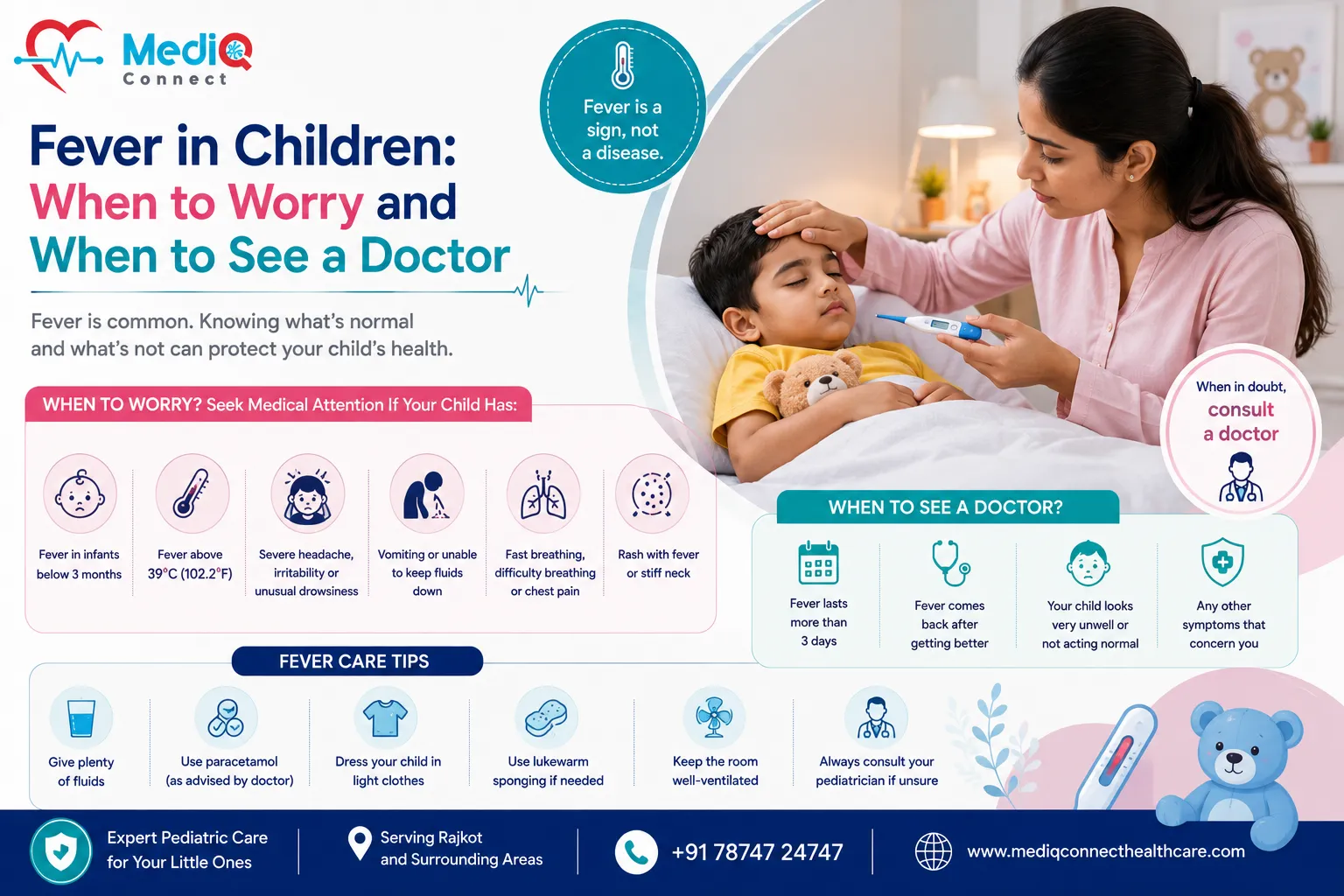
Fever in Children: When to Worry, By Age
Age is the single most important factor in deciding whether a fever needs urgent attention. Here's the breakdown parents ask about most when trying to understand fever in children when to worry.
Newborns and Infants (0–3 Months)
Any fever of 100.4°F or higher in a baby under 3 months needs immediate medical attention - call your pediatrician or go to urgent care right away, even if your baby otherwise seems fine. A young infant's immune system is still developing, and fever can be the only sign of a serious underlying infection.
Infants and Toddlers (3 Months to 2 Years)
Contact your doctor if the fever lasts longer than 24 hours, climbs above 102.2°F, or is accompanied by other concerning symptoms. If your child in this age group is feeding well, alert, and consolable, a brief mild fever can often be monitored at home first.
Children (2 Years and Older)
Fever lasting more than 72 hours warrants a doctor's visit, as does any fever above 104°F regardless of duration. As with younger children, behaviour matters as much as the thermometer - a child who's playful between fever spikes is generally less concerning than one who stays listless throughout.
Any Age - Immediate Attention
Regardless of age, seek urgent care for a fever paired with a seizure, difficulty breathing, a stiff neck, a rash that doesn't fade under pressure, repeated vomiting, or extreme lethargy that makes your child hard to wake.
This age-based framework is exactly how pediatricians assess fever in children when to worry in real clinical practice - the number on the thermometer is only ever half the picture.
Red-Flag Symptoms That Matter More Than the Number
A moderate fever with these accompanying symptoms is more concerning than a high fever alone. Watch for:
- Difficulty breathing or unusually fast breathing
- Bluish tint to lips, face, or nails
- Severe headache, especially with neck stiffness
- A rash that doesn't fade when pressed with a glass
- Repeated vomiting or inability to keep fluids down
- Signs of dehydration - dry mouth, no tears when crying, significantly reduced urination
- Extreme irritability or a child who's unusually difficult to console
- Unusual drowsiness or trouble waking your child fully
If any of these appear alongside a fever, don't wait to see if it resolves on its own - these are exactly the signals doctors mean when they talk about high fever in children requiring urgent evaluation.
Home Care - Managing a Mild Fever Safely
For an otherwise healthy child over 3 months who's alert, drinking fluids, and not showing red-flag symptoms, a mild fever can usually be managed comfortably at home.
- Offer plenty of fluids - water, oral rehydration solution, or breast milk/formula for infants
- Dress your child in light clothing rather than bundling them up
- Use a lukewarm sponge bath if your child is uncomfortable - never cold water or ice, which can cause shivering and raise temperature further
- Fever-reducing medication (acetaminophen or, for children over 6 months, ibuprofen) can help with comfort, dosed by weight per your pediatrician's guidance
- Let your child rest - fatigue is the body's way of conserving energy to fight infection
The goal of treatment is comfort, not necessarily eliminating the fever entirely - a mild fever doing its job doesn't always need to be brought all the way down, as long as your child is comfortable and drinking fluids.
What NOT to Do When Your Child Has a Fever
A few well-meaning habits can actually make things worse or delay you noticing a genuine problem.
- Don't use cold baths, ice packs, or alcohol rubs - these can cause shivering, which raises core temperature
- Don't over-bundle your child in blankets, which traps heat and can worsen discomfort
- Don't alternate or double-dose fever medications without your doctor's specific guidance
- Don't give aspirin to children - it's linked to a rare but serious condition called Reye's syndrome
- Don't rely on touch alone to judge fever severity - use a proper thermometer for an accurate reading
Fever and Teething, Vaccination, and Other Common Causes
Not every fever means a serious infection. Some of the most common everyday triggers include:
- Teething - often causes a very mild temperature rise, rarely above 100.4°F on its own
- Post-vaccination response - a mild fever for 24–48 hours after immunisation is common and expected
- Common viral infections - colds, flu, and other seasonal viruses are the leading cause of fever in toddlers and older children
- Overheating - especially relevant in hot weather, from excess clothing, or after vigorous play
If a fever seems disproportionately high for something like teething, or persists well beyond the expected 24–48 hour post-vaccination window, that's worth a call to your pediatrician rather than assuming it's still the original cause.
Febrile Seizures - What Parents Should Know
Febrile seizures can be frightening to witness, but they're usually not dangerous. They occur in a small percentage of children, typically between 6 months and 5 years, and are triggered by a rapid rise in temperature rather than the fever's absolute height.
If your child has a seizure during a fever: lay them on their side on a soft, flat surface, remove nearby hard objects, and time the seizure. Most last under a few minutes and resolve on their own. Call emergency services if it lasts longer than 5 minutes, if breathing seems impaired, or if this is your child's first seizure - an evaluation afterward is always recommended even for a brief, typical episode.
How to Take Your Child's Temperature Correctly
Accurate readings matter for making good decisions. The method that works best depends on your child's age.
- Newborn to 3 months: Digital rectal thermometer - the most accurate method at this age, and the one doctors rely on for this age group
- 3 months to 4 years: Rectal, ear (tympanic), or forehead (temporal) thermometers all work reasonably well
- 4 years and older: Oral thermometers become practical once your child can hold it under the tongue reliably
- Avoid mercury thermometers entirely - they're outdated and pose a mercury-exposure risk if broken
Whichever method you use, take the reading the same way each time so you can accurately track whether the fever is rising, holding steady, or coming down.
Fever Patterns That Warrant Extra Attention
Beyond a single reading, certain patterns are worth flagging to your pediatrician even without other red-flag symptoms:
- A fever that goes away and returns after several fever-free days
- A fever that keeps climbing despite fever-reducing medication
- A fever lasting longer than the expected window for your child's age (see the age-based section above)
- Recurrent fevers with no clear pattern over several weeks
These patterns don't automatically mean something serious, but they're exactly the kind of detail a pediatrician needs to properly evaluate what's going on - mention them clearly at your visit rather than just describing how high the fever got.
Common Myths About Children's Fever, Debunked
A lot of fever-related anxiety comes from myths that have circulated for generations. Clearing these up removes a surprising amount of unnecessary worry.
Myth: The higher the fever, the more serious the illness
Not necessarily. A child with a mild viral infection can spike a high fever, while a child with a more serious bacterial infection sometimes runs a lower one. Behaviour and accompanying symptoms are far more telling than the number alone.
Myth: You must bring a fever down immediately
Fever itself is doing useful work. Unless your child is uncomfortable, dehydrated, or has a history of febrile seizures, there's often no urgent need to medicate purely to lower the number on the thermometer.
Myth: A fever means you should stop feeding your child
The opposite is true - fluids and light, easily digestible food support recovery and prevent dehydration, which is a much bigger risk than the fever itself in most cases.
Myth: Fever always means your child needs antibiotics
Most childhood fevers are caused by viruses, against which antibiotics do nothing. A pediatrician will determine whether the presentation suggests a bacterial cause that actually warrants antibiotic treatment.
Myth: Any fever above 98.6°F is cause for concern
98.6°F is just an average - body temperature naturally varies through the day and between children. The medically accepted fever threshold is 100.4°F and above, not the slightest elevation above 98.6°F.
Hydration and Nutrition During a Fever
Fever increases fluid loss through sweating and faster breathing, which makes hydration one of the most important things to monitor - often more important than the fever number itself.
- Offer small, frequent sips of water, oral rehydration solution, or diluted juice rather than large amounts at once
- Continue breastfeeding or formula feeding on demand for infants - this often provides sufficient hydration on its own
- Don't force solid food if appetite is low; focus on fluids first and let appetite return naturally as the fever resolves
- Popsicles or ice chips can help with both hydration and a sore throat, if your child is old enough to have them safely
Watch for early dehydration signs - a dry mouth, fewer wet diapers or reduced urination, sunken eyes, or lack of tears when crying. Catching these early prevents a straightforward fever from turning into a more serious concern.
Fever in Children With Existing Health Conditions
Children with certain underlying conditions need a lower threshold for concern than otherwise healthy kids, since their bodies may respond differently to infection.
- Chronic conditions such as heart disease, sickle cell disease, or immune system disorders
- Children on medications that suppress the immune system
- Children with a history of febrile seizures
- Premature infants, even after they've passed the newborn stage
If your child falls into any of these categories, it's worth having a specific conversation with their pediatrician in advance about exactly when to call for a fever - the general age-based guidance above may not fully apply, and having a personalised plan removes guesswork during an actual fever episode.
Preparing for a Doctor's Visit: What to Note Down
A clear, organised description of the fever helps your doctor make a faster, more accurate assessment. Before your visit or call, try to have this ready:
- When the fever started and the highest temperature recorded, with the method used
- Whether it responds to fever-reducing medication, and for how long
- Any other symptoms - rash, cough, ear pulling, reduced appetite, unusual behaviour
- Recent exposures - sick contacts at school or daycare, recent travel, recent vaccinations
- Any medications already given, including dose and timing
Parents who arrive with this information consistently get a faster, more targeted assessment than those trying to recall details from memory in the moment.
School and Daycare Guidelines During a Fever
Most schools and daycares in India follow a simple rule: children should stay home while febrile and for at least 24 hours after the fever resolves without medication. This isn't just an administrative rule - it genuinely reduces the spread of infection to other children and staff.
If your child's fever is caused by something more specifically contagious, like chickenpox or a confirmed bacterial infection, your doctor will usually give more specific guidance on how long to stay home beyond the general 24-hour rule.
In-Clinic Visit vs Video Consultation vs Emergency Room - What to Choose
Not every feverish child needs the same level of care. Matching the situation to the right option saves you time and gets your child the appropriate care faster.
Home Monitoring
Appropriate for a mild fever in a child over 3 months who's alert, feeding normally, and free of red-flag symptoms.
Video Consultation
A good first step when you're unsure whether a fever needs an in-person visit - a pediatrician can assess your child's behaviour, breathing, and overall appearance over video and advise on next steps.
In-Clinic Visit
Appropriate for fevers lasting beyond the age-based thresholds above, for a physical examination, or when other symptoms need hands-on assessment like a throat or ear check.
Emergency Room
Reserved for any red-flag symptom - difficulty breathing, seizure, non-blanching rash, extreme lethargy, or a fever in an infant under 3 months. Don't wait for a same-day clinic appointment in these situations.
Comparing Fever-Reducing Medications: Acetaminophen vs Ibuprofen
Both medications are commonly used and effective, but they work slightly differently and have different age restrictions worth understanding.
Acetaminophen (Paracetamol)
Safe for infants over 2 months (with pediatrician guidance for younger babies), acetaminophen is generally the first choice for fever and discomfort. It's dosed by weight, not age, so always check the packaging or ask your pharmacist for the correct dose for your child's current weight.
Ibuprofen
Approved for children over 6 months, ibuprofen tends to last slightly longer than acetaminophen and can be particularly effective for fever accompanied by inflammation or pain, such as an ear infection. It should be given with food to reduce stomach irritation.
Using Them Together
Some pediatricians recommend alternating between the two for a fever that isn't responding well to one alone, but this should only be done under specific medical guidance - timing errors between the two medications are a common and avoidable dosing mistake.
Never give aspirin to a child with a fever, and always use the dosing syringe or cup provided rather than a regular kitchen spoon, which can lead to inaccurate dosing.
Understanding Different Thermometer Types
Not all thermometers are equally accurate for every age, and choosing the right one makes a real difference in getting reliable readings.
- Digital rectal thermometers: Most accurate for infants and toddlers under 3, considered the gold standard for newborns
- Digital ear (tympanic) thermometers: Fast and convenient for children over 6 months, though positioning affects accuracy
- Temporal artery (forehead) thermometers: Non-invasive and quick, reasonably accurate when used correctly across the forehead
- Digital oral thermometers: Reliable once a child is old enough to hold it properly under the tongue without biting down, typically around age 4 and up
- Underarm (axillary) thermometers: The least accurate option, useful mainly as a quick screening check rather than a definitive reading
Whichever thermometer you choose, keeping one reliable, working thermometer in the house - with fresh batteries - is one of the simplest things you can do to stay prepared for the next fever episode.
Fever Care Across the Whole Family
When one child in the house has a fever from a contagious illness, a few simple habits reduce the chances of it spreading to siblings or parents.
- Encourage frequent handwashing for everyone in the household, not just the sick child
- Avoid sharing cups, utensils, or towels during the illness
- Keep the sick child's toys and frequently touched surfaces wiped down
- Watch siblings for early symptoms over the following several days, since incubation periods vary by illness
It's also worth pacing yourself as a parent - a feverish child often means broken sleep and a stressful few days. Looping in a partner, family member, or trusted friend for even a few hours of relief makes a genuine difference in how you're able to care for your child through the illness.
Recurrent Fevers: When a Pattern Needs Investigation
Occasionally, a child experiences fever episodes that recur every few weeks with no obvious trigger. While most turn out to be a string of unrelated common infections, a pattern worth flagging to your pediatrician includes fevers recurring on a fairly predictable cycle, especially alongside mouth sores, sore throat, or swollen glands each time.
This pattern is sometimes associated with a condition called PFAPA (periodic fever, aphthous stomatitis, pharyngitis, and adenitis), which is generally manageable and not dangerous, but benefits from a proper diagnosis rather than repeated unrelated sick visits. Your pediatrician can guide you through the evaluation process if this pattern sounds familiar.
Fever After Travel or International Exposure
If your child develops a fever within a few weeks of travel - especially to regions with different disease patterns - mention this specifically when you see a doctor. Travel-related fevers occasionally point to infections that aren't common locally and need a different diagnostic approach than a routine seasonal fever.
This applies even to travel within India between very different climates, and is especially relevant after monsoon-season travel to areas with known mosquito-borne illness activity.
A Realistic Walkthrough: What a Fever Episode Often Looks Like
To make all of this less abstract, here's how a typical, non-emergency fever episode tends to unfold for a toddler with a common viral infection.
- Day 1: Fever begins, often in the evening; child is fussier than usual but still drinking fluids
- Day 1–2: Fever-reducing medication helps with comfort; temperature may still spike again after it wears off
- Day 2–3: Other symptoms may emerge - runny nose, cough, or reduced appetite, helping clarify the cause
- Day 3–4: Fever typically starts to ease as the body clears the infection
- Day 4 onward: If fever persists beyond this window or a new symptom appears, it's time to check in with a pediatrician rather than continuing to wait it out
This general pattern matches most viral illnesses in otherwise healthy children older than 3 months. If your child's experience deviates significantly - fever climbing rather than easing, new red-flag symptoms appearing, or your gut telling you something's different this time - that's exactly when to stop waiting and reach out for medical advice.
Quick Reference: Fever Action Checklist
Keep this simple checklist handy for the next time your child spikes a temperature - it condenses everything above into an at-a-glance reference.
- ✔ Under 3 months + any fever ≥100.4°F → seek immediate medical care
- ✔ 3 months–2 years + fever beyond 24 hours → call your doctor
- ✔ 2+ years + fever beyond 72 hours → call your doctor
- ✔ Any age + fever above 104°F → call your doctor
- ✔ Any red-flag symptom (breathing trouble, seizure, non-blanching rash, extreme lethargy) → emergency care immediately
- ✔ Mild fever, alert child, drinking fluids → safe to monitor at home
This checklist reflects exactly how pediatricians think through fever in children when to worry in real consultations - and it's worth keeping saved somewhere accessible, whether that's a note on your phone or printed on your fridge.
A Note for Anxious Parents
If fever genuinely makes you anxious every single time, you're far from alone - it's one of the most common sources of parental worry, and for good reason, since children can't always tell you clearly how they're feeling. Having a clear framework, like the one in this guide, tends to help far more than trying to remember scattered advice in the moment.
And when in doubt, a quick video consultation with a pediatrician is almost always faster and less stressful than an anxious night of searching symptoms online. Trust your instincts, use the age-based thresholds as your guide, and don't hesitate to reach out for professional reassurance - that's exactly what your child's doctor is there for.
How MediQConnect Helps When Your Child Has a Fever
Trying to decide whether a fever needs urgent attention while your child is uncomfortable and you're exhausted is genuinely hard. MediQConnect is built to make that decision faster and less stressful when you're facing fever in children when to worry.
- Same-day video consultations with verified pediatricians, so you get a professional opinion quickly
- Home consultation options when travelling with a sick child isn't practical
- Verified doctor profiles with clear experience, specialisation, and consultation fees
- A directory of children's hospitals with 24-hour emergency and NICU access, for situations that need immediate in-person care
Whether you just need reassurance or your child is showing symptoms that concern you, you can compare verified pediatrician profiles and book the right type of consultation within minutes.
For a complete framework on choosing a long-term doctor for your child, see our guide to the best pediatrician in Rajkot, which covers credentials, hospital backup, and what to check before your first visit.
If you're trying to decide whether tonight's fever needs an in-person visit, our guide to video consultation with a doctor in Rajkot explains exactly what a video consult can and can't assess.
For sick days when travel with a feverish child isn't practical, see our detailed breakdown of doctor consultation at home in Rajkot.
You can also browse verified doctors near me in Rajkot across all specialities if you need a second opinion or a different consultation type.
Frequently Asked Questions
When should I worry about my child's fever?
Worry more about your child's overall behaviour than the exact number - difficulty breathing, extreme lethargy, a non-blanching rash, or a fever in an infant under 3 months are the clearest signs to act on immediately. For everything else, use the age-based thresholds in this guide to judge whether it's time to call a doctor.
What temperature is considered a high fever in a child?
A temperature above 104°F is generally considered a high fever at any age and warrants a call to your doctor. Below that, context - age, duration, and accompanying symptoms - matters more than the number alone.
How long can a fever last before I should see a doctor?
For infants 3 months to 2 years, see a doctor if the fever lasts more than 24 hours. For children over 2, the general threshold is 72 hours. Infants under 3 months need evaluation for any fever, regardless of duration.
Can teething cause a high fever in children?
Teething typically causes only a mild temperature rise, rarely above 100.4°F. A genuinely high fever during teething is more likely caused by an unrelated infection and should be evaluated rather than attributed to teething alone.
Is it safe to let a child's fever go untreated?
Yes, in many cases - fever itself is not dangerous and doesn't need to be eliminated as long as your child is comfortable, alert, and drinking fluids. Fever-reducing medication is for comfort, not a medical necessity for every fever.
What are the warning signs of a fever in toddlers that needs emergency care?
Seek emergency care for a seizure, trouble breathing, blue lips or nails, a stiff neck, a rash that doesn't fade under pressure, or a toddler who is unusually difficult to wake or console.
Can a high fever cause brain damage in children?
This is one of the most common parental fears, and it's largely a myth. Fevers from common infections essentially never reach the extreme temperature (around 107°F) needed to cause tissue damage - the body has natural mechanisms that prevent infection-related fevers from climbing that high.
Should I wake my child up to give fever medication?
Generally no - sleep is valuable for recovery. If your child is sleeping comfortably, let them rest rather than waking them purely to administer medication, unless your doctor has specifically advised otherwise for your child's situation.
When should a fever in children go to the emergency room instead of a clinic?
Go straight to the emergency room for any red-flag symptom - difficulty breathing, seizure, extreme lethargy, non-blanching rash - or for any fever in a baby under 3 months. A same-day clinic or video consultation is appropriate for milder situations without these warning signs.
Can I give my child a bath to bring down a fever?
A lukewarm sponge bath can help with comfort, but avoid cold water or ice baths, which cause shivering and can actually raise core temperature further. The water should feel comfortably warm to the touch, not cold.
Does a fever always need to be treated with medication?
No - if your child is comfortable, alert, and drinking fluids, you don't have to medicate purely to bring the number down. Medication is primarily for comfort when a fever is genuinely bothering your child, not a requirement for every elevated temperature.
How is fever different in vaccinated vs unvaccinated children?
Vaccinated children may occasionally run a brief, mild fever as an expected immune response to the vaccine itself, usually resolving within 24–48 hours. This is different from an infection-related fever and generally doesn't require the same level of concern, though the same red-flag symptoms still apply if they appear.
Building Confidence for Next Time
Every parent eventually gets more comfortable handling a fever after going through it once or twice with good information. The goal of understanding fever in children when to worry isn't to eliminate all worry - a certain amount of concern is a normal, healthy part of caring for a sick child - but to replace panic with a clear, calm plan of action.
Keep a working thermometer, fever-reducing medication dosed for your child's current weight, and this guide's age-based thresholds within easy reach. That preparation alone resolves most of the stress the next time a fever shows up unannounced.
Conclusion: Trust the Pattern, Not Just the Number
Understanding fever in children when to worry comes down to a few consistent principles: age matters more than most parents realise, behaviour tells you more than the thermometer alone, and most fevers resolve safely with simple home care. Keep the age-based thresholds in this guide handy, watch for the specific red-flag symptoms, and don't hesitate to reach out for a professional opinion when something feels off - that instinct is worth trusting.
When you do need to reach a doctor, MediQConnect makes it simple to get a fast, verified opinion - whether that's a same-day video consult, a home visit, or an in-clinic appointment.
Need a pediatrician right now? view doctors across specialities on MediQConnect and book a consultation in minutes.