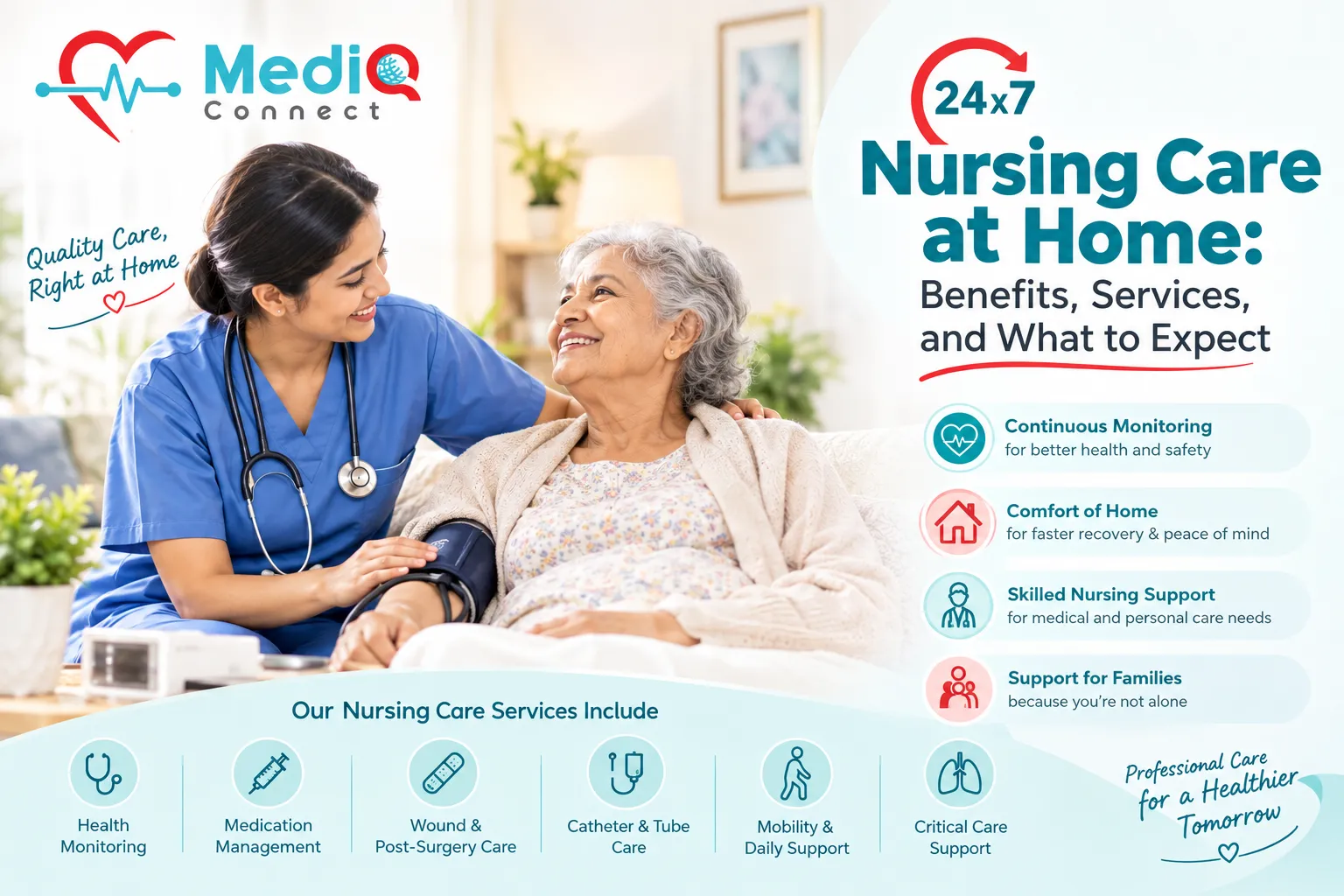



24×7 Nursing Care at Home: Benefits, Services, and What to Expect
Somewhere between "stable enough to leave the ICU" and "able to manage without constant supervision" sits a genuine gap - a patient who needs continuous, skilled medical attention, but not necessarily a hospital bed. For a growing number of Indian families, the answer to that gap isn't an extended hospital stay. It's bringing that same level of skilled nursing into the home, where recovery can happen in familiar, comfortable surroundings surrounded by the people who matter most.
This guide covers exactly what 24×7 nursing care at home involves - who it's genuinely for, the qualifications behind it, what a home ICU setup actually looks like, and honest cost figures so you can plan this decision with real information rather than guesswork or scattered, inconsistent numbers pulled from different sources online.
Common Myths About 24×7 Home Nursing, Debunked
Myth: Home care can't match hospital ICU safety standards
With properly trained ICU nurses, hospital-grade equipment, and physician oversight, home-based critical care can achieve comparable safety outcomes for appropriately selected, stable patients - the equipment and training are genuinely the same standard, just relocated.
Myth: A single live-in nurse provides the same coverage as shift-based nursing
A single nurse, no matter how dedicated, cannot maintain the same alertness and responsiveness across 24 hours without rest as a properly rotated shift team. This distinction matters considerably for genuinely critical cases.
Myth: 24×7 nursing care is only for the terminally ill
While palliative care is one application, round-the-clock nursing is equally used for post-surgical recovery, ventilator weaning, and stabilising chronic conditions - situations with a genuinely positive recovery trajectory, not only end-of-life care.
Myth: All home nursing agencies provide equivalent quality
Training standards, equipment quality, and accountability structures vary considerably between agencies. Verifying specific credentials and asking detailed questions matters enormously, particularly for critical care needs.
Myth: Once ventilator support starts at home, hospital transfer is no longer an option
A well-run home nursing arrangement always maintains a clear emergency transfer protocol - home care doesn't mean abandoning hospital access if the patient's condition genuinely requires it.
The Emotional Side of Critical Home Care
Arranging round-the-clock nursing for a family member, particularly following a serious illness or injury, carries significant emotional weight beyond the practical logistics.
- Watching a loved one require this level of care can bring genuine grief, even alongside relief that they're stable enough to be at home
- Family members often feel torn between wanting to be constantly present and needing to maintain their own routines and rest
- Coordinating with a rotating nursing team, rather than a single familiar caregiver, can initially feel less personal - though most families report this eases as trust builds with the regular team
- Financial stress often compounds the emotional burden, particularly for extended care periods
These reactions are completely normal. Many hospitals and agencies offer counselling support alongside medical care - it's worth asking about this directly rather than assuming you should manage the emotional weight entirely alone.
Monitoring Technology in Modern Home Nursing
Technology has meaningfully improved the safety and connectivity of home-based critical care in recent years.
- Remote monitoring systems allow specialists to review vital sign trends without being physically present
- Alarm-integrated equipment alerts the nursing team immediately to any concerning change in patient status
- Digital care logs give family members visibility into shift-by-shift updates, even when they can't be present
- Video consultation platforms allow quick physician input on any change in the care plan without requiring an in-person visit for every adjustment
None of this technology replaces skilled, attentive nursing - it supplements it, adding an extra layer of safety and family reassurance to an already carefully monitored situation.
What 24×7 Nursing Care at Home Actually Means
Unlike a daily attendant or periodic nurse visit, round-the-clock nursing means a qualified nurse is present and actively monitoring the patient at all times, typically working in shifts to maintain continuous coverage without fatigue-related lapses.
- Continuous vital sign monitoring - heart rate, blood pressure, oxygen saturation, and body temperature, tracked around the clock without gaps
- Medication administration on precise schedules, including IV medications where clinically needed and appropriate
- Wound care, catheter management, and other similar hands-on clinical tasks requiring training
- Immediate response to any change in the patient's condition, without the delay of waiting for a scheduled visit
- Coordination with the treating physician for any necessary and timely adjustments to the ongoing care plan
This is meaningfully different from a general attendant, who provides valuable daily support but isn't trained or licensed to perform clinical tasks or make medical judgment calls during an emergency or sudden change in the patient's condition.
Common Conditions Requiring 24×7 Home Nursing
A few specific medical situations most commonly lead families to arrange round-the-clock nursing support.
Post-ICU Recovery
Patients discharged from hospital ICU but not yet stable enough for reduced supervision, often requiring continued close monitoring of vitals and gradual weaning off intensive interventions.
Stroke Recovery
Particularly in the acute phase, requiring monitoring for recurrence risk factors, swallowing difficulties, and coordinated rehabilitation support.
Advanced Cancer Care
Often involving pain management, symptom control, and close monitoring during active treatment or palliative phases.
Severe Chronic Disease Exacerbation
Conditions like advanced COPD or heart failure sometimes require intensive home monitoring during a flare-up, avoiding a hospital admission when home-based management is clinically appropriate.
Post-Transplant Recovery
Requires very close infection monitoring and medication management during the vulnerable early recovery period following an organ transplant.
Each of these situations benefits from a nursing team with specific relevant experience - ask directly about an agency's track record with your particular condition, not just general critical care credentials.
Coordinating Multiple Specialists Alongside Home Nursing
Complex cases often involve more than just nursing staff - coordinating effectively across the full care team significantly affects outcomes.
- The primary treating physician should remain actively involved, reviewing the care plan regularly rather than handing off entirely to the nursing team
- Specialist input (cardiology, pulmonology, or others relevant to the condition) may be needed periodically, ideally coordinated through a single point of contact
- Physiotherapists often play a role in recovery-focused cases, working alongside the nursing team rather than independently
- A designated family member as primary contact helps avoid conflicting instructions reaching different providers
The nursing team functions best as the continuous, on-the-ground presence within a broader, well-coordinated medical team - not as an isolated service operating independently of the patient's other doctors.
Documentation and Communication Standards to Expect
Given the clinical complexity and stakes involved, proper documentation is a genuine safety feature, not just administrative overhead.
- A detailed shift log recording vital signs, medications administered, and any notable changes throughout each shift
- Clear handover notes between outgoing and incoming nursing staff, reviewed and signed off by both
- Regular updates to family members, at a frequency and format agreed upon in advance
- Documented communication with the treating physician for any significant changes or concerns
- Accessible records that family members or a new provider could review if care needs to transition
Ask to see a sample of how an agency documents care before committing - thorough, professional documentation is a strong signal of an organised, safety-focused provider.
Preparing Family Members to Support the Nursing Team
While the nursing team handles clinical care, family involvement genuinely improves the overall experience and outcomes for the patient.
- Understanding the basics of the patient's condition and care plan helps family members ask informed questions and notice concerning changes
- Maintaining a calm, supportive presence, even during difficult moments, genuinely benefits patient wellbeing
- Respecting the nursing team's clinical judgment while still asking questions builds a collaborative rather than adversarial relationship
- Managing the practical logistics - supplies, space, coordinating visitors - supports the nursing team's ability to focus on clinical care
Families who stay engaged without micromanaging the clinical details tend to report the smoothest overall experience, both for themselves and for the patient.
Who Needs Round-the-Clock Nursing Support?
This level of care isn't right for every recovery - it's specifically suited to situations where a patient's condition genuinely requires continuous professional monitoring.
- Patients transitioning out of a hospital ICU but not yet stable enough for reduced supervision
- Ventilator-dependent patients, whether temporarily or long-term
- Post-major-surgery patients with a high risk of complications requiring close monitoring
- Patients with unstable vitals, unpredictable seizures, or conditions requiring frequent intervention
- Terminally ill patients receiving palliative care who need continuous comfort management
- Patients with complex tube feeding, tracheostomy care, or multiple ongoing IV medications
For less intensive needs - a stable senior needing supervision, or a recovering patient managing well between periodic check-ins - a daily attendant or scheduled nurse visits are usually more appropriate and considerably more affordable than full round-the-clock nursing care for the whole family.
A Realistic Scenario: Post-ICU Transition Care
To make this less abstract, here's how a typical post-ICU transition to home nursing might unfold for a patient recovering from major surgery with complications.
- Day 1–3: ICU-trained nurses on 12-hour shifts, continuous monitoring, coordination with the discharging surgical team
- Day 4–10: Vitals stabilise; monitoring frequency reduces slightly while shift-based nursing coverage continues
- Day 11–14: Physician reassessment determines whether to step down to general duty nursing or continue critical care coverage
- Week 3 onward: If stable, transition to general duty nursing or, eventually, a daily attendant with periodic nurse check-ins
This kind of staged step-down approach - rather than an abrupt shift from ICU to minimal supervision - is exactly what well-coordinated home nursing care is designed to provide.
Questions to Ask When Interviewing a Home Nursing Agency
A structured set of questions during your initial calls helps you compare providers fairly for this higher-stakes type of care.
- What specific qualifications do your ICU-trained nurses hold, and can you provide documentation?
- How do you handle shift changes and handovers to maintain continuity of care?
- What is your protocol if a nurse is unavailable for a scheduled shift?
- Is a physician on-call as part of the service, and how quickly can they be reached?
- What happens if the patient's condition suddenly deteriorates - what's the emergency transfer protocol?
- Can you provide references from families who've used this service for a comparable case?
An agency that answers these questions with specific, confident detail - rather than general reassurance - is a considerably stronger, safer choice for critical care needs.
When to Step Down From 24×7 Nursing to Lower-Intensity Care
Round-the-clock nursing isn't necessarily a permanent arrangement - many patients transition to less intensive support as their condition stabilises.
- Stable, predictable vitals sustained over several days without clinical intervention needed
- Successful weaning from any mechanical support (ventilator, continuous IV medication)
- Physician assessment confirming reduced monitoring needs
- Family confidence and competence in managing simpler ongoing care tasks, if applicable
This transition should always be physician-guided rather than a cost-driven decision made independently - stepping down too early carries genuine risk, just as staying at an intensive level longer than needed adds unnecessary cost and disruption.
Nurse Qualification Tiers - General Duty vs ICU-Trained
Not all nurses providing round-the-clock care have the same training, and matching the right tier to your patient's actual needs meaningfully affects both safety and cost.
General Duty Nurse (GNM/BSc Nursing)
Handles routine post-operative recovery, chronic illness management, and basic monitoring. Appropriate for stable patients needing continuous supervision without complex medical intervention.
ICU-Trained / Critical Care Nurse
Additional specialised training in managing ventilators, unstable vitals, continuous IV medication, and emergency response. Necessary for genuinely critical or high-dependency cases.
Always clarify explicitly which qualification tier your patient's condition actually requires - over-hiring adds unnecessary cost, while under-hiring for a genuinely critical case is a real safety risk. A treating physician can usually advise on the appropriate tier.
Balancing Cost and Care Level Responsibly
It's worth acknowledging directly: the cost difference between general duty and ICU-trained nursing is significant, and families sometimes feel pressure to choose the lower-cost option even when a physician recommends the higher tier.
This is a conversation worth having openly with the treating physician - ask specifically what risks are involved in choosing a lower nursing tier than recommended, and whether a hybrid approach (ICU-trained coverage during higher-risk periods, general duty otherwise) might be appropriate. A good physician will engage honestly with cost constraints rather than dismissing them, while still being clear about genuine safety trade-offs.
For NRI Families Coordinating Care From Abroad
Arranging round-the-clock nursing for a parent in India while living overseas brings its own specific challenges worth addressing directly.
- Choose an established agency over an independent hire specifically for the accountability and documented communication this provides across time zones
- Set up a clear communication schedule that accounts for time zone differences, rather than relying on ad-hoc updates
- Designate a trusted local contact - another relative or family friend - who can visit periodically and provide an independent check-in
- Ensure the agency can handle international payment arrangements smoothly, if that's part of your situation
- Request digital access to care logs and documentation so you can stay informed despite the distance
Distance adds genuine logistical complexity, but a well-organised agency with strong documentation practices makes remote coordination considerably more manageable than it might initially seem.
A Quick Reference Checklist
Keep this condensed checklist handy when arranging or evaluating round-the-clock nursing care.
- ✔ Correct nurse qualification tier matched to the patient's actual medical needs
- ✔ Clear shift structure with documented handover procedures
- ✔ Physician on-call support integrated into the arrangement
- ✔ Hospital-grade, regularly serviced equipment with backup power arrangements
- ✔ Written, itemised cost breakdown covering nursing, equipment, and consumables separately
- ✔ Clear emergency transfer protocol back to hospital if needed
- ✔ Thorough, accessible documentation practices
A provider checking most of these boxes is very likely a safe, reliable choice for this higher-stakes level of home-based care.
How Shifts Actually Work in 24×7 Home Nursing
True round-the-clock coverage requires more than one nurse, since no single person can safely and effectively work continuously without rest.
- Typically structured as two 12-hour shifts, or three 8-hour shifts, depending on the agency and case complexity
- A live-in single-nurse arrangement is sometimes used for lower-dependency cases, though this isn't genuinely continuous, alert supervision
- Proper handover between shifts - a documented briefing on the patient's current status, recent changes, and any pending tasks - is critical for continuity of care
- Agencies should provide backup coverage for a nurse's sick day or emergency absence, without leaving a gap in care
Ask any prospective provider directly how they structure shifts and handle handovers between nurses - a vague or generic answer here is a meaningful gap in what should be a carefully coordinated, well-documented system.
Home ICU Setup - Equipment and What It Involves
For genuinely critical cases, a home ICU setup replicates key elements of hospital intensive care within the patient's own home.
- ICU-grade hospital bed with adjustable positioning
- Multi-parameter patient monitor tracking vital signs continuously
- Oxygen concentrators or cylinders, with backup supply arrangements
- Suction apparatus for airway management
- Infusion pumps for precise IV medication delivery
- Ventilator, for patients requiring mechanical respiratory support
- A basic setup (monitoring and oxygen, no ventilator) typically costs ₹3,000–₹10,000 per day; an advanced setup with ventilator support runs ₹6,500–₹14,000 per day
Reputable providers use hospital-standard equipment, regularly serviced and sanitised, with on-call physician supervision alongside the nursing team - confirm these specific standards explicitly before committing to any home ICU arrangement for your family member.
Ventilator and Tracheostomy Care at Home
Patients who can't breathe adequately on their own sometimes transition to home-based ventilator support rather than an extended hospital stay, particularly for long-term or stable respiratory needs.
- Non-invasive ventilation (via mask) is used when a patient needs breathing support without a surgical airway
- Invasive ventilation (via tracheostomy) is used for longer-term or more severe respiratory failure, delivering oxygen directly to the lungs
- Continuous monitoring and alarm systems track the ventilator's function and the patient's response in real time
- This level of care always requires ICU-trained nursing support, given the complexity and risk involved
- Regular device servicing and backup power arrangements are essential, since equipment failure in this context is a genuine emergency
Ventilator care at home is one of the more medically complex forms of home nursing, and it should only be arranged through a provider with specific, demonstrable experience in exactly this kind of care and equipment management.
Benefits of 24×7 Nursing Care at Home vs Hospital ICU
For appropriately selected patients, home-based critical care offers real advantages beyond simply avoiding a hospital environment.
- Significantly reduced risk of hospital-acquired infections, a genuine and well-documented concern in institutional ICU settings
- Family presence and involvement throughout recovery, which research consistently links to reduced patient stress and anxiety
- A personalised environment - familiar sounds, routines, and comfort - that can genuinely support recovery
- Often significantly more affordable than an extended hospital ICU stay, where per-day charges can run ₹15,000–₹50,000 or more
- Care routines customised to the patient's specific preferences, rather than institutional scheduling
None of this means home care is always the right choice - some cases genuinely need hospital-level resources unavailable at home - but for appropriately stable, carefully selected patients, the benefits are real, well-documented, and worth serious consideration.
Cost of 24×7 Nursing Care at Home in India
Costs vary significantly by nurse qualification, city, and case complexity. Here's a realistic 2026 breakdown.
|
Care Level |
Monthly Cost |
Typical Use Case |
|
General duty nursing (24-hour) |
₹35,000–₹60,000/month |
Stable post-op recovery, chronic disease monitoring |
|
ICU-trained/critical care nursing |
₹60,000–₹1,20,000/month |
Ventilator care, unstable vitals, complex cases |
|
Basic home ICU setup (no ventilator) |
₹3,000–₹10,000/day |
Close monitoring without mechanical respiratory support |
|
Advanced home ICU (with ventilator) |
₹6,500–₹14,000/day |
Ventilator-dependent, long-term respiratory support |
Metro cities (Delhi, Mumbai, Bangalore) typically run ₹45,000–₹80,000 monthly for general nursing, while smaller towns and non-metro areas usually see ₹30,000–₹50,000 for comparable care - always confirm current pricing directly with a specific provider, since it shifts periodically based on market conditions.
What's Included vs Billed Separately
Understanding what a quoted price actually covers prevents surprises partway through an extended care arrangement.
- Usually included: nursing staff coverage, basic monitoring, and routine clinical tasks
- Often billed separately: equipment rental (ventilator, ICU bed, monitors), consumables (IV fluids, catheters, dressing supplies), and physician visit fees
- Sometimes billed separately: emergency transport arrangements, should a hospital transfer become necessary
Request a full itemised breakdown covering nursing fees, equipment rental, and consumables separately - this remains the only reliable way to compare quotes between different providers accurately for this kind of extended, complex care arrangement.
How to Choose a Safe, Reliable Provider
Given the clinical complexity involved, vetting a provider for round-the-clock nursing deserves particular care.
- Choose an established agency over an independent hire wherever possible - agencies provide documented accountability, backup coverage, and a formal point of contact
- Verify nursing staff credentials specifically match your patient's care level (general duty vs ICU-trained)
- Confirm 24/7 physician on-call support is part of the arrangement, not just nursing coverage alone
- Ask about equipment servicing schedules and backup power arrangements for critical devices like ventilators
- Check for accreditation (NABL or similar) as a marker of quality and safety standards
A reputable provider will readily share this information and credentials without hesitation - vagueness or defensiveness on any of these specific points is a meaningful reason for genuine caution before moving forward.
Red Flags in Critical Home Nursing Services
Given the medical stakes involved, a few warning signs deserve particularly serious attention.
- No clear documentation of individual nurses' specific qualifications and certifications
- No backup coverage plan if the assigned nurse is unavailable
- Equipment that appears old, poorly maintained, or without visible service records
- No clear emergency protocol for equipment failure or sudden patient deterioration
- Reluctance to provide references from other families who've used the service for comparable care
For critical care specifically, these aren't minor conveniences - they're genuine safety factors, and any hesitation from a provider here warrants looking elsewhere rather than proceeding out of convenience or time pressure.
Insurance and Financial Planning for Extended Nursing Care
Given how significant extended critical care costs can become, understanding what's typically covered helps with realistic planning.
- Health insurance generally covers hospital ICU stays, including nursing charges, but home-based nursing coverage varies considerably by policy
- Some newer policies include home healthcare riders, particularly for post-hospitalisation care within a defined window
- Comparing the total cost of extended home nursing against continued hospital ICU stay often reveals meaningful savings, worth presenting to your insurer if negotiating extended coverage
- Tax deductions under Section 80D and 80DD may apply to certain medical and home-nursing expenses - consult a tax advisor for specifics
Given the potential for extended costs, discussing the full financial picture with your insurer and the care agency upfront helps avoid difficult, rushed decisions partway through an already stressful medical situation.
Transitioning From Hospital ICU to Home Nursing Safely
Moving a critically ill patient from hospital to home requires careful coordination to maintain continuity of care and safety.
- Request a detailed discharge summary from the ICU team, including current medications, equipment settings, and specific monitoring parameters
- Arrange home nursing and equipment setup before discharge day, so everything is ready when the patient arrives
- Have the home nursing team communicate directly with the discharging ICU physician for a proper handover
- Schedule a follow-up appointment with the treating specialist before leaving the hospital
- Confirm emergency transport arrangements back to the hospital are in place, should they become necessary
This transition is one of the highest-risk points in the entire care journey - a well-coordinated handover between hospital and home nursing teams meaningfully reduces that risk and helps ensure nothing important gets lost in the process.
How MediQConnect Supports Coordinated Home Nursing Care
Arranging 24×7 nursing care, coordinating physician oversight, and managing the broader medical picture is genuinely complex. MediQConnect helps bring key pieces of this together.
- Verified doctors available for home visits or video consultations for ongoing medical oversight
- A directory of verified specialists for coordinated care alongside intensive nursing support
- Transparent consultation fees, so there are no surprises when arranging physician involvement
- Easy booking for follow-up assessments as the patient's condition evolves
Whether you need periodic physician oversight or specialist coordination alongside your nursing team, MediQConnect helps you find and book verified medical support without any added scheduling hassle or confusion.
For a broader look at home-based care across all support levels - not just critical nursing - see our complete guide to Patient Care at Home: A Complete Guide for Families in India.
For seniors needing daily support rather than critical nursing, our guide to Elderly Care at Home: Benefits, Services, Costs & How to Choose covers the full range of appropriate options.
For the physician-visit component of ongoing care, see our detailed guide to doctor consultation at home in Rajkot.
You can also browse verified doctors near me in Rajkot across all specialities on MediQConnect.
Frequently Asked Questions
What is the cost of 24×7 nursing care at home in India?
Typically ₹35,000 to ₹80,000 per month for general duty nursing, and ₹60,000 to over ₹1,20,000 per month for ICU-trained critical care nursing, depending on city and the patient's specific medical needs. Home ICU setups with equipment typically add ₹3,000 to ₹14,000 per day on top of nursing fees.
Can a ventilator patient be cared for at home?
Yes - with the right setup, including ICU-trained nursing staff, proper equipment, backup power arrangements, and physician oversight, ventilator-dependent patients can be safely managed at home, whether temporarily or long-term.
What's the difference between a general duty nurse and an ICU-trained nurse?
A general duty nurse handles routine monitoring and post-operative recovery. An ICU-trained nurse has additional specialised training for managing ventilators, unstable vitals, and complex medical interventions - necessary for genuinely critical cases.
Is home ICU care cheaper than a hospital ICU?
Often yes, particularly for extended stays - hospital ICU charges can run ₹15,000 to ₹50,000 or more per day, while a comparable home ICU setup typically costs ₹3,000 to ₹14,000 per day depending on equipment needs.
How many nurses are needed for round-the-clock home care?
Genuine 24-hour coverage typically requires two or three nurses working in shifts (either two 12-hour shifts or three 8-hour shifts), since no single nurse can safely provide continuous, alert care alone.
Does insurance cover 24-hour nursing care at home?
Coverage varies significantly by policy - hospital ICU stays are generally covered, but home-based nursing coverage is less consistent. Some newer policies include home healthcare riders; check your specific policy terms directly.
What equipment is needed for a home ICU setup?
A basic setup includes an ICU-grade bed, multi-parameter monitor, oxygen support, and suction equipment. An advanced setup adds a ventilator and infusion pumps for patients needing mechanical respiratory support and IV medication.
How do I know if my family member needs 24×7 nursing care versus a daily attendant?
If the patient has unstable vitals, requires ventilator support, complex wound care, or needs immediate clinical response at any time, round-the-clock nursing is appropriate. For stable patients needing supervision and daily support, a general attendant is usually sufficient and more affordable. When in doubt, ask the treating physician directly for their specific recommendation based on the patient's current condition and likely trajectory.
Final Thoughts Before Arranging Round-the-Clock Care
Deciding on 24×7 nursing care for a family member is rarely a decision made lightly, and it's completely normal to feel overwhelmed by the clinical terminology, cost figures, and provider options involved. Take the time to ask direct questions, verify credentials carefully, and lean on your treating physician's guidance rather than navigating this entirely alone.
Most families who arrange this kind of care well - with proper vetting, clear documentation, and physician coordination - describe it as a genuine source of relief and safety, not an added burden, even amid an already difficult medical situation.
Conclusion: Bringing Hospital-Level Safety Into a Familiar Setting
Understanding what genuine 24×7 nursing care involves - the qualifications, the equipment, the realistic costs - replaces a lot of uncertainty with a clear framework for a genuinely difficult decision. For the right patients, it offers hospital-level safety without the hospital environment, keeping families closely involved throughout the recovery process.
When physician coordination is part of the picture, MediQConnect makes it simple to find verified medical support alongside your existing nursing care arrangement, whatever stage of recovery you're currently in.
Need physician support as part of a nursing care plan? view doctors across specialities on MediQConnect and book a consultation today.