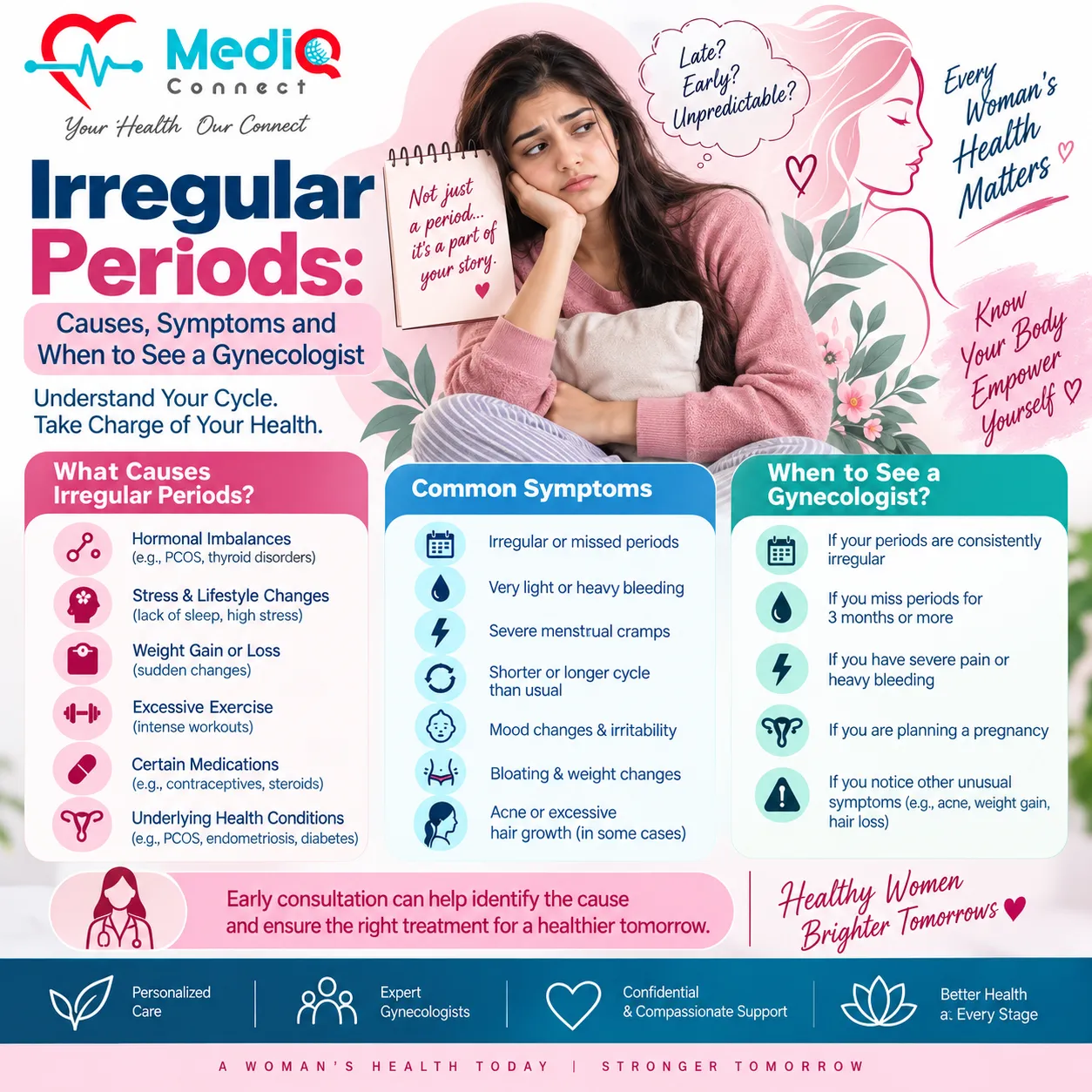



Irregular Periods: Causes, Symptoms and When to See a Gynecologist
Almost every woman experiences at least one irregular cycle at some point, whether it arrives early, late, unusually heavy, or unusually light. For some, this happens occasionally and resolves on its own. For others, it becomes a recurring pattern that raises real questions.
Understanding irregular periods causes and treatment starts with knowing what "normal" actually means for a menstrual cycle, since the range is wider than most people assume, and not every irregularity signals a problem.
This guide walks through the common causes behind irregular cycles, the symptoms worth paying attention to, when it is time to see a gynecologist, and what general treatment approaches typically look like, so you can have an informed conversation with your doctor rather than guessing.
Why Consistency With One Doctor Matters
Switching gynecologists frequently, whether out of frustration or convenience, often means repeating your history and restarting the diagnostic process each time, which can genuinely slow down finding an effective treatment.
If your current doctor is responsive, thorough, and willing to explain their reasoning, staying with them through a full evaluation and treatment cycle is usually more productive than doctor-hopping in search of a faster answer.
A Note on Online Symptom Checkers
It is tempting to type symptoms into a search engine or app and expect a clear answer, but menstrual irregularity has too many overlapping possible causes for a symptom checker to reliably distinguish between them.
Online tools can be a reasonable starting point for general awareness, which is part of why this guide exists, but they should never replace an actual conversation with a gynecologist who can examine you and order appropriate tests.
How Long Treatment Typically Takes to Show Results
Patience matters when it comes to hormonal treatment, since the menstrual cycle does not respond instantly to a new medication or lifestyle change. Most gynecologists suggest evaluating progress over two to three full cycles before deciding whether an approach is working.
This timeline can feel frustrating when you are eager for answers, but rushing to switch treatments too early often means restarting the evaluation process unnecessarily. Trusting the timeline your doctor sets, while still reporting any concerning changes promptly, generally leads to better outcomes.
If a treatment genuinely is not working after the recommended trial period, that is exactly the right time to revisit the plan with your gynecologist rather than waiting indefinitely without feedback.
Follow-Up Care and Long-Term Monitoring
Treating irregular periods is often not a one-time event. Depending on the cause, ongoing monitoring, whether through periodic blood tests, ultrasounds, or simply cycle tracking, helps confirm that a treatment plan continues to work as your body changes over time.
This is particularly true for conditions like PCOS, which typically require long-term management rather than a single course of treatment. Staying consistent with follow-up appointments, even once symptoms improve, helps catch any changes early.
MediQConnect makes it easier to stay consistent with one gynecologist over time by keeping your appointment history and past visit notes accessible, so every follow-up builds on the last rather than starting over.
How MediQConnect Verifies Its Gynecologists
Every gynecologist listed on MediQConnect goes through a defined onboarding process before appearing in search results, confirming their degree, state medical council registration, current practice location, and specialisation.
This matters more for a sensitive topic like irregular periods causes and treatment than it might for a less personal medical concern, since patients need real confidence in who they are discussing symptoms with before they even book the first appointment.
Doctors also confirm their consultation formats and fee structure directly, so what you see on the profile matches what you experience when you book, whether that is an in-clinic visit or a video consultation.
Making the Platform Easy to Use for Every Patient
A verification-first platform is only genuinely useful if booking is also simple, particularly for patients who may already feel anxious about discussing menstrual health. MediQConnect's search and booking flow is designed to be straightforward: filter by specialty, compare, and book.
Family members can also book on behalf of a daughter, sister, or mother, which can help reduce the friction that sometimes delays a first gynecology visit, particularly for younger patients or those less comfortable navigating apps independently.
A Quick Glossary: Hormones and Terms Worth Knowing
- Estrogen - the primary hormone regulating the first half of the menstrual cycle
- Progesterone - the hormone that rises after ovulation and supports the second half of the cycle
- FSH (Follicle-Stimulating Hormone) - stimulates the ovaries to prepare an egg for release
- LH (Luteinizing Hormone) - triggers ovulation, the release of an egg from the ovary
- TSH (Thyroid-Stimulating Hormone) - regulates thyroid function, which indirectly affects the menstrual cycle
Understanding these terms makes it easier to follow what your gynecologist is explaining when discussing test results, rather than feeling lost in unfamiliar terminology.
Does Family History Matter?
Certain causes of irregular periods, including PCOS and early menopause, can have a genetic component, which means a family history of similar patterns is worth mentioning to your gynecologist.
This does not mean irregular periods are inevitable if a close relative experienced them, but it does give your doctor useful context when narrowing down likely causes and deciding which tests to prioritise.
How MediQConnect Approaches Medical Content Accuracy
This guide, and others across the MediQConnect blog, are written to reflect general, well-established medical information intended for education and awareness, not to replace a professional diagnosis.
Content covering topics like irregular periods causes and treatment is reviewed for accuracy against general medical consensus, and we consistently direct readers toward a qualified gynecologist for anything specific to their individual health, since online information can never replace an actual examination.
A Quick Checklist Before Your Appointment
- Note your last three to six cycle start dates, if you can recall or find them
- List any medications or supplements you are currently taking
- Write down any symptoms beyond irregular cycles, even ones that seem unrelated
- Note whether you are currently trying to conceive or avoiding pregnancy
- Prepare two or three specific questions you want answered during the visit
What Counts as a "Normal" Menstrual Cycle?
A typical menstrual cycle is counted from the first day of one period to the first day of the next, and can range anywhere from 21 to 35 days for most women, with bleeding usually lasting between two and seven days.
A cycle is generally considered irregular when it falls outside this range, when the length varies significantly from month to month, when periods stop altogether for several months without pregnancy, or when bleeding is unusually heavy, light, or accompanied by severe pain.
Occasional variation is common and not automatically a concern. Understanding irregular periods causes and treatment becomes relevant when the pattern is persistent, worsening, or accompanied by other symptoms that affect daily life.
Types of Menstrual Irregularities Explained
Medical terminology around menstrual irregularity can feel confusing, so it helps to know the basic categories doctors use to describe different patterns.
- Oligomenorrhea - infrequent periods, typically more than 35 days apart
- Amenorrhea - absence of periods for three or more consecutive cycles
- Menorrhagia - abnormally heavy or prolonged menstrual bleeding
- Metrorrhagia - irregular bleeding that occurs between expected periods
- Polymenorrhea - periods that occur more frequently than every 21 days
Knowing which pattern best describes your experience makes it easier to explain your symptoms clearly during a consultation, which in turn helps your doctor narrow down likely causes faster.
How Irregular Periods Present Differently by Age
Irregular periods causes and treatment considerations shift depending on life stage, since the underlying hormonal context is different at each point in a woman's reproductive life.
Teenagers and Early Reproductive Years
It is common for cycles to be irregular for the first year or two after a girl's first period, as the hormonal system is still maturing. This is usually not a cause for concern unless periods are absent for extended periods or accompanied by severe pain.
Reproductive Years
For women in their 20s and 30s, irregular cycles are more likely to point toward PCOS, thyroid issues, stress, or lifestyle factors, and are worth evaluating, particularly if pregnancy is being planned.
Perimenopause and Beyond
In the years leading up to menopause, irregular cycles become increasingly common as hormone production naturally declines. However, any bleeding after menopause has been confirmed should always be evaluated promptly.
Common Causes of Irregular Periods
There is rarely a single explanation for irregular cycles. The list below covers the most common causes, though only a gynecologist can confirm which one, if any, applies to your specific situation.
Hormonal Imbalances
The menstrual cycle is regulated by a delicate balance of hormones, primarily estrogen and progesterone. Even small shifts in this balance, caused by stress, illness, or underlying conditions, can throw off cycle timing and flow.
Polycystic Ovary Syndrome (PCOS)
PCOS is one of the most common and well-documented causes among the many irregular periods causes and treatment discussions in gynecology today. It involves a hormonal imbalance that can lead to infrequent or prolonged periods, along with other symptoms like acne or excess hair growth.
Thyroid Disorders
Both an overactive thyroid (hyperthyroidism) and an underactive thyroid (hypothyroidism) can disrupt the menstrual cycle, since thyroid hormones directly influence the reproductive hormone system.
Stress and Lifestyle Factors
Significant stress, sudden weight changes, intense exercise, or disrupted sleep patterns can all affect the part of the brain that regulates reproductive hormones, leading to delayed, skipped, or irregular periods.
Perimenopause
As women approach menopause, typically in their 40s, hormone levels naturally become less predictable, which often shows up first as irregular periods before cycles stop altogether.
Pregnancy and Breastfeeding
A missed period is often one of the earliest signs of pregnancy, and breastfeeding can also delay the return of regular cycles postpartum due to hormonal changes.
Uterine Conditions
Fibroids, polyps, or structural changes in the uterus can cause irregular or heavier-than-usual bleeding, and typically require a gynecologist's examination to identify accurately.
Certain Medications
Birth control, blood thinners, and some other medications can alter cycle patterns as a known side effect, which is worth discussing with your doctor if the change feels significant.
Diagnostic Tests Explained
Understanding what each common test actually checks can make the diagnostic process feel less intimidating.
- Blood tests - measure hormone levels including estrogen, progesterone, thyroid hormones, and sometimes androgens
- Pelvic ultrasound - creates images of the uterus and ovaries to check for fibroids, cysts, or structural abnormalities
- Pap smear - screens for cervical changes, though not specifically for irregular periods, it is often done alongside a gynecology visit
- Pregnancy test - usually one of the first steps to rule out pregnancy as the cause of a missed period
Your gynecologist will decide which combination of these is relevant based on your age, symptoms, and medical history, rather than running every test automatically.
Living With PCOS: A Brief Overview
Since PCOS comes up so often in irregular periods causes and treatment discussions, it deserves a closer look. PCOS is a hormonal condition affecting how the ovaries function, and it is one of the more common reproductive health conditions among women of reproductive age.
Beyond irregular periods, PCOS can involve symptoms like acne, excess hair growth, weight fluctuation, and difficulty conceiving, though the presentation varies significantly from person to person, which is part of why professional diagnosis matters.
Management is typically ongoing rather than a one-time fix, often involving a combination of medical treatment and lifestyle support, tailored by a gynecologist based on individual symptoms and whether pregnancy is currently a goal.
Symptoms That Often Accompany Irregular Periods
Irregular periods rarely occur in complete isolation. Watching for accompanying symptoms can help your gynecologist narrow down the underlying cause more efficiently.
- Unusually heavy or prolonged bleeding
- Spotting between periods
- Severe menstrual cramps or pelvic pain
- Acne, oily skin, or excess facial or body hair
- Unexplained fatigue or changes in energy levels
- Noticeable weight changes without a clear cause
Any combination of these alongside irregular cycles is worth mentioning specifically during a gynecology consultation, since it gives the doctor a fuller picture to work from.
When to See a Gynecologist
Some irregularity is normal, but certain patterns warrant a proper medical evaluation rather than waiting to see if things resolve on their own.
- Periods that stop for three or more months without pregnancy
- Cycles consistently shorter than 21 days or longer than 35 days
- Bleeding heavy enough to soak through a pad or tampon every hour or two
- Bleeding or spotting between periods, or after sex
- Severe pain that disrupts daily activities
- Any irregular bleeding after menopause
If you notice any of these patterns, scheduling a consultation is the most reliable next step. Delaying an evaluation rarely helps and can sometimes allow an underlying condition to progress further.
How Irregular Periods Are Typically Diagnosed
A gynecologist usually starts by reviewing your medical history and cycle patterns in detail, including when irregularities began and any other symptoms you have noticed.
From there, common diagnostic steps may include a physical examination, blood tests to check hormone levels and thyroid function, and an ultrasound to look at the uterus and ovaries for structural causes like fibroids or cysts.
The exact combination of tests depends on your age, symptoms, and medical history, which is why a proper in-person or video consultation matters more than trying to self-diagnose based on symptoms alone.
General Treatment Approaches
Discussions of irregular periods causes and treatment always come back to one central point: treatment depends entirely on the underlying cause, and only a doctor can determine the right approach for your specific situation. The categories below are for general awareness, not a substitute for a personalised treatment plan.
- Hormonal therapy, such as birth control pills, to help regulate cycle timing
- Treatment of an underlying condition, such as thyroid medication for a thyroid disorder
- Lifestyle adjustments, such as stress management or moderate changes to exercise routines
- Monitoring and follow-up, particularly for perimenopause-related irregularity
- In some cases, procedures to address fibroids, polyps, or other structural causes
None of these should be self-prescribed. A gynecologist will weigh your specific symptoms, test results, and health goals, including whether you are trying to conceive, before recommending a course of treatment.
Irregular Periods and Fertility
One of the most common concerns tied to irregular periods causes and treatment discussions is fertility. Irregular ovulation can make it harder to predict a fertile window, which sometimes complicates conception timing.
This does not mean pregnancy is impossible with irregular cycles, but it often means a more structured approach, sometimes with medical support, is helpful. If irregular periods have been affecting your ability to conceive, our detailed guide on the best IVF doctor in Rajkot covers what to expect from a fertility-focused consultation.
For most women, a gynecologist is the right first step even before considering fertility-specific treatment, since correcting the underlying cause of irregular cycles often improves fertility outcomes on its own.
Lifestyle Factors Worth Discussing With Your Doctor
While lifestyle changes alone cannot resolve every cause of irregular periods, certain everyday factors are worth discussing openly during a consultation, since they can meaningfully influence cycle regularity.
Chronic stress, significant changes in body weight, very intense exercise routines, and inconsistent sleep patterns are all known to affect the hormonal signals that regulate menstruation. Bringing these up honestly helps your doctor build a more complete picture.
Rather than making major changes on your own, it is generally more effective to discuss these factors with a gynecologist, who can help identify which, if any, are contributing to your specific pattern of irregular periods.
Myths and Facts About Irregular Periods
Misinformation around menstrual health is common, and separating myth from fact helps avoid unnecessary worry or delayed care.
- Myth: Irregular periods always mean infertility. Fact: Many women with irregular cycles conceive naturally, sometimes with minor medical support.
- Myth: Skipping a period once means something is seriously wrong. Fact: Occasional variation is common and often resolves without intervention.
- Myth: Only older women need to worry about irregular cycles. Fact: PCOS and thyroid issues can affect women at almost any reproductive age.
- Myth: Home remedies alone can fix hormonal irregularities. Fact: While lifestyle habits help, underlying conditions usually need proper medical evaluation.
Understanding irregular periods causes and treatment accurately, rather than relying on assumptions, makes it far easier to know when a doctor's visit is genuinely necessary.
Addressing the Stigma Around Menstrual Health
In many households, menstrual health is still treated as a private or even taboo subject, which can make women hesitant to seek help for irregular periods even when symptoms are clearly affecting their daily life.
This hesitation often leads to delayed diagnosis, sometimes for conditions like PCOS or thyroid disorders that are far easier to manage when caught early. Normalising conversations about menstrual health, both at home and with a doctor, genuinely improves outcomes.
A gynecologist's office is a judgment-free space built specifically for these conversations. There is no symptom too minor or embarrassing to bring up when it comes to understanding irregular periods causes and treatment options relevant to you.
Beyond Irregular Periods: Broader Women's Health Support
Menstrual health is just one part of overall reproductive wellbeing. Regular gynecological check-ups, even outside of active symptoms, help catch potential issues early and build a consistent health record over time.
MediQConnect's directory covers gynecologists handling everything from routine check-ups to more specialised concerns, so the same platform you use to address irregular periods can support your broader reproductive health needs going forward.
Questions to Ask Before Starting Any Hormonal Treatment
If your gynecologist recommends hormonal therapy, a few clarifying questions can help you feel confident about the decision before starting.
- What specific outcome is this treatment meant to achieve?
- What side effects are common, and which ones should prompt a follow-up call?
- How long before we expect to see a change in my cycle pattern?
- Are there alternatives if this treatment does not suit me?
Asking these questions upfront ensures you understand not just what you are taking, but why, and what success is expected to look like.
Understanding Consultation Costs
Gynecology consultation fees vary based on experience and whether additional tests are needed. MediQConnect displays consultation charges upfront on each doctor's profile, so you can plan and compare before booking.
If tests like blood work or an ultrasound are recommended, these are usually billed separately from the consultation itself. Asking about approximate costs during booking or at the start of your visit avoids surprises later.
If you have health insurance, confirm whether gynecology consultations and related diagnostic tests are covered under your specific policy, since coverage for this category can vary between insurers.
Talking to a Teenage Daughter About Irregular Periods
Parents are often unsure whether a teenager's irregular cycles are a normal part of development or something that needs medical attention. In general, some irregularity is expected during the first couple of years after periods begin.
It is still worth scheduling a consultation if periods are absent for several months, extremely painful, or causing visible distress, since early guidance can help a teenager feel more informed and less anxious about her own body.
Framing the conversation around understanding rather than alarm tends to work best, and involving a gynecologist early normalises regular check-ins as a standard part of healthcare, not something reserved only for problems.
General Wellness Habits That Support Hormonal Health
While no lifestyle habit can replace medical treatment for an underlying condition, a few general wellness practices are commonly associated with more stable hormonal function, and are worth discussing with your doctor as a complement to, not a substitute for, proper care.
Balanced, Consistent Eating Patterns
Very restrictive dieting or highly irregular eating patterns can affect hormone production. A gynecologist or nutritionist can offer guidance suited to your specific situation rather than following generic advice found online.
Regular, Moderate Physical Activity
Consistent, moderate exercise is generally associated with better hormonal balance, while extremely intense training without adequate recovery can sometimes contribute to irregular cycles, particularly in competitive athletes.
Adequate, Consistent Sleep
Sleep plays a meaningful role in regulating the hormones involved in the menstrual cycle. Chronic sleep disruption is worth mentioning to your doctor if it coincides with the onset of irregular periods.
None of these habits are a guaranteed fix, and none should delay a proper medical evaluation. They are best viewed as supportive factors your doctor may factor into a broader treatment plan.
How Your Gynecologist Builds a Treatment Plan
A good treatment plan for irregular periods is rarely one-size-fits-all. Your gynecologist will typically weigh your test results, symptom severity, age, and personal goals, such as whether you are trying to conceive, before recommending next steps.
Plans are often revisited after a few months to see how your body is responding, with adjustments made based on follow-up test results or changes in symptoms, rather than a single fixed prescription handed out at the first visit.
This is part of why continuity with one gynecologist tends to work better than switching doctors repeatedly, since a consistent provider can track your response to treatment over time rather than starting fresh each visit.
Related Conditions Worth Knowing About
A few other reproductive health conditions are commonly discussed alongside irregular periods causes and treatment, since they can overlap in symptoms or sometimes coexist.
Endometriosis
This condition involves tissue similar to the uterine lining growing outside the uterus, often causing painful periods and sometimes irregular bleeding. It typically requires specialist evaluation to diagnose accurately.
Uterine Fibroids
Fibroids are non-cancerous growths in or around the uterus that can cause heavier bleeding, longer periods, or bleeding between cycles, depending on their size and location.
Premature Ovarian Insufficiency
This occurs when the ovaries stop functioning normally before age 40, leading to irregular or absent periods. It is less common but important to rule out, especially in younger women with persistent irregularity.
None of these should be self-diagnosed based on symptoms alone. They are mentioned here so you recognise the terms if your gynecologist brings them up during your evaluation.
Common Mistakes to Avoid
A few avoidable mistakes often delay proper diagnosis and treatment for menstrual irregularities.
- Assuming irregular periods will resolve on their own without ever tracking the pattern
- Self-diagnosing based on online symptom lists rather than a professional evaluation
- Starting or stopping hormonal medication without medical guidance
- Delaying a consultation out of embarrassment about discussing menstrual symptoms
- Ignoring accompanying symptoms like fatigue or skin changes as unrelated
Avoiding these mistakes generally leads to a faster, clearer path toward understanding your specific irregular periods causes and treatment options.
Supporting a Partner or Family Member
If someone close to you is dealing with irregular periods, the most helpful thing you can often do is encourage them to see a gynecologist without minimising their concerns or assuming it is not a big deal.
Offering to help with logistics, such as booking the appointment or accompanying them if they would like support, can make a genuine difference, particularly if anxiety about the visit itself is part of what is causing delay.
When to Consider a Second Opinion
If a proposed treatment plan for irregular periods does not feel right, or if symptoms persist despite following medical advice, seeking a second opinion is a reasonable and common step, not a sign of distrust in your original doctor.
When seeking a second opinion, bring your existing test results and treatment history. This helps the second gynecologist build on what has already been tried rather than starting the diagnostic process from scratch.
Data Privacy When Discussing Menstrual Health Online
Menstrual health is a personal topic, and it is reasonable to want clarity on how a platform handles this information before booking a consultation or storing records digitally.
MediQConnect outlines its approach in its published privacy policy and terms and conditions. Reviewing these briefly before your first booking is a sensible habit, particularly for sensitive health topics.
Comparing MediQConnect to Generic Health Directories
Generic directories often list gynecologists without verifying credentials in depth, which matters more than usual for a topic like irregular periods causes and treatment, given how personal and potentially complex the underlying causes can be.
- Verification: MediQConnect confirms credentials and registration before listing a gynecologist
- Fee transparency: consultation charges are displayed upfront
- Consultation options: both in-clinic and video consultation are available where offered
- Local focus: listings are specific to Rajkot, not a generic nationwide template
This structured approach means patients researching menstrual health concerns can move from information-gathering to booking a real consultation without losing trust along the way.
Why Tracking Your Cycle Helps
Keeping a simple record of cycle start dates, flow intensity, and any notable symptoms makes conversations about irregular periods causes and treatment far more productive, since patterns that are hard to recall from memory become obvious on paper or in an app.
Even a basic tracking habit, kept for two or three months before your appointment, gives your gynecologist concrete data to work with rather than general impressions, which can speed up diagnosis considerably.
Note anything unusual alongside your cycle dates, such as stress levels, significant weight changes, or new medications, since these details often turn out to be relevant even if they do not seem connected at first.
In-Clinic vs. Video Consultation for Gynecology Concerns
Many patients feel more comfortable discussing menstrual health in person, but a video consultation is a reasonable first step for an initial discussion, especially to review your history and decide what tests, if any, are needed.
Physical examinations and certain procedures will still require an in-clinic visit, but video consultations can save time for follow-ups, discussing test results, or adjusting a treatment plan once the initial evaluation is complete.
MediQConnect lists which gynecologists offer video consultation alongside in-clinic visits, so you can choose the format that feels most comfortable for each stage of your care.
Emotional Wellbeing and Menstrual Health
Dealing with unpredictable periods can be frustrating and, for some, a source of ongoing anxiety, particularly when trying to conceive or managing a condition like PCOS. This emotional weight is a normal and valid part of the experience.
Mentioning how irregular periods are affecting you emotionally, not just physically, during a consultation is worthwhile. A good gynecologist will take this into account as part of your overall care, not just the physical symptoms.
How MediQConnect Helps You Find the Right Gynecologist
Finding a qualified gynecologist should not add stress to an already uncomfortable situation. MediQConnect lists verified gynecologists across Rajkot, with clear registration details, experience, and consultation fees displayed upfront.
You can compare specialists, check availability, and choose between an in-clinic visit or a video consultation, whichever suits your comfort level and schedule better. Our detailed guide on the best gynecologist in Rajkot walks through what to look for before booking.
Every listed doctor goes through a verification process before appearing in search results, so when discussing something as personal as irregular periods causes and treatment, you can feel confident about who you are actually consulting.
What to Expect at Your First Gynecology Consultation
Bring a record of your recent cycle history if you have one, even a rough note of dates and flow, since this gives your doctor a much clearer starting point than trying to recall details from memory during the appointment.
Be prepared to discuss your general health history, current medications, and any symptoms beyond irregular cycles, including changes in weight, skin, or energy levels, since these details often matter for an accurate diagnosis.
Do not feel embarrassed about any part of this conversation. Gynecologists discuss these exact topics daily, and being thorough and honest leads to a faster, more accurate understanding of your situation.
Preparing Questions for Your Doctor
Walking into a consultation with a few clear questions prepared makes the conversation more productive and ensures you leave with the information you actually need.
- What is the most likely cause of my irregular periods based on my symptoms?
- Do I need any tests, and if so, what will they involve?
- Are there lifestyle changes that could help alongside any treatment?
- How will we know if the treatment is working?
- Should I be concerned about my fertility given this pattern?
Writing these down beforehand, even briefly, helps ensure nothing important gets forgotten in the moment.
People Also Ask
What are the most common causes of irregular periods?
The most common causes include hormonal imbalances, PCOS, thyroid disorders, stress, significant weight changes, perimenopause, and certain medications. A gynecologist can help identify which applies to you.
When should I see a doctor for irregular periods?
See a doctor if periods stop for three or more months, cycles are consistently shorter than 21 or longer than 35 days, bleeding is unusually heavy, or you notice bleeding between periods or after sex.
Can stress cause irregular periods?
Yes. Significant or chronic stress can affect the hormones that regulate ovulation and menstruation, leading to delayed, skipped, or irregular periods.
Is PCOS the main cause of irregular periods?
PCOS is one of the most common causes, but not the only one. Thyroid disorders, stress, perimenopause, and uterine conditions can also cause irregular cycles.
Can irregular periods affect fertility?
Irregular ovulation can make it harder to predict a fertile window, which may affect conception timing. This does not mean pregnancy is impossible, but medical support can help in many cases.
How are irregular periods diagnosed?
Diagnosis typically involves a review of your cycle history, a physical examination, blood tests for hormone and thyroid levels, and sometimes an ultrasound to check the uterus and ovaries.
Are irregular periods always a sign of a serious problem?
Not always. Occasional variation is common and often harmless. Persistent or worsening irregularity, especially with other symptoms, is what typically warrants a medical evaluation.
Are irregular periods always a sign of a serious problem?
Not always. Occasional variation is common and often harmless. Persistent or worsening irregularity, especially with other symptoms, is what typically warrants a medical evaluation.
Can irregular periods be treated without medication?
Sometimes, if lifestyle factors like stress or extreme exercise are the cause, addressing those directly may help. However, conditions like PCOS or thyroid disorders usually require medical treatment alongside any lifestyle changes.
Is it normal for period length to change from month to month?
Minor variation in cycle length from month to month is common. Consistent, significant swings, or cycles outside the typical 21 to 35 day range, are worth discussing with a gynecologist.
How soon should I see a gynecologist after noticing irregular periods?
If the irregularity has persisted for more than two or three cycles, or is accompanied by concerning symptoms, it is reasonable to book a consultation rather than waiting several more months to see if it resolves.
Final Thoughts
Irregular periods are common, but that does not mean they should be ignored, especially when the pattern is persistent or accompanied by other symptoms. Understanding irregular periods causes and treatment gives you the context to know when a doctor's visit is genuinely necessary, rather than guessing based on incomplete information online.
If your cycles have felt unpredictable lately, consider booking a consultation with a verified gynecologist in Rajkot through MediQConnect. A proper evaluation is the most reliable way to understand what is actually happening and what, if anything, needs to be done about it.
Note: This article is written for general education and awareness. It is not a substitute for medical diagnosis or treatment. If you are experiencing irregular periods, please consult a qualified gynecologist for advice specific to your situation.
Have Questions About This Article?
Reach out with your inquiry and our team will get in touch with you shortly.