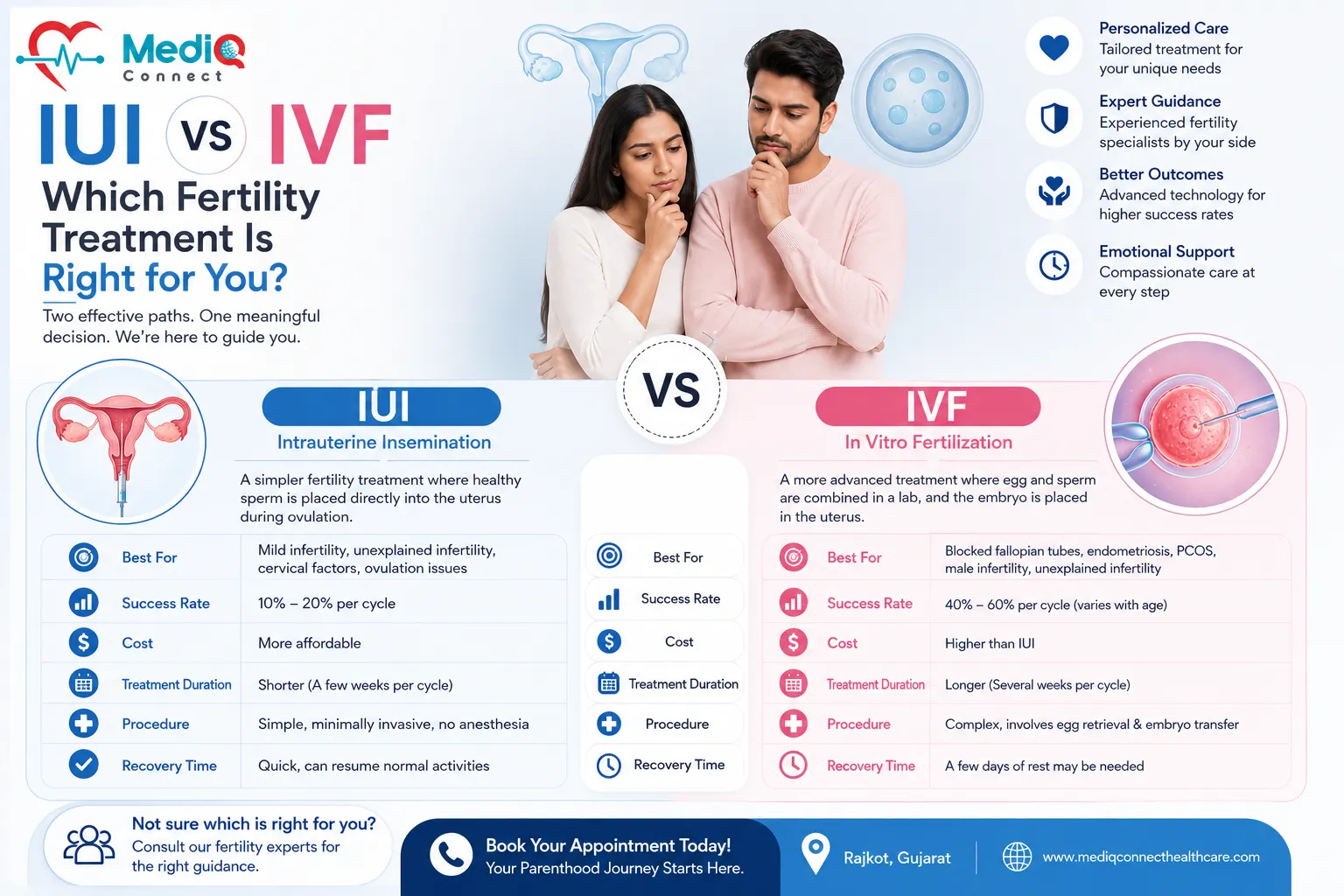



IUI vs IVF: Which Fertility Treatment Is Right for You?
Once a fertility workup identifies a likely cause - or confirms there isn't an obvious one - the next question almost every couple asks is the same: IUI or IVF? Search results tend to answer this with dense medical jargon or, just as often, marketing copy pushing straight toward IVF regardless of the individual situation and diagnosis in front of them.
This guide breaks down the real IUI vs IVF decision in plain terms - how each treatment actually works, who tends to do well with which option, and the specific factors your fertility specialist will weigh before recommending a path. The goal is to help you walk into that consultation already understanding the conversation, not hearing these terms for the first time and trying to absorb everything on the spot while also processing what a diagnosis might mean for your family plans.
IUI and IVF at a Glance - The Core Difference
Both are forms of assisted reproductive technology, but they differ fundamentally in where fertilization happens and how much of the natural process they replace.
IUI (Intrauterine Insemination)
A prepared, concentrated sample of healthy sperm is placed directly into the uterus around the time of ovulation. Fertilization still happens naturally inside the body - IUI simply gives sperm a head start by bypassing the cervix.
IVF (In Vitro Fertilization)
Eggs are retrieved from the ovaries and fertilized with sperm in a laboratory. The resulting embryo is cultured for several days, then transferred directly into the uterus. Fertilization happens entirely outside the body.
The practical difference is significant: IUI is a simpler, less invasive, lower-cost procedure that works with the body's natural cycle, while IVF is a more involved, multi-stage process that bypasses several potential obstacles to conception entirely - including blocked fallopian tubes, which IUI cannot overcome.
How IUI Works, Step by Step
IUI is a comparatively simple procedure, often completed within a single monthly cycle.
- Ovulation tracking - via ultrasound, blood tests, or ovulation predictor kits, sometimes combined with mild ovulation-stimulating medication
- Sperm sample collection and "washing" - separating the healthiest, most motile sperm from the seminal fluid
- Insemination - a thin catheter places the prepared sperm directly into the uterus, timed precisely around ovulation
- A two-week wait, followed by a pregnancy test
The procedure itself takes only a few minutes and is typically painless, often described as similar to a Pap smear. Most patients resume normal activities immediately afterward.
How IVF Works, Step by Step
IVF is a longer, more involved process spanning several distinct stages over four to six weeks.
- Ovarian stimulation - daily hormone injections for 9–14 days to develop multiple eggs, with frequent monitoring
- Trigger shot and egg retrieval - a minor surgical procedure under sedation, roughly 20–30 minutes
- Fertilization - eggs combined with sperm in the lab, via conventional insemination or ICSI
- Embryo culture - embryos monitored and graded in the lab for 3–6 days
- Embryo transfer - a quick, generally painless procedure placing the embryo into the uterus
- A two-week wait, followed by a pregnancy blood test
For a full stage-by-stage breakdown of what each IVF appointment actually involves, our detailed guide to the IVF process walks through every step in depth.
Side-by-Side Comparison: Success Rate, Cost, Time, Invasiveness
|
Factor |
IUI |
IVF |
|
Success rate per cycle |
10–20%, roughly comparable to natural conception odds per cycle |
40–50% for women under 35, declining with age |
|
Typical cost (India) |
₹15,000–₹25,000 per cycle |
₹1,00,000–₹2,50,000+ per cycle |
|
Time per cycle |
About 2–3 weeks, aligned with the natural menstrual cycle |
4–6 weeks from stimulation to transfer |
|
Invasiveness |
Minimally invasive; no surgical procedure |
Involves a minor surgical egg retrieval procedure |
|
Bypasses blocked tubes? |
No - requires at least one open fallopian tube |
Yes - fertilization happens outside the body entirely |
|
Suitable for severe male factor? |
Generally not effective for low sperm count/motility |
Yes, especially combined with ICSI |
|
Multiple pregnancy risk |
Slightly elevated with stimulation medication |
Reduced with modern single embryo transfer practices |
Neither option is universally "better" - the right choice depends entirely on the underlying cause of infertility, age, and how many cycles you're prepared to try before reassessing your approach with your specialist.
Who Should Start With IUI?
IUI tends to be recommended as a first-line treatment for couples where the underlying issue is relatively mild and doesn't involve a structural barrier to natural conception.
- Mild male-factor infertility - slightly reduced sperm count or motility, but not severe
- Unexplained infertility, particularly in the earlier stages of investigation
- Mild ovulation irregularities, especially when combined with ovulation-stimulating medication
- Same-sex couples or single women using donor sperm, with no other fertility concerns
- Cervical factor infertility, where sperm has difficulty passing through the cervix naturally
IUI is generally not recommended for women with blocked fallopian tubes, severe male-factor infertility, or significantly diminished ovarian reserve - in these cases, it's unlikely to succeed regardless of how many cycles are attempted.
Who Should Go Straight to IVF?
Certain diagnoses make IVF the clinically appropriate starting point rather than something to try only after IUI has failed.
- Blocked or severely damaged fallopian tubes - IUI cannot work around this physical barrier
- Severe male-factor infertility - very low sperm count, poor motility, or abnormal morphology
- Significantly diminished ovarian reserve, particularly in women over 38–40
- Endometriosis, especially moderate to severe stages
- A need for genetic screening (PGT), which is only possible with IVF-created embryos
- Previous failed IUI cycles - typically after 3–4 attempts without success
A fertility specialist recommending IVF immediately, without exploring IUI first, isn't necessarily being overly aggressive - for these specific diagnoses, it's often the clinically correct starting point rather than a skipped step.
When to Move From IUI to IVF
For couples who start with IUI, there's a well-established point at which continuing to repeat IUI cycles stops making clinical sense.
- After 3–4 unsuccessful IUI cycles, cumulative success rates drop off significantly with further attempts
- If a follow-up evaluation reveals a new finding - such as declining ovarian reserve - that changes the recommended approach
- If age is a significant factor and time is a meaningful consideration, moving to IVF sooner may be advised rather than exhausting all IUI attempts first
This isn't a failure of IUI as a treatment - many couples do get useful diagnostic information from unsuccessful cycles that shapes a more targeted next step. But repeating IUI indefinitely without reassessment is rarely the right approach.
Male-Factor Infertility - Which Treatment Fits?
Roughly 40–50% of infertility cases involve a male-factor component, and the severity of that factor is often the single clearest signal for choosing between IUI and IVF.
- Mild reduction in sperm count or motility: IUI is often tried first, since sperm washing concentrates the healthiest sperm
- Moderate to severe male-factor infertility: IVF with ICSI (a single sperm injected directly into each egg) significantly improves fertilization odds
- Azoospermia (no sperm in the ejaculate): Surgical sperm retrieval (TESA/PESA) combined with ICSI-IVF is typically required
A semen analysis early in the process gives a clear, objective read on which category applies - this is one of the most useful, low-cost tests in the entire evaluation and should never be skipped, even if the female partner's testing looks entirely normal.
Age and Its Effect on the IUI vs IVF Decision
Age affects both treatments, but it affects the calculus of which to choose even more directly, since time itself becomes a factor in the decision.
- Under 35: IUI is often a reasonable first step for mild-to-moderate issues, given more time to attempt multiple cycles if needed
- 35–37: Many specialists recommend moving to IVF sooner, or limiting IUI attempts to 2–3 cycles before reassessing
- 38 and above: IVF is frequently recommended as the first-line treatment, given the more time-sensitive nature of declining egg quality and quantity at this stage
This isn't about rushing anyone into a bigger, costlier treatment unnecessarily - it reflects the reality that egg quality and quantity decline in a way that makes waiting through multiple failed IUI cycles a genuinely costly delay for some women, both financially and biologically.
Emotional and Practical Considerations
Beyond the clinical factors, a few practical and emotional considerations genuinely matter when choosing between these paths.
- IUI's lower cost and lower physical demand make it appealing to try first, even in borderline cases, simply to see if a simpler approach works
- IVF's higher success rate per cycle can mean fewer total cycles - and less cumulative emotional strain - even though each individual cycle is more demanding
- Financial planning matters here: some couples prefer several lower-cost IUI attempts, while others prefer investing in the higher per-cycle success rate of IVF sooner
- Work and travel flexibility during treatment differs meaningfully - IVF's frequent monitoring appointments require more schedule flexibility than IUI's simpler cycle
There's no universally "right" answer here - a good fertility specialist walks through these trade-offs with you rather than defaulting to one approach based on clinic economics alone.
Questions to Ask Your Fertility Doctor Before Choosing
A short, direct list of questions helps you leave your consultation with real clarity rather than a recommendation you don't fully understand.
- Based on my specific test results, why are you recommending IUI or IVF as the starting point?
- What are my realistic success rate odds per cycle, given my age and diagnosis specifically?
- If we start with IUI, how many cycles would you recommend before moving to IVF?
- What would change your recommendation from IUI to IVF, or vice versa?
- What is the full cost of each option, including medication and monitoring?
A doctor who answers these clearly, with reasoning specific to your case rather than a generic script, is generally a good sign of genuine clinical engagement with your situation rather than a one-size-fits-all approach applied regardless of what your actual test results show.
What Diagnostic Testing Comes Before Either Treatment
Before recommending IUI or IVF, a thorough fertility evaluation for both partners establishes the actual cause - treatment choice without this step is essentially guessing, and can lead to months of an approach that was never going to work for the underlying issue.
- For women: AMH and FSH blood tests (ovarian reserve), antral follicle count via ultrasound, and a check for tubal patency (often via HSG)
- For men: A semen analysis assessing sperm count, motility, and morphology
- Both partners: A review of medical history, previous pregnancies, and relevant family history
- Additional testing as indicated - thyroid function, prolactin levels, or a hysteroscopy if uterine abnormalities are suspected
This evaluation typically takes one to two weeks and directly shapes which treatment path makes sense - skipping or rushing through it tends to lead to treatment that doesn't address the actual underlying cause.
Combining Approaches: When Doctors Use Both
The IUI-versus-IVF decision isn't always a strict either/or choice. Some treatment plans genuinely combine elements of both, or use one as a diagnostic step toward the other.
- A cycle of ovulation-stimulating medication alone (without insemination) is sometimes tried first for mild ovulation issues, before adding IUI
- IUI cycles often provide useful diagnostic information - how the body responds to stimulation medication - that shapes an eventual IVF protocol if needed
- Some clinics recommend a defined trial of IUI with a clear reassessment point built in from the start, rather than open-ended repetition
Thinking of these as strictly separate, competing options can miss how often they're actually used as sequential steps within a single, coherent treatment plan.
What Happens If Neither Treatment Succeeds Initially
A cycle not resulting in pregnancy - whether IUI or IVF - is disappointing, but it isn't the end of the road, and it often provides genuinely useful clinical information.
- A detailed review of what happened during the cycle - hormone response, embryo quality if applicable, timing - helps refine the next attempt
- Additional testing may be recommended if the result was unexpected given the initial diagnosis
- A change in protocol, medication, or approach is common between attempts, rather than simply repeating the exact same plan
- For IVF specifically, reviewing whether donor eggs, donor sperm, or gestational surrogacy should be part of the conversation, depending on what the cycle revealed
Many couples need more than one attempt regardless of which treatment they start with - this is a normal, expected part of the process rather than a sign that something has gone unusually wrong.
Cost Planning: Thinking Beyond a Single Cycle
Because both treatments sometimes require multiple attempts, realistic financial planning should account for more than just the cost of a single cycle.
- If starting with IUI, budget for 3–4 cycles as a realistic planning range, not just one
- If starting with IVF, budget for 1–3 cycles depending on age and diagnosis, since the national average for a live birth varies by these factors
- Ask specifically about package pricing or EMI financing options, which several Rajkot clinics now offer for IVF treatment specifically
- Factor in medication costs separately, since these are typically billed apart from the core procedure cost for both IUI and IVF
A clinic that gives you a clear, itemised cost estimate - rather than just a headline number - is generally being more transparent about what the full financial commitment might actually look like.
Preparing for Your First Fertility Consultation
Walking into your first appointment with the right information ready helps your specialist make a faster, more accurate recommendation between IUI and IVF.
- Bring any previous fertility testing already completed by either partner
- Note your menstrual cycle history - regularity, length, and any unusual symptoms
- Be ready to discuss how long you've been trying to conceive and any previous pregnancies
- List relevant family history - PCOS, endometriosis, early menopause, or genetic conditions
- Come with your specific questions written down, since a lot of new information is typically covered in a single visit
Couples who arrive prepared this way tend to leave their first consultation with a considerably clearer sense of their recommended path than those relying on the appointment to jog their memory on the spot.
The Emotional Weight of Choosing a Treatment Path
Deciding between IUI and IVF often carries more emotional weight than the clinical facts alone suggest, especially for couples who've already been trying to conceive for a while before reaching this point.
It's common to feel pressure to "just go straight to IVF" for the highest odds, even when a specialist recommends starting with IUI for genuinely sound clinical reasons - and equally common to feel disappointed if IVF is recommended immediately, as though simpler options were skipped unfairly. Neither reaction reflects anything wrong with you; this is a genuinely difficult decision layered with real emotion, and a good fertility team makes space for that rather than treating it as purely transactional.
How Rajkot's Fertility Landscape Has Evolved
Rajkot's fertility care infrastructure has matured considerably in recent years, which is worth knowing if your only reference point is an older assumption about what's locally available.
- Several dedicated IVF centres now offer AI-assisted embryo selection and time-lapse incubators, technology once available only in major metro cities
- PGT-A genetic screening and ERA (endometrial receptivity assay) testing are increasingly available locally, reducing the need to travel for advanced diagnostics
- Some fertility specialists in the city now hold memberships in international reproductive medicine bodies, reflecting deeper subspecialty training
- EMI financing options have become more common, making the higher upfront cost of IVF more manageable for more families
This matters for the IUI-versus-IVF decision specifically because it means more advanced diagnostic tools - which can meaningfully sharpen the choice between the two - are genuinely accessible locally, not just something you'd need to travel to a bigger city to access.
Finding the Right Fertility Specialist in Rajkot
Once you have a clearer sense of which treatment path likely applies to your situation, the next step is finding a fertility specialist who can confirm that assessment and guide you through treatment.
We've already put together a detailed directory of verified fertility specialists and IVF centres in Rajkot - including doctor credentials, hospital affiliations, and a full cost breakdown - so this guide won't repeat that here.
For verified doctor profiles, hospital details, and a framework for evaluating fertility clinics beyond marketing claims, see our Best IVF Doctor in Rajkot: Your Complete Guide to Fertility Specialists & IVF Treatment, which covers exactly this.
For a detailed, stage-by-stage walkthrough of what IVF treatment actually involves, see our guide to the IVF process step by step.
If you're just starting your fertility evaluation, our broader guide to choosing a best gynecologist in Rajkot covers what to check before your first appointment.
You can also browse verified doctors near me in Rajkot across related specialities, including andrology, if male-factor testing is part of your evaluation.
Common Myths About IUI and IVF, Debunked
Myth: IUI is basically the same as trying naturally
IUI meaningfully improves the odds compared to unassisted timing by concentrating healthy sperm and placing it directly past the cervix - it's a genuine intervention, not simply a supervised version of natural conception.
Myth: If IUI doesn't work, IVF definitely will
IVF has a higher success rate than IUI, but it isn't a guarantee, particularly for certain diagnoses like significantly diminished ovarian reserve. A specialist can give a more accurate, personalised expectation based on your specific test results.
Myth: Starting with IUI wastes time you could spend on IVF
For appropriate candidates - mild issues, younger age, adequate ovarian reserve - IUI is a reasonable, evidence-based first step, not a delay tactic. The key is having a clear reassessment point rather than repeating it indefinitely.
Myth: IVF success rates are the same everywhere
Success rates vary meaningfully by clinic, largely based on laboratory quality and embryologist experience. Always ask for a specific clinic's live birth rate by age group, not just a headline national average.
How Ovulation-Stimulating Medication Fits Into Both Paths
Medication plays a role in both treatments, though its purpose and intensity differ considerably between the two.
In IUI Cycles
Mild oral medication (like clomiphene or letrozole) or low-dose injectable hormones are sometimes used to encourage the release of one or two eggs, slightly improving the odds of the cycle without the intensity of a full IVF stimulation protocol.
In IVF Cycles
Stimulation medication is used at a considerably higher dose specifically to develop multiple follicles simultaneously, since the goal is retrieving several eggs rather than allowing just one or two to mature naturally.
This difference in medication intensity is part of why IVF requires more frequent monitoring visits - blood tests and ultrasounds every 2–3 days - compared to the lighter monitoring schedule typical of an IUI cycle.
Same-Sex Couples and Single Parents: Which Treatment Applies
Both IUI and IVF are commonly used pathways for same-sex couples and single parents building a family with donor sperm or donor eggs, and the same clinical logic generally applies.
- Single women or same-sex female couples using donor sperm, with no other fertility concerns identified, often start with IUI
- If initial IUI cycles aren't successful, or if age or ovarian reserve are factors, IVF becomes the next step
- Same-sex male couples or single fathers require IVF with donor eggs and a gestational surrogate, since neither IUI nor unassisted conception applies to this family-building path
A fertility specialist experienced in working with LGBTQ+ patients and single parents by choice can help map out the most appropriate - and most cost-effective - path based on the specific family-building goal.
The Role of Lifestyle Factors in Either Treatment's Success
Regardless of which treatment path you choose, certain lifestyle factors genuinely influence outcomes, and addressing them beforehand can meaningfully improve the odds of either approach.
- Both partners: avoiding smoking and limiting alcohol, both linked to reduced egg and sperm quality
- Maintaining a healthy weight, since both being significantly underweight or overweight can affect ovulation and treatment response
- Managing chronic conditions like thyroid disorders or diabetes, which can directly affect fertility if poorly controlled
- Starting prenatal vitamins, particularly folic acid, ideally a few months before beginning either treatment
None of these guarantee success on their own, but addressing them before starting treatment gives both IUI and IVF the best possible chance of working as intended.
What a Failed Cycle Doesn't Mean
It's worth saying directly: a single unsuccessful IUI or IVF cycle does not mean pregnancy isn't possible for you, and it doesn't necessarily mean the chosen treatment path was wrong.
Fertility treatment success is inherently probabilistic - even with an ideal candidate and a well-executed cycle, any single attempt has a meaningful chance of not resulting in pregnancy purely due to biological variability. This is precisely why cumulative success rates across multiple cycles, rather than a single attempt, are the more meaningful number to focus on when planning your approach.
A Realistic Decision Framework
Bringing everything in this guide together, here's a simplified way to think through the decision before your consultation.
- Both fallopian tubes open, mild or no male-factor issues, under 35, adequate ovarian reserve → IUI is often a reasonable starting point
- Blocked tubes, severe male-factor infertility, significantly diminished ovarian reserve, or age 38+ → IVF is often the more appropriate starting point
- Unexplained infertility → Often starts with IUI, with a clear plan to move to IVF after 3–4 unsuccessful cycles
- Need for genetic screening or donor gametes → IVF is required, since these options aren't available through IUI
This is a general framework, not a diagnosis - your specific test results and your fertility specialist's clinical judgment should always take priority over any generalised guide, including this one.
A Note on Terminology You'll Hear Often
A few terms come up repeatedly in fertility consultations and are worth knowing in advance, so they don't slow down your appointment or leave you nodding along without full understanding.
- Ovarian reserve - the number and quality of eggs remaining, typically assessed via AMH blood test and antral follicle count
- Sperm motility - how well sperm move, a key factor in both natural conception and IUI success specifically
- Endometrial lining - the uterine lining that needs to be adequately thick and receptive for successful implantation to occur
- Beta-hCG - the pregnancy hormone measured in the blood test that confirms whether a cycle has succeeded
Knowing these terms beforehand means you can focus your consultation time on questions specific to your situation, rather than spending it decoding vocabulary.
Frequently Asked Questions
What is the main difference between IUI and IVF?
IUI places prepared sperm directly into the uterus, with fertilization still happening naturally inside the body. IVF fertilizes eggs with sperm in a laboratory, and the resulting embryo is transferred into the uterus. IVF bypasses more potential obstacles to conception, including blocked fallopian tubes, which IUI cannot.
Is IUI or IVF more successful?
IVF generally has a higher success rate per cycle - roughly 40–50% for women under 35, compared to 10–20% for IUI. However, IUI is significantly less expensive and less invasive, which is why it's often tried first for milder cases.
How many IUI cycles should I try before switching to IVF?
Most fertility specialists recommend reassessing after 3 to 4 unsuccessful IUI cycles, since cumulative success rates drop off meaningfully beyond that point. Age and specific diagnosis can shorten this recommendation.
Can IUI work with blocked fallopian tubes?
No - IUI requires at least one open, functioning fallopian tube for sperm to reach the egg naturally. With blocked tubes, IVF is necessary, since fertilization happens outside the body entirely.
Is IVF always more expensive than IUI?
Yes, IVF typically costs significantly more per cycle than IUI in India - IUI generally ranges from ₹15,000 to ₹25,000, while IVF ranges from ₹1,00,000 to ₹2,50,000 or more depending on additional procedures like ICSI or genetic testing.
Does age affect the choice between IUI and IVF?
Yes, significantly. Younger women often have more flexibility to try IUI first, while women over 38 are frequently advised to consider IVF sooner, given the more time-sensitive nature of declining egg quality and quantity with age.
Can male infertility be treated with IUI?
Mild male-factor infertility can sometimes respond well to IUI, since sperm washing concentrates the healthiest sperm. Moderate to severe male-factor infertility generally requires IVF with ICSI for meaningfully better fertilization odds.
Is IUI painful?
Most patients describe IUI as mild discomfort at most, similar to a Pap smear, with no anaesthesia required. The procedure itself takes only a few minutes.
Final Thoughts Before Your Consultation
The IUI vs IVF question rarely has a single universally correct answer - it depends on your specific diagnosis, age, and what you and your partner are comfortable with financially and emotionally. What matters most is getting a clear, honest recommendation grounded in your actual test results, not a generic default.
Whichever path your specialist recommends, understanding the reasoning behind it - rather than just following instructions - tends to make the entire treatment experience feel considerably more manageable and less like something happening to you rather than with you.
Conclusion: The Right Path Depends on Your Specific Situation
The IUI vs IVF decision isn't about which treatment is objectively "better" - it's about matching the right treatment to your specific diagnosis, age, and circumstances. IUI offers a simpler, lower-cost starting point for mild cases; IVF offers a more powerful solution for situations IUI genuinely can't address.
A thorough fertility evaluation, followed by a clear conversation with a specialist who explains their reasoning, is the best way to know which path applies to you. When you're ready to take that step, our doctor directory linked above can help you find and book a verified fertility specialist in Rajkot.
Ready to get a personalised recommendation? view doctors across specialities on MediQConnect and book a fertility consultation today.
Have Questions About This Article?
Reach out with your inquiry and our team will get in touch with you shortly.