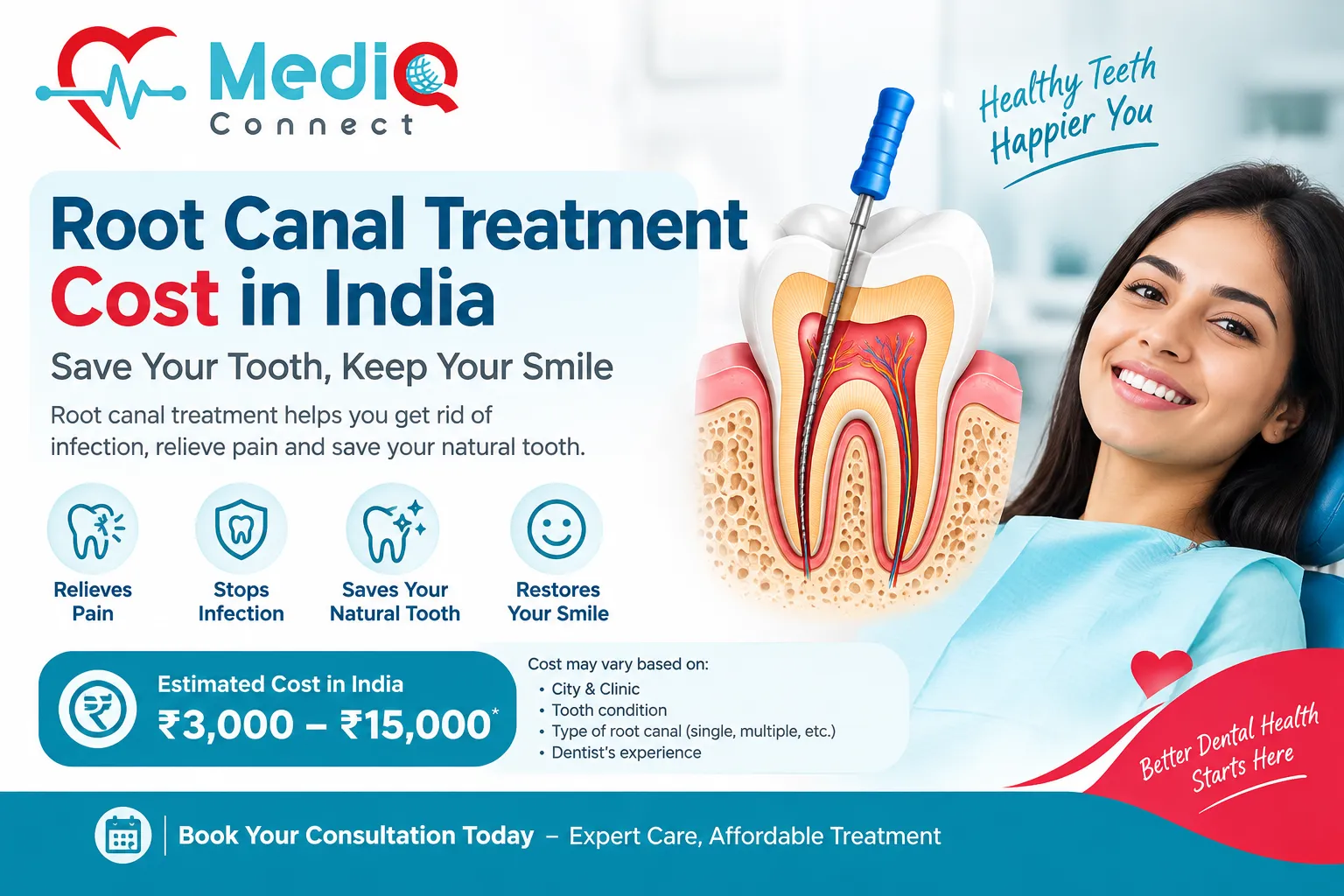



Root Canal Treatment Cost in India: What to Expect
A dentist mentions "root canal" and, for a lot of people, two worries surface immediately - will it hurt, and what will it cost? The pain question has a genuinely reassuring answer (modern RCT is far less uncomfortable than its reputation suggests). The cost question deserves an equally clear one, without the vague "it depends" that most online searches turn up.
This guide breaks down the real root canal treatment cost India landscape - by tooth type, by city, with and without a crown - so you know roughly what to expect financially before you're sitting in the chair with an unfamiliar quote in front of you.
What Is a Root Canal and Why It's Needed
A root canal treatment removes infected or damaged pulp - the soft tissue containing nerves and blood vessels inside a tooth - then thoroughly cleans, disinfects, and seals the space to stop the infection from spreading further and to save the natural tooth wherever possible.
It's typically needed when deep decay, a crack, or repeated dental procedures on the same tooth allow bacteria to reach the pulp, causing pain, swelling, or noticeable sensitivity. Without treatment, the infection can spread to the surrounding bone, often resulting in a painful abscess and, eventually, complete loss of the tooth.
Root Canal Cost Across Major Indian Cities
Beyond the broad metro/tier-2/smaller-town breakdown, here's a more specific city-level comparison based on current clinic pricing across India.
- Mumbai: ₹4,500–₹18,000 per tooth, among the higher end nationally due to premium clinic overheads
- Delhi/Gurgaon/Noida: ₹3,500–₹20,000 per tooth, with significant range between budget and premium clinics
- Bangalore: ₹4,000–₹15,000 per tooth, reflecting the city's mix of established and newer dental practices
- Rajkot and other Gujarat tier-2 cities: ₹3,000–₹10,000 per tooth, generally more affordable while maintaining modern equipment standards
- Pune: ₹3,500–₹12,000 per tooth
- Chennai/Hyderabad: ₹3,000–₹12,000 per tooth
These city-level ranges overlap considerably, since individual clinic quality and technology matter as much as geography - a well-equipped tier-2 city clinic can easily match or exceed a budget metro clinic in both quality and price.
How Dental Insurance and Corporate Health Plans Handle RCT
If you have health insurance or a corporate wellness benefit, it's worth understanding how root canal treatment is typically handled before assuming it's covered.
- Most standard health insurance policies in India exclude routine dental procedures, treating them as elective rather than medically necessary
- Some newer, more comprehensive policies offer dental riders providing partial coverage for procedures like root canals
- Corporate health benefits occasionally include a dental allowance or reimbursement, worth checking with your HR department specifically
- Dental-specific insurance plans, though still uncommon in India, are gradually becoming more available and worth considering if you anticipate ongoing dental needs
Given limited insurance coverage for most patients, budgeting directly for the combined RCT-and-crown cost, rather than assuming partial reimbursement, is generally the safer financial approach.
EMI and Financing Options for Dental Treatment
For patients facing a higher combined cost - particularly multiple teeth needing treatment, or a premium crown material - financing options have become increasingly accessible.
- Many clinics now offer in-house EMI plans, sometimes interest-free for a defined period
- Third-party medical financing providers partner with dental clinics to offer structured monthly payment plans
- Personal loans or credit card EMI conversion are additional options some patients use for larger combined treatment costs
- Some clinics offer a modest discount for full upfront payment compared to financed plans - worth asking about directly
If cost is a genuine concern, raising it directly during your consultation is far more productive than delaying treatment - most clinics have handled this conversation many times before and can suggest a workable plan.
Common Myths About Root Canal Cost and Treatment, Debunked
Myth: Root canal treatment is always extremely painful
Modern local anaesthesia makes the procedure itself comparable in discomfort to a routine filling. The pain people associate with root canals is usually from the infection itself, before treatment - the procedure is what relieves that pain, not what causes it.
Myth: A cheaper root canal means lower quality
Price differences often reflect location and overhead more than clinical quality. A well-trained dentist using standard rotary instruments in a lower-cost city can deliver outcomes just as good as a premium metro clinic.
Myth: You can skip the crown and just leave the filled tooth as is
Especially for molars, skipping the crown significantly increases the risk of the tooth fracturing under normal chewing pressure, potentially requiring extraction later - often costing far more than the crown would have.
Myth: Root canal treatment always takes multiple sittings
Many straightforward cases are now completed in a single visit using modern rotary systems. Multiple sittings are typically reserved for more complex or heavily infected cases specifically.
Myth: Once treated, a root canal tooth can never get infected again
While uncommon, reinfection can occur, which is why retreatment exists as an option. Good oral hygiene and a properly fitted crown significantly reduce this risk over the long term.
What Determines Root Canal Cost?
The wide range you'll see quoted online - anywhere from ₹2,000 to ₹20,000 or more - isn't random or arbitrary. A handful of specific, identifiable factors explain nearly all of that apparent variation between clinics.
- Tooth type - molars have more canals and complex anatomy, making them more time-consuming and expensive to treat than front teeth
- City and clinic location - metro cities like Mumbai, Delhi, and Bangalore typically run higher than smaller towns due to overheads and demand
- Number of sittings - single-sitting RCT using rotary instruments often costs somewhat more per visit but saves you multiple trips
- Technology used - digital X-rays, rotary endodontic systems, and apex locators improve precision and are often reflected in the price
- Case complexity - an abscessed tooth, a previously failed root canal needing retreatment, or unusual canal anatomy all add time and cost
- Dentist's experience - a general dentist and a specialist endodontist may price the same procedure differently, particularly for complex cases
- Whether a crown is included - the RCT itself is only part of the total cost; the protective crown afterward is usually priced and billed separately
Understanding these variables is the fastest way to make sense of any root canal treatment cost India quote you receive, rather than comparing headline numbers that may not reflect the same scope of treatment.
Root Canal Cost by Tooth Type
Tooth type is one of the single biggest drivers of price, since the number of canals and root complexity differ significantly across the mouth.
|
Tooth Type / Scenario |
Typical Cost in India |
Notes |
|
Front teeth (incisors, canines) |
₹2,500–₹6,000 |
Simplest anatomy, usually a single canal |
|
Premolars |
₹3,500–₹8,000 |
Typically 1–2 canals |
|
Molars (back teeth) |
₹5,000–₹15,000 |
3–4 canals, most time-consuming and technically demanding |
|
Re-root canal (retreatment) |
₹6,000–₹18,000 |
More complex than a first-time RCT; higher skill and time required |
If your dentist quotes a price before taking an X-ray, treat it as a rough estimate only - the actual canal anatomy, only fully visible on proper imaging, is what ultimately determines the final complexity and cost of your specific case.
A Realistic Cost Scenario: Front Tooth RCT
To make the numbers less abstract, here's a realistic breakdown for a straightforward front tooth root canal in a tier-2 city.
- Consultation and X-ray: ₹300–₹600
- Root canal procedure (single sitting): ₹3,500
- Metal-ceramic crown: ₹5,000
- Total: approximately ₹9,000, assuming no complications
This kind of itemised breakdown - rather than a single bundled figure - is exactly what a transparent clinic should provide, and it's worth requesting explicitly if you receive a lump-sum quote instead.
A Realistic Cost Scenario: Molar RCT With Zirconia Crown
For comparison, here's a realistic breakdown for a more complex molar case with a premium crown choice.
- Consultation and X-ray: ₹500–₹800
- Root canal procedure (molar, multiple sittings): ₹9,000
- Post and core build-up (if needed): ₹1,500
- Zirconia crown: ₹14,000
- Total: approximately ₹25,300, reflecting the added complexity of a molar plus a premium crown material
These scenario breakdowns are illustrative rather than binding quotes for any specific clinic, but they show how the individual cost components discussed throughout this guide come together in an actual treatment plan.
Root Canal Treatment for Children
Children occasionally need a form of root canal treatment on baby teeth, called pulpotomy or pulpectomy, when decay reaches the pulp before the tooth naturally falls out.
- Baby tooth pulpotomy/pulpectomy typically costs ₹1,500–₹4,000, generally less than adult RCT given the simpler procedure on primary teeth
- A pediatric dentist or pedodontist is generally best suited for this procedure, given specific training in managing children's behaviour and smaller dental anatomy
- Preserving a badly decayed baby tooth, rather than extracting it early, helps maintain proper spacing for permanent teeth coming in later
If your child's dentist recommends this treatment rather than extraction, it's usually because preserving the tooth's natural spacing function genuinely matters for their developing bite.
Post and Core Build-Up: An Often-Overlooked Cost
When a tooth has lost significant structure due to decay or a previous large filling, a post and core build-up is often needed before a crown can be properly fitted - and this is a cost many patients don't anticipate.
- A post and core build-up typically costs ₹1,000–₹3,000, depending on the material used (fiber post vs metal post)
- This step provides a stable foundation for the crown, particularly important for molars bearing significant chewing force
- Not every RCT case needs this step - it depends on how much natural tooth structure remains after the infected pulp is removed
Ask your dentist directly whether your specific case is likely to need this step, so it doesn't come as a surprise addition to your final bill.
Warranty and Follow-Up Care After Root Canal Treatment
A properly performed root canal, protected by a well-fitted crown, is designed to last many years - often decades - but a few follow-up considerations are worth understanding.
- Some clinics offer a limited warranty period on RCT treatment, typically covering retreatment at reduced or no cost if the same tooth develops issues within that window
- Regular six-monthly dental check-ups help catch any developing issues with a treated tooth early
- Good oral hygiene around the crown margin is particularly important, since decay can still develop at the edge where the crown meets the natural tooth
- Avoiding excessive force on a treated molar - like chewing ice or very hard foods - helps protect the crown long-term
Ask specifically about warranty terms when comparing quotes between clinics - this is a meaningful value difference that a simple price comparison alone won't reveal.
Root Canal Cost by City - Metro vs Smaller Towns
Location remains one of the most consistent factors behind price differences, largely reflecting clinic overheads, rent, and local demand rather than a difference in the underlying treatment quality.
- Metro cities (Mumbai, Delhi, Bangalore, Gurgaon): ₹4,000–₹15,000+ per tooth, with premium clinics sometimes reaching ₹20,000 for complex molar cases
- Tier-2 cities (Rajkot, Surat, Jaipur, Lucknow): ₹3,000–₹10,000 per tooth, generally more affordable while still offering modern equipment at established clinics
- Smaller towns and rural areas: ₹2,000–₹6,000 per tooth, though technology and specialist availability may be more limited
A lower price in a smaller city doesn't automatically mean lower quality of care - many tier-2 city clinics now use the very same rotary systems and digital imaging as leading metro clinics, simply with lower overhead costs passed on directly to patients.
Root Canal With Crown - Combined Cost Breakdown
A crown is strongly recommended after root canal treatment, particularly for molars, to protect the now more brittle tooth from fracturing under normal biting force. This is where total cost often surprises patients who only budgeted for the RCT itself.
- RCT alone: ₹2,500–₹15,000 depending on tooth type, as covered above
- Metal-ceramic (PFM) crown: ₹3,000–₹8,000 - the most affordable, widely used option
- Zirconia crown: ₹8,000–₹18,000 - stronger, more aesthetic, longer-lasting
- Full metal crown: ₹4,000–₹10,000 - highly durable, less commonly chosen for visible front teeth due to appearance
- Combined RCT + crown total: typically ₹8,000–₹25,000+ depending on tooth type and crown material chosen
Always ask specifically whether a quoted price includes the crown or covers only the root canal procedure alone - this single clarification explains a large share of the pricing confusion patients consistently report when comparing clinics.
Single-Sitting vs Multiple-Sitting RCT - Cost Difference
Modern rotary endodontic technology has made single-visit root canal treatment increasingly common, though it isn't the right approach for every case.
Single-Sitting RCT
Completes cleaning, disinfection, and sealing of the canal in one appointment, typically costing somewhat more due to the advanced equipment and additional chair time required in a single visit. Best suited to straightforward cases without significant infection.
Multiple-Sitting RCT
Spreads treatment across 2–3 visits, often used for more complex or heavily infected cases where the tooth needs time with medication between appointments before final sealing. Per-visit cost is typically lower, though total cost can be similar once all visits are combined.
Your dentist's recommendation between the two approaches is generally based on infection severity and canal complexity, not simply cost - trust this clinical judgment over any personal preference for fewer visits alone.
Government/Dental College vs Private Clinic Pricing
Cost-conscious patients often ask about government hospitals and dental college pricing, which can be dramatically lower than private clinics.
- Government dental hospitals: Often ₹200–₹1,500 per tooth, sometimes even less, though wait times can be considerably longer
- Dental college clinics: Treatment performed by supervised final-year students or postgraduates, often at a fraction of private clinic cost, with faculty oversight
- Private clinics: Higher cost but generally faster appointments, more flexible scheduling, and typically newer equipment
Dental college treatment, while somewhat slower due to teaching-hospital protocols, is often performed to a genuinely high clinical standard under direct faculty supervision - a completely reasonable option for patients prioritising cost over speed.
Delaying Treatment: How It Affects Cost Over Time
Putting off a recommended root canal, whether from cost concerns or simple avoidance, often makes the eventual treatment more expensive and more complicated, not less.
- An untreated infection can spread, sometimes requiring a more complex procedure or even surgery by the time treatment finally happens
- A worsening infection can lead to a dental abscess, sometimes requiring antibiotics and an emergency visit before RCT can even proceed
- In severe cases, delay can result in the tooth becoming unsalvageable, requiring extraction and a considerably more expensive replacement (implant or bridge) instead
- Pain and disruption to daily life - difficulty eating, disrupted sleep - carry a real cost too, even if it's not reflected on an invoice
If cost is the main reason for delaying, discussing payment plans or lower-cost options (like a dental college clinic) directly with a provider is almost always better than waiting and hoping the problem resolves on its own.
Choosing Between a General Dentist and an Endodontist for RCT
Root canal treatment can be performed by either a general dentist or an endodontist (a root canal specialist), and knowing when each is appropriate helps you make a more informed choice.
- General dentists routinely handle straightforward RCT cases, particularly for front teeth and premolars with typical canal anatomy
- Endodontists bring additional specialised training and are often better suited for complex molars, retreatment cases, or teeth with unusual canal anatomy
- Endodontists may charge somewhat more than a general dentist for the same tooth, reflecting their additional specialisation
- For a complicated or previously failed case, the higher cost of a specialist is often justified by meaningfully better odds of a successful, lasting outcome
If your general dentist recommends a referral to an endodontist for your specific case, that's generally a sign of appropriate, careful case management rather than an unnecessary added expense.
Regional Price Variation Within the Same City
Even within a single city, prices can vary meaningfully between different neighbourhoods and clinic types, which is worth knowing when comparing options close to home.
- Clinics in prime commercial areas or upscale neighbourhoods typically carry higher overhead, reflected in their pricing
- Established clinics with long-standing reputations sometimes price at a premium relative to newer practices seeking to build a patient base
- Clinics affiliated with larger dental chains may have more standardised, sometimes higher, pricing compared to independent practices
- A short drive to a slightly different part of the same city can sometimes yield meaningfully different pricing for comparable quality
It's worth getting quotes from more than one clinic even within your own city, rather than assuming proximity alone determines the best value for your specific treatment.
Preparing for Your Root Canal Appointment
A little preparation makes the appointment itself go more smoothly and helps you get the most accurate cost estimate.
- Bring any previous dental X-rays or records if you're seeing a new dentist for this issue
- Note when the pain or sensitivity started and what specifically triggers it, to help with diagnosis
- Ask for the full written estimate, including the crown, before treatment begins
- Eat a light meal beforehand if local anaesthesia is planned, since numbness can make eating immediately afterward briefly awkward
- Plan for mild soreness for a day or two after treatment, and have appropriate over-the-counter pain relief on hand
Patients who prepare this way tend to leave their appointment with a clearer understanding of both their treatment and its total cost than those who go in without any prior information gathering.
What's Usually Included in a Root Canal Quote
Understanding what a typical RCT quote covers - and what's often separate - helps you compare prices between clinics accurately.
- Usually included: local anaesthesia, cleaning and shaping of the canal(s), disinfection, and filling/sealing material
- Often billed separately: initial consultation, diagnostic X-rays, the post-treatment crown, and any pain medication prescribed
- Sometimes billed separately: a post and core build-up, needed when significant tooth structure is missing before a crown can be placed
Ask for a full itemised breakdown covering every stage from diagnosis to final crown placement - this remains the single most reliable way to compare root canal treatment cost in India between different clinics without missing a hidden component.
Re-Root Canal (Retreatment) Cost
Occasionally, a previously treated tooth develops a new infection or the original treatment doesn't fully resolve the problem, requiring retreatment - a more technically demanding procedure than a first-time RCT.
- Retreatment typically costs ₹6,000–₹18,000, reflecting the added complexity of removing old filling material before re-treating the canal
- Retreatment success rates are generally still good, though slightly lower than first-time treatment due to the more complex starting point
- In some cases, a specialist procedure called apicoectomy (surgical treatment of the root tip) may be recommended instead of standard retreatment, at a different cost
If a tooth that previously had a root canal starts hurting again months or years later, don't automatically assume it needs extraction - retreatment often successfully saves the tooth a second time around.
Root Canal vs Tooth Extraction - Cost and Long-Term Comparison
Extraction is sometimes considered as a cheaper alternative to root canal treatment, but the full picture is more complicated than the upfront number alone.
- Simple extraction: ₹500–₹3,000 - lower upfront cost than RCT
- Root canal + crown: ₹8,000–₹25,000 - higher upfront cost, but preserves the natural tooth
- Replacing an extracted tooth (implant or bridge): ₹15,000–₹55,000 - often required later to restore chewing function and prevent adjacent teeth from shifting
When you factor in eventual tooth replacement, root canal treatment is frequently the more economical choice over the long term, in addition to preserving your natural tooth and overall bite function - extraction's lower upfront cost often isn't the complete financial picture worth considering.
Signs You Need a Root Canal
A few symptoms commonly indicate the pulp inside a tooth may be infected or damaged, warranting a dental evaluation.
- Persistent or severe toothache, especially when biting or applying pressure
- Prolonged sensitivity to hot or cold that lingers well after the stimulus is removed
- Swelling or tenderness in the gums near a specific tooth
- Darkening or discoloration of a tooth
- A small bump (abscess) on the gum near the affected tooth
Not every toothache necessarily means a root canal is needed, but any of these symptoms warrants a proper dental evaluation rather than waiting to see if it resolves on its own - delaying tends to make treatment more complex and costly overall.
The Root Canal Procedure, Step by Step
Understanding the actual process helps put the cost breakdown into context - you're paying for a precise, multi-stage procedure, not a single quick fix.
- Diagnosis - X-ray to assess the extent of infection and canal anatomy
- Local anaesthesia - numbing the area completely before starting
- Access opening - a small opening is made in the top of the tooth to reach the pulp chamber
- Cleaning and shaping - infected pulp is removed and the canal(s) are cleaned and shaped using fine instruments
- Disinfection - the canal is thoroughly disinfected to eliminate remaining bacteria
- Filling and sealing - the cleaned canal is filled with a biocompatible material and sealed
- Crown placement - typically done in a follow-up visit, once any temporary filling has settled
Modern anaesthesia makes the procedure itself considerably more comfortable than its reputation suggests - most patients report the experience as similar to getting a routine filling.
How to Avoid Overpaying - Questions to Ask
A few direct questions before starting treatment help ensure you're getting a fair, transparent price for what you actually need.
- Does this quote include the crown, or is that priced separately?
- Will this likely be a single-sitting or multi-sitting procedure, and does that change the total cost?
- What crown material do you recommend for this specific tooth, and why?
- Is a post and core build-up likely to be needed, and is that included in the estimate?
- What happens if the case turns out to be more complex than expected once you start?
A transparent dentist will answer all of these clearly before starting - hesitation or vagueness, particularly around the crown and total combined cost, is worth taking seriously as a caution sign.
How MediQConnect Helps You Find the Right Dentist
Comparing per-tooth pricing, crown options, and dentist experience across multiple clinics takes real research. MediQConnect brings this together to help you evaluate root canal treatment cost India options more confidently.
- Verified dentist profiles with clear qualifications and experience
- Transparent consultation fees before you book, so there are no surprises at the first visit
- Genuine patient reviews to help you gauge real-world experience
- Easy appointment booking for an evaluation and personalised cost estimate
Getting an X-ray and a proper diagnosis is the only way to move from these general ranges to an accurate number for your specific tooth - book a consultation rather than relying on a phone estimate alone.
For Rajkot patients specifically, our detailed Best Dentist in Rajkot | Dental Specialist Guide 2026 includes an experienced endodontist with over three decades of root canal expertise.
If you're evaluating a dentist for the first time, our How to Choose the Right Dentist in Rajkot: A Practical Checklist covers credentials and questions worth asking before any procedure.
If extraction and replacement is also on the table for your specific tooth, our Dental Implants Cost in Rajkot: Complete Price Guide covers what that alternative path costs.
You can also browse verified doctors near me in Rajkot across all specialities on MediQConnect.
Frequently Asked Questions
What is the average root canal treatment cost in India?
Typically ₹2,500 to ₹15,000 per tooth depending on tooth type and city, with an additional ₹3,000 to ₹18,000 for a protective crown afterward, bringing the combined total to roughly ₹8,000–₹25,000 in most cases.
Why is root canal treatment for a molar more expensive?
Molars have 3 to 4 canals with more complex anatomy compared to the single canal typical of front teeth, requiring more time, skill, and materials - directly increasing the cost.
Does root canal cost include the crown?
Usually not - the root canal procedure and the crown are typically quoted and billed separately. Always confirm this explicitly when comparing quotes between clinics.
Is single-sitting root canal more expensive than multiple sittings?
Often slightly more per visit due to the advanced equipment and additional chair time required, though total cost across multiple visits can end up similar once everything is combined.
Is it cheaper to extract a tooth than get a root canal?
Extraction alone has a lower upfront cost, but replacing the missing tooth afterward with an implant or bridge often makes the total long-term cost higher than root canal treatment with a crown.
How much does a re-root canal (retreatment) cost in India?
Typically ₹6,000 to ₹18,000, reflecting the added complexity of removing old filling material before retreating the canal - generally more expensive than a first-time root canal on the same tooth.
Are government hospital root canal treatments as good as private clinics?
Clinical quality can be comparable, particularly at dental college teaching hospitals with faculty supervision, though wait times are typically longer and scheduling less flexible than private clinics.
Can I get root canal treatment cost estimates without an X-ray?
Only as a very rough range - an accurate quote requires an X-ray to assess canal anatomy and infection extent, since this directly determines the case's actual complexity and final cost.
Final Thoughts Before Your Appointment
Comparing root canal treatment cost India figures across different sources can feel confusing given how much they vary - but once you understand the drivers (tooth type, city, sitting count, and crown inclusion), the picture becomes considerably clearer. Most of the apparent inconsistency between quotes comes down to comparing genuinely different scopes of treatment.
Approach your consultation with the questions and checklist covered in this guide, and you'll be well positioned to get an accurate, itemised estimate rather than trying to reconcile conflicting numbers from clinic advertising alone.
Conclusion: Understanding the Full Picture Before You Commit
Understanding the real root canal treatment cost India breakdown - by tooth type, city, and whether a crown is included - puts you in a considerably stronger position than comparing a single headline number between clinics. A confident decision comes from a full, itemised estimate after a proper examination, not a phone quote taken at face value.
When you're ready to get a personalised estimate, MediQConnect makes it simple to compare verified dentists and book a consultation to discuss your specific tooth, symptoms, and treatment plan in detail.
Dealing with tooth pain right now? view doctors across specialities on MediQConnect and book a dental consultation today.