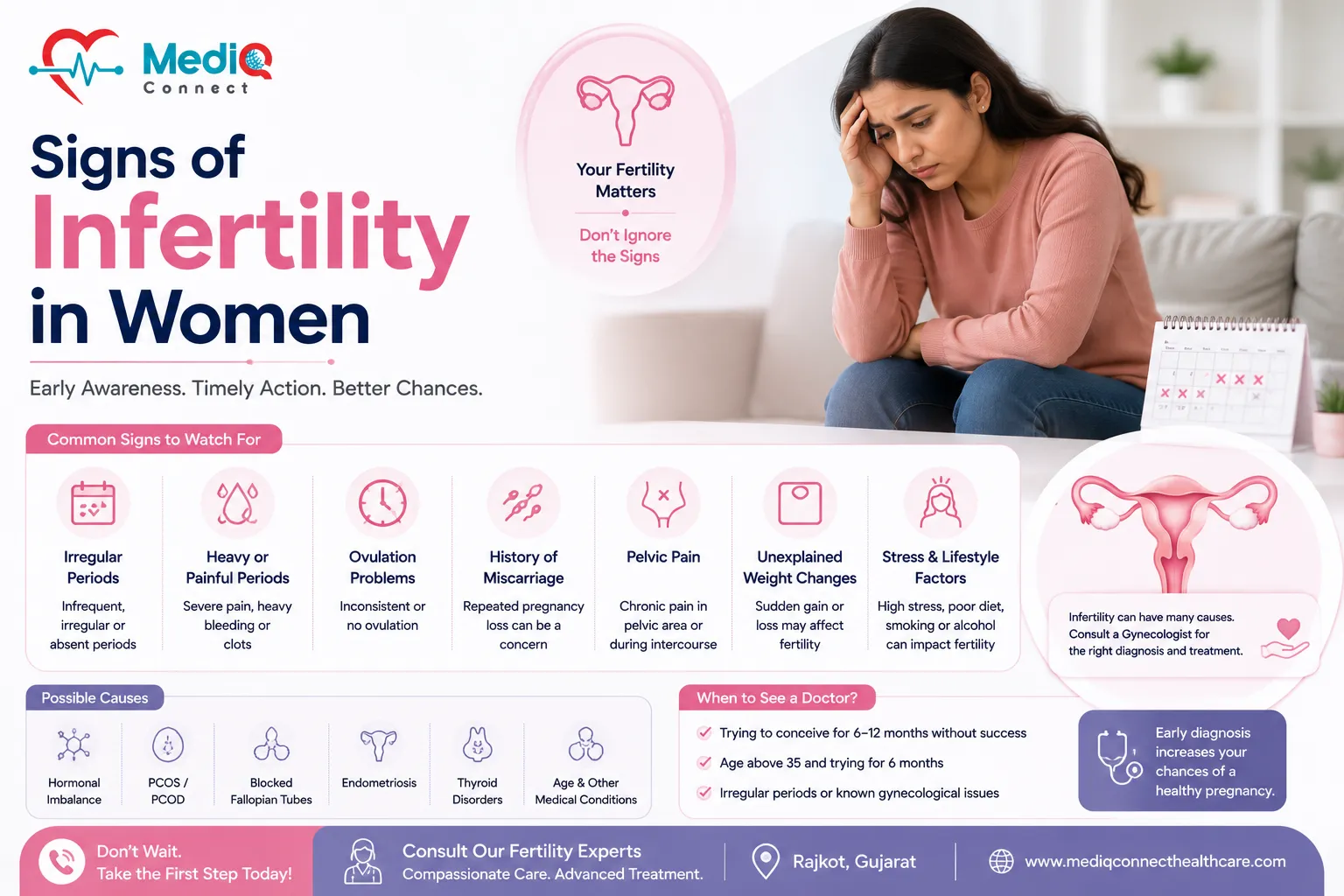



Signs of Infertility in Women: When to See a Fertility Specialist
Most women don't experience a single, dramatic symptom that clearly signals a fertility problem. Instead, it's usually a collection of smaller things - a cycle that's always been a little irregular, periods that hurt more than they used to, a year of trying that's quietly turned into more than a year. Individually, each of these is easy to explain away as normal variation, stress, or simply bad luck with timing.
This guide walks through the actual signs of infertility in women worth paying attention to, what they might mean, and - just as importantly - exactly when the guidelines say it's time to stop wondering and book a fertility evaluation instead of waiting it out on your own for another few months hoping things resolve by themselves.
What Counts as Infertility, Medically Speaking
Infertility has a specific clinical definition: the inability to conceive after 12 months of regular, unprotected intercourse for women under 35, or after 6 months for women 35 and older. This isn't an arbitrary cutoff - it reflects how quickly fertility naturally declines with age.
It's worth saying clearly: needing this timeline to pass doesn't mean nothing can be evaluated sooner. If specific symptoms or known risk factors are present, seeing a specialist earlier is often the right call, not something to wait on until the full 6 or 12 months have passed.
Irregular or Absent Periods - The Clearest Signal
A regular menstrual cycle typically falls somewhere between 21 and 35 days in length. Cycles that are consistently shorter, longer, wildly variable, or absent altogether are one of the most reliable indicators that ovulation isn't happening as expected.
- Amenorrhea (no period for 3+ months, when not pregnant or breastfeeding) often points to a hormonal or hypothalamic issue
- Cycles shorter than 21 days may indicate a shortened follicular phase, affecting egg maturation
- Cycles longer than 35 days, or highly unpredictable timing, often suggest ovulation isn't occurring consistently
Among all the signs of infertility in women that doctors look for first, irregular or absent periods is consistently the one with the strongest direct link to an underlying ovulation problem - which is why it's usually the first thing a fertility evaluation investigates.
Painful Periods and What They Might Mean
Some menstrual discomfort is entirely normal, but periods that are severe enough to disrupt daily life are worth mentioning to a doctor specifically in the context of fertility, not just period pain.
- Endometriosis - tissue similar to the uterine lining growing outside the uterus, a leading cause of both painful periods and infertility
- Uterine fibroids - noncancerous growths that can distort the uterine cavity and interfere with implantation
- Adenomyosis - uterine lining tissue growing into the muscular wall of the uterus, causing pain and heavy bleeding
- Pelvic inflammatory disease (often from an untreated infection) - can cause scarring that affects the fallopian tubes
Pain alone doesn't confirm any of these conditions on its own, but severe, worsening, or unusual pelvic pain is a legitimate reason to ask specifically whether it could be connected to fertility, rather than assuming it's simply a bad period.
Signs Linked to Hormonal Imbalance
Hormones don't just regulate the menstrual cycle - imbalances often show up in ways that seem unrelated to fertility at first glance.
- Unexplained weight gain or difficulty losing weight, despite consistent diet and activity
- Excess facial or body hair growth, often linked to elevated androgen levels
- Acne that develops or worsens in adulthood, beyond typical hormonal skin changes
- Thinning hair or hair loss not explained by other causes
- Persistent fatigue that doesn't improve with adequate rest
These signs frequently cluster together in conditions like PCOS (polycystic ovary syndrome) or thyroid disorders, both of which are common, treatable causes of infertility when identified early.
Changes in Cervical Mucus and Ovulation Signs
Cervical mucus changes predictably throughout a normal cycle, and understanding your own pattern can be a genuinely useful early indicator, even before formal testing.
- Around ovulation, healthy cervical mucus typically becomes clear, stretchy, and slippery - often compared to raw egg whites
- An absence of this fertile-quality mucus at any point in the cycle can suggest ovulation isn't occurring as expected
- No noticeable change in mucus consistency throughout the month may indicate an anovulatory cycle
- Basal body temperature tracking (a slight rise after ovulation) can help confirm whether ovulation is happening at all
Tracking these patterns for a few cycles - through an app, a simple chart, or ovulation predictor kits - gives you concrete, specific information to bring to a doctor rather than a vague sense that something feels off.
Recurrent Miscarriage as a Sign Worth Investigating
A single miscarriage is common and doesn't necessarily indicate an underlying fertility problem on its own. Recurrent miscarriage - generally defined as two or more consecutive pregnancy losses - is different and warrants a dedicated evaluation.
- Genetic factors, including chromosomal abnormalities in either partner
- Uterine structural issues, such as fibroids, polyps, or an abnormally shaped uterus
- Hormonal imbalances, including thyroid disorders or luteal phase defects
- Blood clotting disorders that can affect placental development
This is one of the situations where waiting the standard 6-to-12-month timeline doesn't apply - recurrent pregnancy loss is a clear signal to seek evaluation promptly, regardless of how long you've technically been trying to conceive.
Known Conditions That Signal a Higher Infertility Risk
Certain diagnosed medical conditions are strongly associated with fertility challenges, and knowing you have one of these is itself a reason to seek an earlier evaluation, even without other obvious signs.
- PCOS (Polycystic Ovary Syndrome) - the most common cause of ovulatory infertility
- Endometriosis - affects an estimated 10–15% of women of reproductive age
- Thyroid disorders - both hypothyroidism and hyperthyroidism can disrupt ovulation
- A history of pelvic inflammatory disease or untreated sexually transmitted infections
- Previous pelvic or abdominal surgery, which can cause scar tissue affecting the tubes or ovaries
- A family history of early menopause or known fertility issues
If any of these apply to you, mentioning it proactively at your first evaluation - rather than waiting to see if you develop other symptoms first - gives your doctor a meaningfully clearer starting point to work from.
Age-Related Signs and Why Timing Matters
Fertility naturally declines with age, and the pace of that decline is often underestimated. Egg quantity and quality both decrease gradually through the 30s, then more noticeably after 35.
- Cycles becoming shorter than they used to be, sometimes an early marker of declining ovarian reserve
- A longer time to conceive compared to previous pregnancies, even without other symptoms
- Reduced response to ovulation tracking or predictor kits compared to earlier years
- An AMH (Anti-Müllerian Hormone) test showing lower-than-expected ovarian reserve for your age
Age-related decline is a normal biological process, not a medical failure - but it's exactly why the recommended waiting period before evaluation shortens from 12 months to 6 months once a woman turns 35, and why some doctors recommend immediate evaluation after 40 without waiting on any specific timeline at all.
Subtle and Often-Missed Signs
A few signs are easy to dismiss as unrelated to fertility, or as general stress, but are worth mentioning to a doctor if they persist.
- A noticeably reduced sex drive, sometimes linked to hormonal shifts
- Persistent mood changes, anxiety, or irritability without an obvious external cause
- Bleeding between periods or after intercourse, which can indicate a uterine or cervical issue
- Unusual vaginal discharge, particularly alongside pelvic discomfort
None of these confirm infertility on their own - many overlap with everyday PMS or general stress - but a persistent pattern, rather than an occasional occurrence, is worth tracking and mentioning at an evaluation.
Questions to Ask at Your First Fertility Appointment
Walking in with a short list of questions helps you leave with genuine clarity rather than a stack of test results you don't fully understand.
- Based on my history and symptoms, what do you think is the most likely explanation?
- Which tests do you recommend first, and what will each one tell us?
- Should my partner be tested at the same time, or only if my results come back unclear?
- What would change your recommendation from monitoring to active treatment?
- How long should we expect the full evaluation process to take?
Writing these down beforehand - and bringing a notebook to jot down the answers - makes a real difference in how much you retain from what's often a dense, information-heavy first visit.
A Note on Unexplained Infertility
In a meaningful percentage of cases, a complete evaluation doesn't identify a clear cause - this is classified as unexplained infertility, and it can feel especially frustrating precisely because there's no specific problem to target.
Unexplained doesn't mean untreatable. Many couples with this diagnosis go on to conceive, either naturally with more time or with the help of treatments like IUI or IVF, which can succeed even without a clearly identified cause. If you receive this diagnosis, it's worth asking your specialist directly what they'd recommend next, since "unexplained" is a starting point for a treatment conversation, not a dead end.
Common Myths About Infertility Signs, Debunked
Myth: If you've had a healthy pregnancy before, you can't become infertile later
Secondary infertility is more common than most people realise. A previous easy pregnancy doesn't rule out a new fertility issue developing afterward - age, new health conditions, or complications from a prior delivery can all play a role.
Myth: Regular periods always mean you're fertile
Regular cycles are a good sign that ovulation is likely occurring, but they don't rule out other causes of infertility, such as blocked fallopian tubes, uterine abnormalities, or male-factor issues that have nothing to do with the menstrual cycle.
Myth: You should wait as long as possible before seeking help, to avoid overreacting
Waiting beyond the recommended guidelines doesn't improve outcomes - if anything, it can narrow treatment options, particularly for age-related decline. Seeking an evaluation within the recommended timeframe isn't overreacting; it's simply following established medical guidance.
Myth: Infertility symptoms are always obvious
Many causes of infertility, particularly tubal blockages or mild male-factor issues, produce no noticeable symptoms at all. This is precisely why the trying-to-conceive timeline itself is a meaningful signal, separate from any specific symptom.
Myth: If you're young, you don't need to worry about these signs
While age is a significant factor, conditions like PCOS, endometriosis, and thyroid disorders can affect fertility at any reproductive age, including in your 20s. Age lowers overall risk but doesn't eliminate it.
Diagnostic Tests Explained in Plain Terms
The names of common fertility tests can sound intimidating - here's what each one actually involves and why it's used.
AMH (Anti-Müllerian Hormone) Test
A simple blood test that estimates ovarian reserve - roughly how many eggs remain. It can be done at any point in the menstrual cycle and gives a useful, though not perfectly precise, picture of egg quantity.
FSH and LH Tests
Blood tests measuring follicle-stimulating hormone and luteinizing hormone, typically done early in the cycle. Abnormal levels can indicate ovulation problems or diminished ovarian reserve.
HSG (Hysterosalpingography)
An X-ray procedure using contrast dye to check whether the fallopian tubes are open. It's typically done in the first half of the cycle and can cause mild cramping, similar to period pain.
Pelvic Ultrasound
A non-invasive scan examining the ovaries and uterus, often used to count antral follicles (an indicator of ovarian reserve) and check for structural issues like fibroids or cysts.
Understanding what each test actually measures helps make sense of the results when they come back, rather than feeling like you're being handed numbers with no context.
What Happens After Diagnosis
Once an evaluation identifies a likely cause, the path forward depends entirely on what's found - there's no single next step that applies to everyone.
- Ovulation disorders (like PCOS) often respond well to medication that induces regular ovulation, sometimes combined with IUI
- Structural issues, such as fibroids or polyps, may require minor surgery before or alongside fertility treatment
- Tubal blockages typically require IVF, since it bypasses the tubes entirely
- Hormonal imbalances, including thyroid disorders, are often treated directly, sometimes resolving fertility issues without needing assisted reproduction at all
- Unexplained infertility, after a complete workup finds no clear cause, is usually approached with a stepwise plan - often starting with IUI before moving to IVF if needed
A significant number of women diagnosed with a treatable cause go on to conceive with relatively straightforward treatment - the evaluation itself is often the biggest hurdle, not the treatment that follows it.
Supporting a Partner Through This Process
If your partner is the one going through evaluation and possibly treatment, a few things genuinely help beyond just being present at appointments.
- Take the emotional weight seriously - this process often carries more anxiety and grief than it's given credit for from the outside
- Complete your own testing (like a semen analysis) promptly, rather than treating it as a lower priority
- Avoid offering unsolicited reassurance like "I'm sure it'll happen" without also acknowledging the real uncertainty involved
- Ask what kind of support is actually wanted - practical help with appointments, or simply someone to listen - rather than assuming
Fertility evaluation and treatment affects both partners, even when the physical testing and procedures fall more heavily on one person, and approaching it as a shared process tends to ease the burden considerably.
Tracking Your Cycle: What to Record Before Your Appointment
Bringing organised cycle information to your first appointment gives your doctor considerably more to work with than a general sense that something feels off.
- Cycle length - count from the first day of one period to the first day of the next, over at least 2–3 months
- Flow characteristics - how many days, how heavy, whether clots are present
- Pain patterns - timing, severity, and whether it's worsening over time
- Any spotting between periods or after intercourse
- Basal body temperature or ovulation predictor kit results, if you've been tracking them
A simple period-tracking app or a basic paper log works fine - what matters is consistency over a few cycles, not a perfect or elaborate system.
Lifestyle Factors That Can Affect Fertility Signs
Certain lifestyle factors can influence or mimic some of the signs discussed in this guide, which is worth knowing before assuming the cause is purely medical.
- Significant weight loss or gain can disrupt ovulation and menstrual regularity on its own
- Excessive high-intensity exercise, particularly when combined with low body fat, can suppress ovulation
- Chronic sleep deprivation and high stress levels can affect hormone regulation over time
- Smoking is linked to reduced ovarian reserve and earlier onset of menopause
- Certain medications, including some used for chronic conditions, can affect cycle regularity
None of this means lifestyle changes alone will resolve a genuine fertility issue, but addressing these factors is often one of the first things a doctor will ask about, since they're both common and, in many cases, modifiable.
Primary vs Secondary Infertility: An Important Distinction
Infertility isn't always about a first pregnancy - the distinction between primary and secondary infertility affects both diagnosis and how the signs should be interpreted.
Primary Infertility
Difficulty conceiving for the first time, with no previous pregnancies. This is the scenario most commonly discussed and covered by the standard evaluation guidelines.
Secondary Infertility
Difficulty conceiving after a previous successful pregnancy, even if that pregnancy happened easily. This is surprisingly common and often catches couples off guard, since they don't expect fertility issues after already having a child.
The same signs and evaluation timelines generally apply to both, though secondary infertility sometimes points toward a new development - like age-related decline, a new condition, or complications from the previous pregnancy or delivery - rather than a long-standing underlying issue.
The Emotional Side of Noticing These Signs
Recognising these signs in yourself often brings up anxiety long before any diagnosis is confirmed - and that reaction is completely understandable, not something to dismiss or push through silently.
It's worth remembering that most of these signs, even in combination, don't automatically mean infertility - many point toward a treatable condition rather than an insurmountable one. Getting a clear evaluation tends to reduce anxiety more than continuing to wonder, even if the news isn't what you were hoping for, simply because uncertainty itself is often harder to sit with than a concrete answer and a plan.
When to See a Fertility Specialist - The Actual Guidelines
Medical guidelines give a clear, specific framework for when to seek an evaluation, rather than leaving it to guesswork.
- Under 35: After 12 months of regular, unprotected intercourse without conception
- 35 and older: After 6 months of trying, since fertility declines more quickly at this stage
- 40 and older: Many specialists recommend seeking evaluation immediately, without waiting any specific number of months
- At any age: Immediately, if you have known risk factors - irregular or absent periods, diagnosed PCOS or endometriosis, recurrent miscarriage, or a history of pelvic infection or surgery
These guidelines exist precisely because the earlier signs are identified and evaluated, the more treatment options remain genuinely available - waiting doesn't make an underlying issue better, and for age-related decline specifically, it can meaningfully narrow the options over time as biology continues to change regardless of intention.
What a Fertility Evaluation Actually Involves
Knowing what to expect makes the decision to book an evaluation feel considerably less intimidating.
- A detailed medical history - menstrual cycle patterns, previous pregnancies, medical and surgical history
- Blood tests measuring hormone levels - AMH, FSH, LH, estradiol, thyroid function, and prolactin
- A pelvic ultrasound to examine the ovaries and uterus, including antral follicle count
- A check for tubal patency, often via HSG (hysterosalpingography), if blocked tubes are suspected
- A semen analysis for the male partner, since infertility involves a male-factor component in a significant proportion of cases
Most of this testing can be completed within one to two weeks, and it gives a specialist enough information to identify a likely cause - or rule several out - and recommend a specific, actionable next step, rather than leaving you with more uncertainty than you started with.
It Takes Two - Male-Factor Signs Worth Knowing
Roughly a third of infertility cases involve a female factor, a third involve a male factor, and the remaining third involve both partners or an unexplained cause - which is exactly why a thorough evaluation always includes the male partner, not just the woman.
- A semen analysis is a simple, low-cost, non-invasive first step that provides significant diagnostic information
- Known risk factors - a history of testicular injury, undescended testicles, certain medications, or significant lifestyle factors - are worth mentioning upfront
- Male-factor infertility often has no noticeable symptoms at all, which is precisely why testing matters even when everything else seems normal
Focusing evaluation entirely on the female partner, without also testing the male partner early in the process, is one of the most common and avoidable delays in the entire fertility evaluation journey.
How MediQConnect Helps You Take the Next Step
Recognising the signs of infertility in women covered in this guide is only useful if it leads to an actual evaluation. MediQConnect makes that next step considerably easier to take.
- Verified gynecologist and fertility specialist profiles with clear qualifications and experience
- Transparent consultation fees before you book, with no surprises
- Flexible booking - in-clinic visits or video consultations for an initial conversation
- Genuine patient reviews to help you find a specialist whose communication style works for you
If you've recognised several of these signs in yourself, or you simply know you've been trying longer than the recommended guidelines suggest, booking that first evaluation is a reasonable, proactive step - not an overreaction.
If your evaluation points toward assisted reproductive treatment, our Best IVF Doctor in Rajkot: Your Complete Guide to Fertility Specialists & IVF Treatment covers verified doctor profiles, hospital details, and what to check before choosing a clinic.
Once you have a diagnosis, our IUI vs IVF: Which Fertility Treatment Is Right for You? walks through how doctors typically decide between these two treatment paths.
For a broader framework on choosing a women's health specialist for this first evaluation, see our guide to the best gynecologist in Rajkot.
If you'd like an initial conversation before committing to in-person testing, see our guide to video consultation with a doctor in Rajkot.
Frequently Asked Questions
What are the most common signs of infertility in women?
Irregular or absent periods are the most commonly cited sign, since they often reflect an underlying ovulation problem. Other signs include painful periods, hormonal symptoms like unexplained weight changes or excess hair growth, and recurrent miscarriage.
Can you have infertility with no symptoms at all?
Yes - some causes of infertility, including certain tubal or male-factor issues, produce no noticeable symptoms. This is exactly why a fertility evaluation after the recommended trying period is important, rather than relying on symptoms alone to decide.
How long should I try to conceive before seeing a doctor?
Generally 12 months for women under 35, and 6 months for women 35 and older. Seek evaluation sooner if you have known risk factors like irregular periods, diagnosed PCOS or endometriosis, or recurrent miscarriage.
Do irregular periods always mean infertility?
Not necessarily, but they're one of the clearer signals worth investigating, since they often indicate ovulation isn't happening consistently. Many causes of irregular cycles are treatable once identified.
What tests are done to check for infertility in women?
A typical evaluation includes hormone blood tests (AMH, FSH, LH, thyroid function), a pelvic ultrasound, and sometimes a test for tubal patency like HSG. A semen analysis for the male partner is usually included as part of a complete evaluation.
Can stress cause infertility?
Significant chronic stress can affect hormone regulation and, in some cases, disrupt ovulation. However, stress alone is rarely the sole cause of infertility, and it shouldn't be assumed as the explanation without a proper evaluation ruling out other causes.
Is infertility always the woman's fault?
No - infertility involves a roughly equal split between female factors, male factors, and combined or unexplained causes. A complete evaluation always includes both partners, not just the woman.
Can you still be fertile with irregular periods?
Yes, it's possible, but irregular periods do increase the likelihood of an ovulation-related issue. Tracking your cycle and discussing the pattern with a doctor is the most reliable way to know for certain rather than assuming either way.
Keeping This in Perspective
It's worth stepping back and remembering that infertility, while common, is not the most likely outcome for most couples trying to conceive. The majority of couples do conceive within a year of regular trying, and among those who don't, a significant proportion have a treatable, identifiable cause once properly evaluated by a specialist.
Reading through a list of signs and symptoms can understandably feel overwhelming, especially if several sound familiar. Try to hold that concern loosely rather than treating it as a confirmed diagnosis - the entire point of an evaluation is to replace that uncertainty with a clear, specific answer, one way or another, so you can actually move forward with a plan.
A Quick Reference Checklist
Bringing everything in this guide together, here's a condensed checklist to help you decide whether it's time to book an evaluation.
- ✔ Under 35 and trying for 12+ months without success
- ✔ 35 or older and trying for 6+ months without success
- ✔ Irregular, absent, or unusually painful periods
- ✔ Diagnosed with PCOS, endometriosis, or a thyroid disorder
- ✔ Two or more consecutive miscarriages
- ✔ A history of pelvic infection, STI, or abdominal/pelvic surgery
- ✔ Noticeable hormonal symptoms - unexplained weight changes, excess hair growth, persistent fatigue
If even one of these applies clearly to your situation, that's a reasonable basis to book an evaluation - waiting for every box to be checked isn't necessary, and isn't how fertility specialists actually recommend approaching this decision.
How Rajkot Women Access Fertility Evaluation Locally
Fertility evaluation has become considerably more accessible in Rajkot in recent years, which is worth knowing if your only reference point is an assumption that this kind of testing requires travelling to a larger city.
- Most gynecologists in Rajkot can order and interpret initial hormone panels and ultrasounds without requiring a specialist referral for the first round of testing
- Dedicated fertility centres in the city now offer AMH testing, HSG, and semen analysis on-site, reducing the need for multiple separate appointments
- Video consultations have made it easier to have an initial conversation with a specialist before committing to in-person testing, particularly useful for a first, exploratory conversation
Starting with a general gynecologist for initial testing, then moving to a dedicated fertility specialist if results suggest further evaluation is needed, is a completely reasonable and commonly used approach - you don't need to know in advance whether you'll need a specialist to take the first step.
Final Thoughts Before You Book an Evaluation
If you've recognised several of the signs of infertility in women covered in this guide, or you've simply crossed the recommended trying-to-conceive timeline for your age, that's genuinely enough reason to book an evaluation - you don't need every symptom on this list, or absolute certainty, before taking that step.
Most women who go through a fertility evaluation say the same thing afterward: even a difficult diagnosis felt more manageable than the uncertainty that came before it. Clarity, even when it's not the answer you were hoping for, tends to open up a path forward - and a path forward, with concrete next steps, is exactly what a good fertility specialist should help you find.
Conclusion: Trust the Pattern, and Don't Wait Too Long
Recognising the signs of infertility in women covered in this guide is about noticing patterns, not diagnosing yourself. No single symptom confirms infertility, and many of these signs overlap with everyday hormonal fluctuation - but a persistent pattern, especially alongside a known risk factor, is worth a proper evaluation rather than continued guessing about what might be going on beneath the surface.
If the timeline guidelines in this guide apply to you, or several of these signs sound familiar, that's a reasonable point to book a fertility evaluation rather than waiting for more certainty first. When you're ready, MediQConnect makes it simple to find a verified specialist and take that first step toward getting real answers.
Ready to get clarity on what's going on? view doctors across specialities on MediQConnect and book a fertility evaluation today.
Have Questions About This Article?
Reach out with your inquiry and our team will get in touch with you shortly.