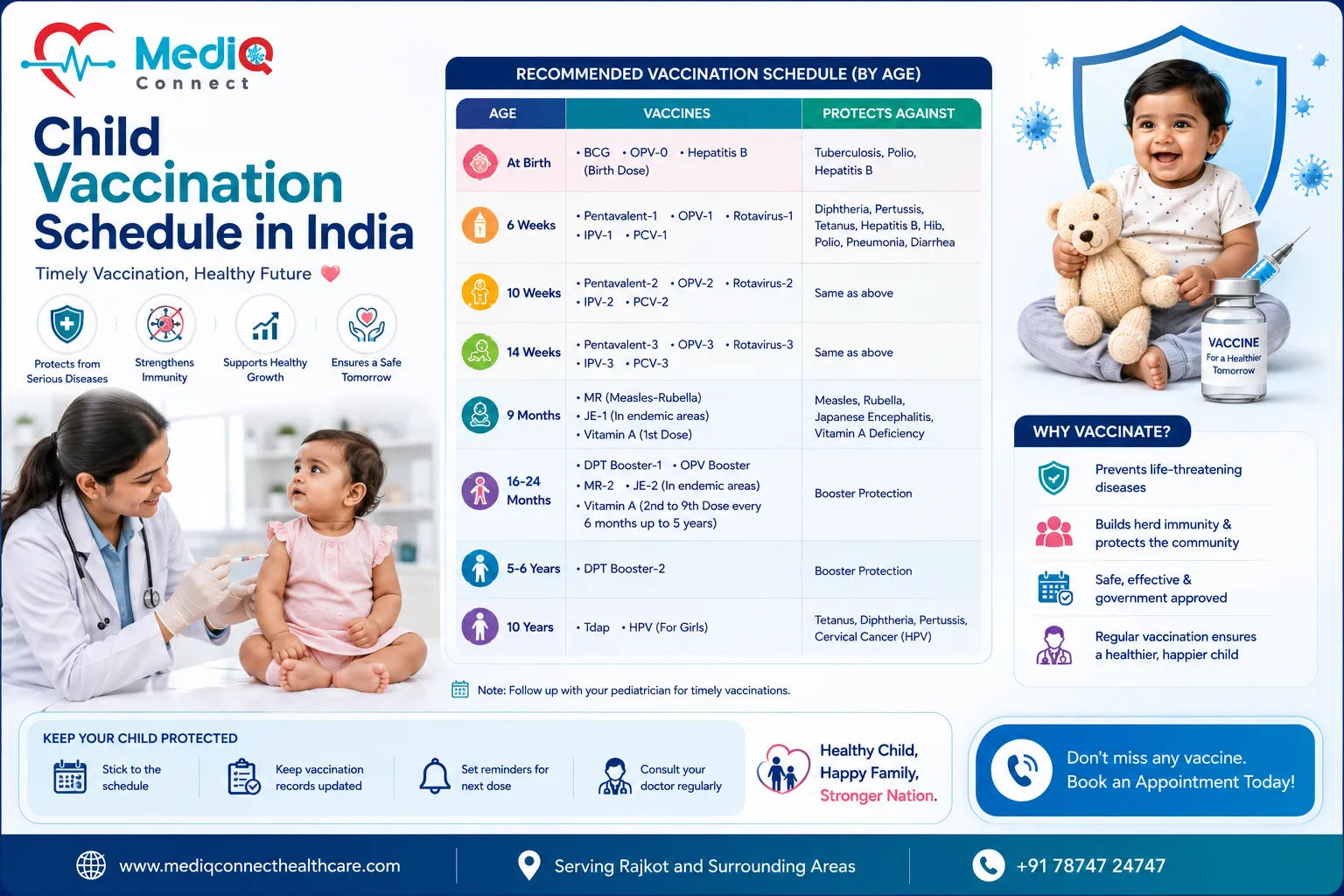



Child Vaccination Schedule in India: Complete Age-Wise Guide
Somewhere between the hospital discharge papers and your baby's first pediatrician visit, someone hands you a small booklet with dates, vaccine names, and a lot of medical shorthand. It's overwhelming at first - but it doesn't need to be. This guide breaks down exactly what your child needs, when, and why, using the current IAP and government-recommended schedule.
Whether you're expecting, have a newborn, or you're catching up on a missed dose for an older child, this is a complete, accurate child vaccination schedule India you can actually use - bookmark it, refer back to it at every visit, and use it alongside your pediatrician's guidance rather than instead of it.
IAP vs UIP - Understanding India's Two Vaccination Tracks
India effectively runs two overlapping vaccination frameworks, and understanding the difference clears up most of the confusion parents run into.
Universal Immunization Programme (UIP)
Run by the Government of India, the UIP provides a core set of vaccines completely free at government hospitals and health centres. It covers the most critical, high-burden diseases - BCG, Polio, DTP, Hepatitis B, Measles, and a few others - and reaches millions of children across the country every year.
IAP (Indian Academy of Pediatrics) Schedule
The IAP schedule, followed by most private pediatricians, includes everything in the UIP plus additional vaccines recommended based on India's specific disease patterns - Hib, PCV, Rotavirus, Typhoid conjugate, Hepatitis A, and Varicella among them. These are usually available at private clinics for a fee.
Most private pediatricians in India recommend following the fuller IAP schedule rather than the UIP list alone, since it offers broader protection. This guide covers the complete IAP-recommended child vaccination schedule India, noting which vaccines are also available free under the UIP.
Complete Age-Wise Vaccination Chart (Birth to 12 Years)
Here's the full schedule at a glance, based on the IAP 2026 recommendations. Bookmark this table - it's the fastest way to check what's due next.
|
Age |
Vaccine(s) |
Protects Against |
|
At Birth |
BCG, OPV-0, Hepatitis B (dose 1) |
Tuberculosis, Polio, Hepatitis B |
|
6 Weeks |
DTwP/DTaP-1, IPV-1, Hib-1, Hep B-2, Rotavirus-1, PCV-1 |
Diphtheria, Tetanus, Pertussis, Polio, Hib, Hepatitis B, Rotavirus, Pneumococcal disease |
|
10 Weeks |
DTwP/DTaP-2, IPV-2, Hib-2, Rotavirus-2, PCV-2 |
Same as above (2nd dose) |
|
14 Weeks |
DTwP/DTaP-3, IPV-3, Hib-3, Rotavirus-3, PCV-3 |
Same as above (3rd dose) |
|
6 Months |
Hepatitis B (dose 3), Influenza (annual, first dose) |
Hepatitis B, Seasonal Flu |
|
9 Months |
MMR-1, Typhoid Conjugate Vaccine |
Measles, Mumps, Rubella, Typhoid |
|
12 Months |
Hepatitis A-1, Varicella-1 |
Hepatitis A, Chickenpox |
|
15 Months |
MMR-2, Varicella-2, PCV booster |
Measles, Mumps, Rubella, Chickenpox, Pneumococcal disease |
|
16–18 Months |
DTwP/DTaP booster-1, IPV booster-1 |
Diphtheria, Tetanus, Pertussis, Polio |
|
18–19 Months |
Hepatitis A-2 |
Hepatitis A (second dose) |
|
4–6 Years |
DTwP/DTaP booster-2, OPV booster, MMR-3 |
Diphtheria, Tetanus, Pertussis, Polio, Measles, Mumps, Rubella |
|
9–14 Years |
HPV (2 doses, girls & boys) |
HPV-related cancers |
|
10–12 Years |
Tdap/Td booster, Typhoid booster (every 3 years) |
Tetanus, Diphtheria, Pertussis, Typhoid |
This table reflects the full child vaccination schedule India as recommended by the IAP Advisory Committee on Vaccines and Immunization Practices - your pediatrician may adjust timing slightly based on your child's specific health history, prematurity, or catch-up needs.
Birth to 14 Weeks - The Foundational Doses
The first few months lay the groundwork for your child's long-term immunity, which is why this stretch involves the most frequent visits.
At Birth
Before you even leave the hospital, your baby typically receives BCG (protects against severe childhood tuberculosis), OPV-0 (the oral polio "zero dose"), and the first dose of Hepatitis B - especially important since Hepatitis B can be transmitted during delivery.
6, 10, and 14 Weeks
These three visits form the backbone of early immunity. To reduce the number of injections per visit, pediatricians commonly use combination shots - Pentavalent or Hexavalent vaccines - which bundle DTwP, Hepatitis B, Hib, and sometimes IPV into a single injection.
Rotavirus and PCV (pneumococcal conjugate vaccine) are given alongside these visits too, protecting against severe diarrhoeal disease and pneumonia/meningitis respectively - both significant causes of hospitalisation in young children in India.
6 to 15 Months - Building Long-Term Immunity
This stretch introduces some of the most well-known childhood vaccines and rounds out the primary immunisation series.
6 Months
The third Hepatitis B dose is completed, and the first annual influenza shot is typically recommended from this age onward, especially before monsoon or winter when flu circulation rises.
9 Months
This is a genuine milestone - the first MMR dose (Measles, Mumps, Rubella) is given, since measles is highly contagious and can cause serious complications in young children. The typhoid conjugate vaccine is also introduced here, reflecting typhoid's continued prevalence in India.
12 and 15 Months
Hepatitis A and Varicella (chickenpox) vaccines begin at 12 months, with second doses following at 15 months alongside the second MMR dose and a PCV booster - completing most of the core immunisation series before your child's second birthday.
5 Years to 12 Years - Boosters and Adolescent Vaccines
Immunity from early childhood doses doesn't last forever, which is exactly why the schedule includes booster shots and additional vaccines as children grow.
- 4–6 years: DTwP/DTaP booster, OPV booster, and the third MMR dose
- 9–14 years: HPV vaccine (2 doses), recommended for both girls and boys to protect against HPV-related cancers later in life
- 10–12 years: Tdap/Td booster, along with a typhoid booster if it's been three years since the last dose
Parents sometimes assume the child vaccination schedule India ends after infancy, but these later boosters are just as important - waning immunity without them leaves older children genuinely vulnerable to diseases they were protected against as toddlers.
Optional but Recommended Vaccines
A few vaccines aren't part of the core UIP or IAP primary schedule but are still worth discussing with your pediatrician, especially depending on your child's health history and local disease patterns.
- Meningococcal vaccine - recommended in specific high-risk situations or before international travel
- Japanese Encephalitis vaccine - recommended in regions where JE is endemic, particularly parts of North and Northeast India
- Cholera vaccine - occasionally recommended for travel to areas with active outbreaks
- Rabies pre-exposure vaccination - considered for children in areas with high stray-animal exposure
These aren't universally required, but your pediatrician can advise whether your specific location or family circumstances make any of them worth adding.
Government (Free) vs Private Vaccines - What's the Difference?
A common point of confusion is why some vaccines are free at government centres while others cost money at private clinics. The short answer: it comes down to which vaccines the UIP currently funds versus the broader IAP-recommended list.
- Free under UIP: BCG, OPV, Hepatitis B, DTP, Measles/MMR, and a few others depending on state-level programmes
- Typically paid, private-clinic vaccines: Hib, PCV, Rotavirus, IPV (in most states), Typhoid conjugate, Hepatitis A, Varicella, HPV, and annual influenza
Both tracks protect against serious disease - the UIP list alone provides solid core protection, while the fuller IAP schedule adds coverage against additional common childhood illnesses. Many families choose a mix based on budget, which is a completely reasonable approach as long as it's discussed openly with your pediatrician.
Vaccination Costs in India - What to Budget For
Costs vary meaningfully by city, clinic, and vaccine brand, but here's a realistic range to help with planning.
- UIP government vaccines: Free at government hospitals and primary health centres
- Combination vaccines (Pentavalent/Hexavalent): ₹1,000–₹3,500 per dose at private clinics
- Rotavirus vaccine: ₹800–₹2,500 per dose
- PCV (Pneumococcal): ₹2,500–₹4,000 per dose
- MMR: ₹500–₹1,200 per dose
- Typhoid conjugate: ₹800–₹1,500 per dose
- HPV vaccine: ₹2,500–₹4,500 per dose (2 doses total)
Total private-clinic vaccination costs through age 12 typically range from ₹25,000 to ₹45,000 depending on brand choices and which optional vaccines you include. Ask your pediatrician about available vaccine brands upfront - costs can vary meaningfully between them for the same protection.
Common Side Effects and How to Manage Them
Mild side effects are normal and are actually a sign that your child's immune system is responding as expected. Here's what to expect and how to help.
- Mild fever within 24–48 hours - manage with fluids, rest, and fever-reducing medication if advised by your pediatrician
- Soreness, redness, or mild swelling at the injection site - a cool compress can help with comfort
- Fussiness or reduced appetite for a day or two - generally resolves on its own
- Mild rash, particularly after MMR or Varicella, appearing 1–2 weeks later - usually harmless and self-resolving
Contact your pediatrician if fever exceeds 104°F, persists beyond 48 hours, or if you notice unusual symptoms like difficulty breathing, persistent crying lasting several hours, or swelling that spreads well beyond the injection site - these are uncommon but worth a prompt call.
What If You Miss a Dose? The Catch-Up Schedule
Life happens - illness, travel, or simply losing track can delay a dose. The good news: missing one doesn't mean starting over.
Pediatricians use an established catch-up schedule that gets your child back on track without repeating completed doses. The key principle is maintaining minimum spacing between doses of the same vaccine, rather than restarting the series from scratch.
If your child has fallen behind on any part of the schedule, book a visit specifically to review their vaccination card - your pediatrician will map out exactly which doses are still needed and space them appropriately to catch up safely and efficiently.
Preparing Your Child for a Vaccination Visit
A little preparation makes vaccination day considerably less stressful for both of you.
- Carry the vaccination card/booklet to every visit, without exception
- Dress your child in clothing that allows easy access to the thigh or upper arm
- Feed your baby shortly before the visit - a full stomach often reduces fussiness
- Bring a comfort item - a favourite toy or blanket helps younger children feel more secure
- Plan for a calm rest of the day afterward, in case of mild soreness or low energy
Breastfeeding or offering a bottle immediately after the injection has been shown to genuinely help soothe infants, if your pediatrician's clinic setup allows it during the visit.
How Vaccines Actually Work - A Quick Explanation
Understanding the basic science behind vaccines can make the whole schedule feel less like an arbitrary checklist and more like a logical, well-designed system.
Live-Attenuated Vaccines
These contain a weakened version of the actual virus - strong enough to trigger a robust immune response, too weak to cause the disease itself. MMR and Varicella fall into this category, which is part of why they're typically given after 9–12 months, once a baby's immune system is developed enough to respond well.
Inactivated or Killed Vaccines
These use a killed version of the pathogen, or just a fragment of it - safe for use even in very young infants. IPV, most Hepatitis vaccines, and Pentavalent combinations fall into this category, which is why they can start as early as 6 weeks.
Why Multiple Doses Are Needed
A single dose often isn't enough to build long-lasting immunity - the first dose primes the immune system, while subsequent doses (sometimes called "boosters") reinforce and extend that protection, occasionally for decades. This is exactly why the schedule includes repeat doses rather than a single shot per disease.
Government Initiatives Supporting the Vaccination Schedule
Beyond the standard UIP vaccine list, the Government of India runs several supporting initiatives worth knowing about, especially if you're navigating vaccination through the public healthcare system.
- Mission Indradhanush - a targeted drive to reach children who have missed routine vaccination, particularly in underserved areas
- U-WIN portal - a digital immunisation tracking platform allowing parents to maintain and access their child's vaccination records online
- ASHA and Anganwadi worker outreach - community health workers who help track and remind families of upcoming due vaccines at the local level
Even if you're vaccinating your child primarily through a private pediatrician, registering on platforms like U-WIN can be a useful backup for maintaining a permanent digital record alongside your physical vaccination card.
Addressing Vaccine Hesitancy With Facts, Not Judgment
It's completely normal to have questions or concerns about vaccination - that's different from outright hesitancy, and either way, judgment doesn't help. What does help is a direct conversation with your pediatrician about your specific worries, backed by evidence rather than anecdotes.
If a friend or family member had a bad experience they've shared with you, it's worth discussing that exact scenario with your doctor rather than generalising from a single story. Vaccines go through years of rigorous testing before approval, and the schedule itself is continuously reviewed and updated by medical experts as new safety data emerges - which is exactly why staying current with the latest recommendations matters.
Premature and Special-Needs Babies - Does the Schedule Change?
Premature infants generally follow the same schedule based on their actual age since birth, not their adjusted (due-date) age - this is a common point of confusion for parents of preemies.
Babies with certain chronic health conditions, weakened immunity, or on specific medications may need an adjusted schedule, additional vaccines, or closer monitoring after each dose. Always flag your child's full medical history at the very first vaccination visit so your pediatrician can personalise the plan appropriately from day one.
Choosing Between Vaccine Brands
For several vaccines - particularly Rotavirus, PCV, and combination shots - multiple brands are available in India, often at different price points. This is a common source of confusion for parents trying to compare options.
- All brands approved for use in India meet the same regulatory safety and efficacy standards
- Differences are typically in dosing schedule (2 vs 3 doses for some Rotavirus brands) and price, not in overall protection level
- Imported brands are sometimes priced higher without necessarily offering superior protection over domestically manufactured options
Ask your pediatrician to walk you through the specific brands available at their clinic, including cost and dosing differences, so you can make an informed choice rather than defaulting to whichever brand is simply in stock that day.
Vaccination Records for School and Daycare Admission
Most schools and daycare centres in India now request proof of vaccination - particularly BCG, DTP, Polio, and MMR - as part of the admission process. Keeping organised records from birth saves considerable last-minute stress later.
- Keep the original vaccination card in a safe, easily accessible place, and consider a photo backup on your phone
- Ask your pediatrician's clinic whether they maintain digital records you can request copies of if the physical card is lost
- Some state health departments and private hospital apps now offer digital immunisation tracking - worth asking about at your next visit
If you've lost track of your child's vaccination history entirely, a pediatrician can often reconstruct a reasonable record through blood antibody testing for certain vaccines, combined with your best recollection of what was given and when.
Traveling With Your Child - Vaccination Considerations
If you're travelling domestically or internationally with your child, a few vaccination-related points are worth planning around.
- Some destinations, particularly certain international ones, require proof of specific vaccinations like Yellow Fever for entry
- Japanese Encephalitis vaccination may be worth discussing before travel to endemic regions within India
- Carry a copy of your child's vaccination card while travelling, in case medical care is needed unexpectedly
- Plan travel around vaccination due dates where possible, rather than skipping a dose to accommodate a trip
If travel plans and a vaccination date genuinely conflict, call your pediatrician in advance - many doses can be given a few days early or slightly delayed without compromising protection, but it's worth confirming rather than guessing.
Beyond Vaccines: What Else Happens at These Visits
Vaccination visits are also an opportunity for your pediatrician to check on your child's overall development - it's worth thinking of these as combined wellness visits rather than just injection appointments.
- Weight, height, and head circumference tracking against growth charts
- Developmental milestone checks appropriate to your child's age
- An opportunity to raise any feeding, sleep, or behavioural questions you've been holding onto
- Vision and hearing screening at relevant ages
Coming prepared with a running list of questions - even minor ones - makes these visits considerably more useful than treating them as a quick in-and-out for the injection alone.
Common Vaccine Myths, Debunked
Myth: Too many vaccines overwhelm a baby's immune system
A newborn's immune system encounters and responds to far more antigens daily through normal environmental exposure than it does from the entire vaccination schedule combined. Combination vaccines are also rigorously tested for safety before approval.
Myth: Natural infection gives better immunity than vaccination
While natural infection can produce immunity, it comes with the real risk of severe complications, hospitalisation, or worse - vaccination provides comparable protection without that risk.
Myth: Delaying vaccines is safer than following the schedule
Delaying doses leaves a genuine window of vulnerability precisely when a child's immune system is still developing and most susceptible to severe disease. The timing in the schedule isn't arbitrary - it's based on when each vaccine is both safest and most effective.
Myth: If most other children are vaccinated, mine doesn't need to be
This reasoning, sometimes called relying on "herd immunity," breaks down quickly as more parents adopt it - and it leaves individual unvaccinated children directly exposed to entirely preventable, sometimes serious disease.
How to Choose a Pediatrician for Ongoing Vaccination Care
Since vaccination is a multi-year relationship rather than a one-time visit, picking the right pediatrician matters as much as knowing the schedule itself. Look for someone who maintains organised records, proactively reminds you of upcoming doses, and takes time to explain any reaction your child had at the previous visit.
Continuity matters too - a pediatrician who has followed your child's vaccination history from birth is far better positioned to make judgment calls about catch-up timing, brand switches, or any special circumstances than someone seeing your child's chart for the first time.
Frequently Asked Vaccination Questions From Rajkot Parents
A few questions come up repeatedly from local parents navigating the schedule for the first time, beyond the general FAQ below.
- Which hospitals in Rajkot offer the full IAP schedule, not just UIP vaccines? - Most private children's hospitals and pediatric clinics stock the complete IAP list; confirm specific vaccine availability when booking
- Can I split the cost by mixing free UIP doses with paid IAP additions? - Yes, this is common practice and worth discussing openly with your pediatrician
- Are evening or weekend vaccination slots available? - Many private clinics now offer extended hours specifically to accommodate working parents
If you're unsure where to start, comparing a few verified pediatrician profiles side by side - including their vaccination fee structure - is a practical first step before committing to one clinic long-term.
How MediQConnect Helps You Stay on Schedule
Tracking dates, finding a trustworthy pediatrician, and comparing vaccine costs across clinics is a lot to manage on top of new parenthood. MediQConnect simplifies the child vaccination schedule India process from start to finish.
- Verified pediatrician profiles across Rajkot with clear experience and clinic affiliation
- Transparent consultation fees so there are no billing surprises at the counter
- Easy appointment booking for clinic visits, ideal for vaccination-day scheduling
- A directory of children's hospitals with dedicated immunisation services
Whether you're booking your newborn's first BCG shot or catching up on a missed dose for an older child, you can find and book a verified pediatrician in a few minutes instead of spending your afternoon on phone calls.
If you haven't chosen a long-term pediatrician yet, our guide to the best pediatrician in Rajkot walks through exactly what to check before your first visit.
Since mild post-vaccination fever is common, our guide on fever in children - when to worry helps you tell the difference between an expected reaction and something that needs a doctor's attention.
Expecting parents may also want to review our pregnancy check-up schedule, month by month, since choosing a pediatrician and reviewing the vaccination schedule ahead of delivery makes the first few months noticeably smoother.
For a sick child who shouldn't travel around vaccination time, see our guide to doctor consultation at home in Rajkot.
Frequently Asked Questions
What is the complete child vaccination schedule in India?
The complete schedule spans birth to 12+ years and includes BCG, OPV, Hepatitis B, DTP, Hib, Rotavirus, PCV, MMR, Typhoid, Hepatitis A, Varicella, and later boosters including Tdap and HPV. The full age-wise breakdown is in the chart above, based on current IAP recommendations.
Which vaccines are free in India?
Under the Universal Immunization Programme (UIP), BCG, OPV, Hepatitis B, DTP, and Measles/MMR are provided free at government hospitals and health centres. Additional IAP-recommended vaccines like Hib, PCV, and Rotavirus are typically available at private clinics for a fee.
What happens if my child misses a vaccine dose?
Missing a dose doesn't mean restarting the entire series. Pediatricians follow a catch-up schedule that maintains proper spacing between remaining doses - bring your vaccination card to your next visit so your doctor can map out the adjusted timeline.
Are combination vaccines safe for babies?
Yes - combination vaccines like Pentavalent and Hexavalent are extensively tested and widely used specifically to reduce the number of injections per visit without compromising safety or effectiveness.
What are the most common vaccine side effects in babies?
Mild fever, soreness at the injection site, and temporary fussiness are the most common reactions, typically resolving within 24–48 hours. Severe reactions are rare, and your pediatrician will explain what to watch for at each visit.
Is the HPV vaccine necessary for boys as well as girls?
Yes - while HPV vaccination is often associated primarily with cervical cancer prevention in girls, it's recommended for boys too, since HPV is linked to several other cancers and boys can also transmit the virus.
How much does the full private vaccination schedule cost in India?
Following the complete IAP-recommended schedule at a private clinic typically costs between ₹25,000 and ₹45,000 through age 12, depending on vaccine brand choices - though many families combine free UIP vaccines with select paid additions to manage cost.
Do I need to follow the exact dates on the vaccination schedule?
Try to stay close to the recommended windows, since timing is chosen for maximum effectiveness - but a delay of a few days to a couple of weeks generally isn't a major concern. Longer delays should be discussed with your pediatrician to plan an appropriate catch-up.
What is the difference between DTwP and DTaP vaccines?
DTwP uses a whole-cell pertussis component and is more commonly used in India's government programme, while DTaP uses an acellular (purified) component and tends to cause milder side effects, often at a higher private-clinic cost. Both are effective; your pediatrician can discuss which is available and suitable for your child.
Can vaccines be given if my child has a mild cold?
Yes - a mild cold, low-grade fever, or minor cough generally isn't a reason to postpone vaccination. Your pediatrician will assess your child at the visit and advise if postponement is genuinely necessary for a specific reason.
Where can I check my child's vaccination status online in India?
The government's U-WIN portal allows digital tracking of immunisation records, and many private hospital chains now offer similar tracking through their own patient apps. Ask your pediatrician's clinic whether they offer digital record access as a backup to the physical card.
Building a Simple Vaccination Tracker at Home
Beyond the official card, many parents find it helpful to keep a simple personal tracker - a note on your phone, a shared spreadsheet with a partner, or a calendar with reminders set a week before each due date.
- List each vaccine, the date given, the brand used, and any reaction noted
- Set a reminder 5–7 days before the next due date so you can book the appointment in advance
- Photograph the vaccination card after every visit as a backup
- Share the tracker with both parents or caregivers so scheduling isn't dependent on one person remembering everything
A simple habit like this turns the child vaccination schedule India from something you're anxiously trying to recall into a system you can trust completely, even during busy or stressful stretches of early parenthood.
A Note for First-Time Parents
If this is your first child, the sheer number of appointments in the first year can feel relentless - and it's completely normal to feel a little overwhelmed by it. Every parent goes through this learning curve, and it gets noticeably easier after the first few visits once the rhythm becomes familiar.
Lean on your pediatrician for anything that feels unclear, don't hesitate to ask the same question twice if you need to, and remember that showing up consistently for these appointments - even when it's inconvenient - is one of the most protective things you can do for your child's health over their entire lifetime.
Final Thoughts Before Your Next Appointment
Vaccination isn't a single decision made once - it's a series of small, consistent choices made over more than a decade of your child's life. Each appointment builds on the last, and missing the bigger picture is easy when you're focused on just the next due date.
Take a moment periodically to review your child's full vaccination card against the age-wise chart in this guide. It's a small habit that catches gaps early, before they turn into a larger catch-up project down the line.
If there's one thing worth remembering from this entire guide, it's that the child vaccination schedule India was designed by medical experts around what actually protects children best at each stage of development - trusting that framework, while still asking questions when something feels unclear, is exactly the balance a good parent strikes.
Conclusion: A Schedule You Can Actually Follow
Understanding the child vaccination schedule India doesn't have to feel like decoding a medical exam. Use the age-wise chart in this guide as your reference, keep your child's vaccination card handy at every visit, and lean on your pediatrician for anything specific to your child's health history. Staying on schedule is one of the most effective things you can do for your child's long-term health.
When you're ready to book a vaccination visit, MediQConnect makes it simple to find a verified pediatrician nearby with transparent pricing and easy scheduling.
However you choose to navigate it - free government vaccines, a full private schedule, or a mix of both - what matters most is consistency. Children who stay on track with their immunisations, visit after visit, carry protection that lasts well into adulthood against diseases that once posed serious, widespread risk to Indian families.
Ready to book your child's next vaccination? view doctors across specialities on MediQConnect and schedule an appointment today.