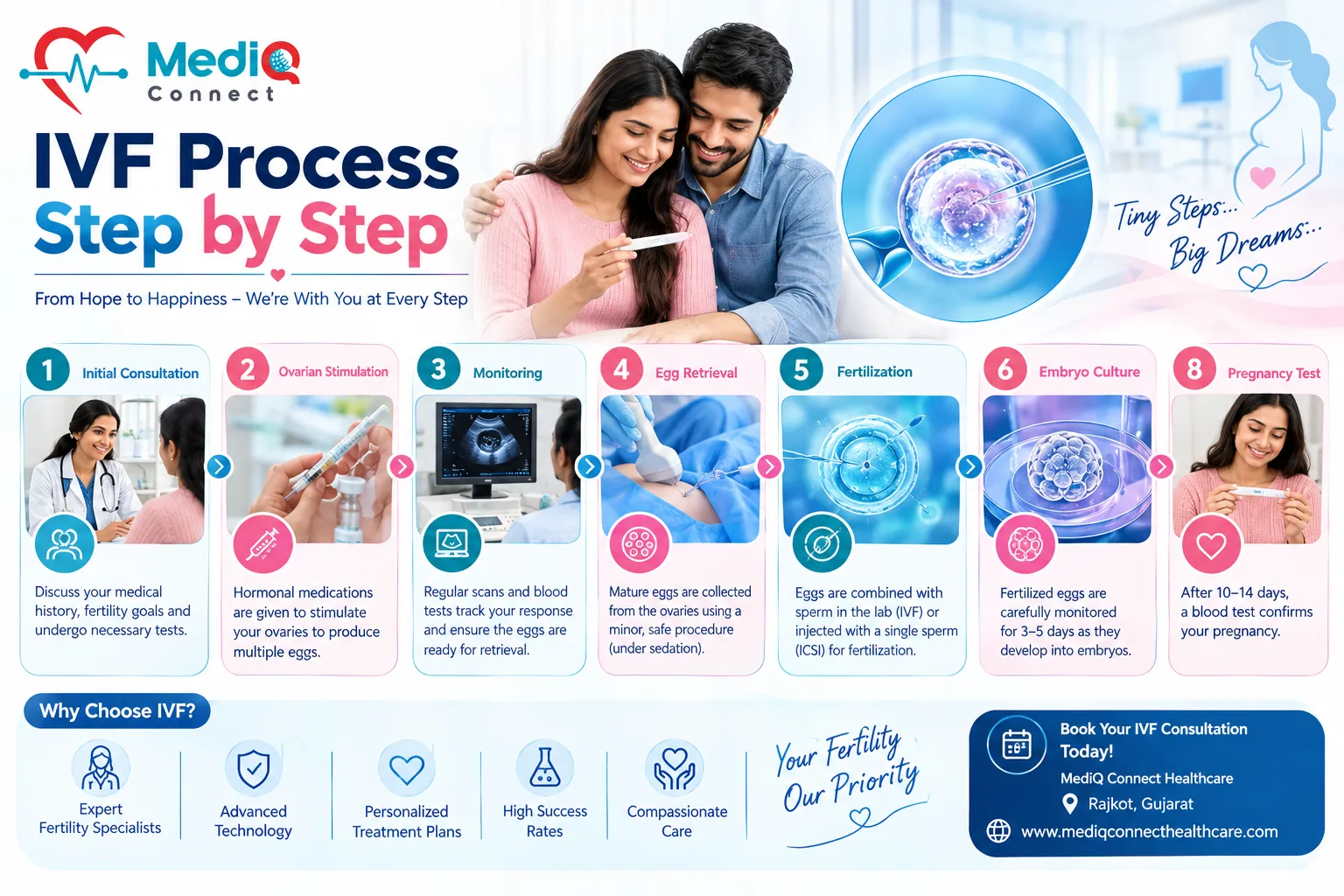



IVF Process Step by Step: What to Expect at Every Stage
The word "IVF" carries a lot of weight before you even start - years of trying, difficult conversations, and a fair amount of uncertainty about what actually happens once you walk through the clinic doors for the first time. The good news: IVF is a highly structured medical process with a predictable sequence of steps, even though the emotional experience of it is anything but predictable.
This guide walks through the complete IVF process step by step, from your very first consultation to the pregnancy test at the end - what happens, roughly how long each stage takes, and what it genuinely feels like, so you can walk in feeling prepared rather than overwhelmed.
What Is IVF and Who Is It For?
In vitro fertilization (IVF) is a fertility treatment where an egg and sperm are combined outside the body, in a laboratory, and the resulting embryo is later transferred into the uterus. It's the most effective and most commonly used assisted reproductive technology available today.
IVF is used for a wide range of situations - blocked or damaged fallopian tubes, ovulation disorders, male-factor infertility, unexplained infertility, age-related fertility decline, genetic conditions requiring embryo screening, and family building for same-sex couples or single parents using donor eggs or sperm.
The Complete IVF Timeline at a Glance
One full IVF cycle, from the start of ovarian stimulation to embryo transfer, typically takes four to six weeks. Add pre-cycle testing and the post-transfer waiting period, and the full journey usually spans six to eight weeks from your first appointment to your pregnancy test result.
|
Stage |
Typical Duration |
What Happens |
|
Consultation & Testing |
1–2 weeks |
Fertility workup, blood tests, ultrasounds, semen analysis |
|
Suppression/Priming |
1–3 weeks (if needed) |
Medications to regulate the cycle before stimulation begins |
|
Ovarian Stimulation |
9–14 days |
Daily hormone injections; monitoring every 2–3 days |
|
Trigger Shot |
1 day |
Final injection to mature the eggs before retrieval |
|
Egg Retrieval |
20–30 minutes |
Minor surgical procedure under sedation |
|
Fertilization |
Day 0–1 |
Eggs combined with sperm via conventional insemination or ICSI |
|
Embryo Culture |
3–6 days |
Embryos monitored and graded in the lab |
|
Embryo Transfer |
A few minutes |
One or more embryos placed into the uterus |
|
Two-Week Wait |
9–14 days |
Waiting period before the pregnancy blood test |
Every clinic personalises the exact protocol, so treat this table as a general map of the IVF process step by step rather than a fixed schedule - your fertility specialist will give you a calendar tailored to your specific hormone levels and treatment plan.
Step 1 - Initial Consultation and Fertility Testing
Your journey begins with a detailed consultation covering medical history, previous pregnancies or fertility treatments, and lifestyle factors. From there, a battery of tests establishes a clear starting point.
- Blood tests for AMH (Anti-Müllerian Hormone) and FSH - measuring ovarian reserve
- Antral Follicle Count (AFC) via ultrasound - counting the follicles available that cycle
- Uterine evaluation - checking the uterine cavity for anything that might affect implantation
- Semen analysis for the male partner, assessing sperm count, motility, and morphology
- Screening for infectious diseases, as required before treatment can begin
This step typically takes one to two weeks, and it's also when your fertility specialist recommends a specific protocol based on your results - this is the foundation the rest of your treatment plan is built on.
Step 2 - Ovarian Suppression and Priming (If Needed)
Depending on your protocol, your doctor may start with a suppression or priming phase, using birth control pills or other medication to regulate your natural hormone cycle before stimulation begins. This helps synchronise follicle growth for a more predictable stimulation phase.
Not every protocol includes this step - some patients move directly into stimulation. When used, it typically lasts one to three weeks and is generally the gentlest phase of the entire process.
Step 3 - Ovarian Stimulation
This is where daily injectable hormone medications (usually FSH, sometimes combined with LH) stimulate your ovaries to develop multiple follicles simultaneously - rather than the single egg released in a natural cycle.
- Typically lasts 9 to 14 days
- Involves daily self-administered injections, usually in the abdomen
- Requires monitoring visits every 2–3 days - blood tests and vaginal ultrasounds to track follicle growth and hormone levels
- Your doctor adjusts medication doses in real time based on how your body responds
This is often the most physically demanding phase - between the injections and frequent clinic visits, it requires real logistical planning, especially if you're working during treatment.
Step 4 - The Trigger Shot
Once follicles reach the right size and hormone levels indicate readiness, you'll receive a single "trigger shot" - typically hCG or a GnRH agonist - that mimics the natural hormone surge needed for final egg maturation.
Timing here is precise: egg retrieval is scheduled exactly 34 to 36 hours after the trigger shot, calculated down to the specific hour, since eggs need to be retrieved just before they would naturally ovulate.
Step 5 - Egg Retrieval
A minor surgical procedure, typically taking 20 to 30 minutes, performed under light sedation so you shouldn't feel pain during the process itself.
- A thin needle, guided by ultrasound, is passed through the vaginal wall into each ovary
- Fluid from each mature follicle is gently suctioned out, containing the egg
- Retrieved fluid is immediately sent to the lab, where embryologists identify and isolate the eggs
- Recovery typically takes about an hour before you can go home, with some cramping expected for a day or two afterward
Most patients describe the procedure itself as far less intimidating than they expected, with recovery feeling similar to a mild menstrual cramp for the following day or two.
Step 6 - Sperm Collection and Fertilization
On the same day as egg retrieval, a sperm sample is collected (fresh or from frozen storage) and prepared in the lab to isolate the healthiest, most viable sperm.
Conventional Insemination
Sperm and eggs are placed together in a lab dish, allowing fertilization to occur naturally over several hours.
ICSI (Intracytoplasmic Sperm Injection)
A single sperm is injected directly into each mature egg - commonly used when sperm quality is a concern, or in cases of previous fertilization difficulty.
Fertilization is typically confirmed the following day, when embryologists check for the presence of two pronuclei - the earliest visible sign that fertilization has occurred successfully.
Step 7 - Embryo Development and Grading
Fertilized eggs, now embryos, are cultured in specialized incubators that replicate the environment of the fallopian tubes and uterus, with embryologists monitoring development daily.
- Day 1: A single-cell zygote showing two pronuclei
- Day 2–3: Cleavage stage - the embryo divides into 4 to 8 cells
- Day 5–6: Blastocyst stage - a more advanced embryo of roughly 100 cells, generally considered to have higher implantation potential
Embryos are graded on their appearance and development pace, helping the team select the strongest candidates for transfer or freezing. Not every fertilized egg makes it to blastocyst stage, which is a completely normal and expected part of the process.
Step 8 - Genetic Testing (PGT), If Chosen
Preimplantation genetic testing (PGT) is optional and involves biopsying a few cells from each blastocyst to screen for chromosomal abnormalities (PGT-A) or specific inherited genetic conditions (PGT-M).
- Often recommended for women over 35, couples with recurrent pregnancy loss, or known genetic conditions in the family
- Results typically take one to three weeks, during which embryos are frozen while awaiting results
- This step adds cost and time but can improve the odds of a successful transfer by helping select embryos with normal chromosome counts
PGT isn't necessary for every IVF cycle - your fertility specialist can help you weigh whether it makes sense for your specific situation and goals.
Step 9 - Embryo Transfer (Fresh vs Frozen)
The transfer itself is a quick, generally painless procedure - a thin catheter carries the selected embryo(s) through the cervix into the uterus, guided by ultrasound so you can often watch the process happen in real time.
Fresh Embryo Transfer
Embryos are transferred within the same cycle as retrieval, typically 3 to 5 days afterward. This is generally more affordable and offers a shorter path to a pregnancy test, though it isn't suitable for every patient's hormonal profile that cycle.
Frozen Embryo Transfer (FET)
Embryos are frozen and transferred in a later cycle, once the uterine lining is optimally prepared. FET has become increasingly common, partly because it allows the body to recover from stimulation medications first and often shows comparable or better outcomes in many cases.
No anaesthesia is needed for the transfer itself, and most patients return to normal activity within a day, though many clinics recommend a brief rest period immediately afterward.
Step 10 - The Two-Week Wait and Pregnancy Test
The period between embryo transfer and the pregnancy blood test - commonly called the "two-week wait" - is, for many patients, the emotionally hardest part of the entire process, even though physically very little is happening.
- Normal daily activities like walking and showering are generally fine
- Strenuous exercise and heavy lifting are usually discouraged for the first few days
- A blood test (measuring hCG levels) is scheduled roughly 9 to 14 days after transfer - far more reliable at this stage than a home urine test
- Some clinics schedule a follow-up test a few days later to confirm hCG levels are rising appropriately
It's normal to feel anxious during this window - many patients describe it as harder than the physical procedures themselves, precisely because there's genuinely nothing left to do but wait.
Common IVF Protocols Explained
You may hear your doctor mention a specific "protocol" - this refers to the exact combination and timing of medications used during your cycle, chosen based on your test results and how your body has responded in the past.
Antagonist Protocol
The most commonly used approach today - stimulation begins early in the cycle, with an antagonist medication added partway through to prevent premature ovulation. Generally shorter and involves fewer injections than older protocols.
Long Agonist Protocol
Involves a longer suppression phase before stimulation begins, historically common and still used in specific cases, particularly for certain diagnoses like endometriosis.
Mini-IVF or Mild Stimulation
Uses lower medication doses to retrieve fewer eggs, often chosen for women with diminished ovarian reserve, those wanting to minimise medication side effects, or those pursuing a gentler, lower-cost approach.
Natural Cycle IVF
Uses no or minimal stimulation medication, relying on the single egg naturally produced each cycle - generally has lower success rates per cycle but avoids most medication side effects entirely.
Your fertility specialist selects the protocol based on your age, ovarian reserve, and previous treatment history if applicable - there's no single "best" protocol universally, only the one best suited to your specific situation.
Lifestyle Preparation Before Starting IVF
What you do in the weeks and months before starting treatment can meaningfully support the process, even though IVF can only work with the eggs and sperm actually available.
- Both partners: avoid smoking and limit alcohol, both linked to reduced egg and sperm quality
- Maintain a balanced diet rich in antioxidants, folate, and healthy fats
- Moderate, regular exercise - avoid both complete inactivity and excessive high-intensity training during stimulation specifically
- Manage stress where possible - while stress doesn't directly cause infertility, chronic stress can affect overall wellbeing throughout a demanding process
- Start prenatal vitamins, particularly folic acid, ideally a few months before beginning treatment
None of these guarantee success on their own, but they give your body the best possible starting point heading into treatment.
Male Partner's Role in the IVF Process
IVF often focuses heavily on the female partner's experience, but the male partner's role - both medical and supportive - genuinely matters throughout the process.
- A semen analysis early in the testing phase assesses sperm count, motility, and morphology
- A fresh or previously frozen sample is provided on the day of egg retrieval
- Lifestyle factors - smoking, alcohol, heat exposure, certain medications - can affect sperm quality in the months leading up to treatment
- Emotional support during stimulation, retrieval, and especially the two-week wait makes a genuine difference to the experience as a whole
For couples facing male-factor infertility specifically, ICSI is commonly recommended to improve fertilization odds regardless of sperm count or motility challenges.
Donor Eggs, Sperm, and Surrogacy Options
Not every IVF journey uses both partners' own eggs and sperm - donor and surrogacy options open the process to a wider range of family-building situations.
- Donor eggs - used when egg quality or quantity is significantly diminished, or for same-sex male couples and single fathers
- Donor sperm - used for male-factor infertility, same-sex female couples, or single mothers by choice
- Gestational surrogacy - used when carrying a pregnancy isn't medically possible or advisable, with the surrogate carrying an embryo genetically unrelated to her
These pathways follow largely the same core process described in this guide, with additional legal and coordination steps specific to using a donor or surrogate - your fertility clinic can walk you through exactly what applies to your situation.
Choosing the Right Fertility Clinic
Not all fertility clinics are equal, and this decision genuinely affects your odds and your experience throughout the process. A few things worth checking before committing to a clinic.
- Clinic-specific success rates by age group and diagnosis, not just national averages
- Laboratory quality and embryologist experience - ask about their embryology team's credentials
- Transparency around total costs, including medication, additional testing, and what happens if a cycle needs adjustment
- Communication style - how easily can you reach your care team with questions between appointments
- Availability of counselling or emotional support services alongside medical treatment
It's completely reasonable to consult with more than one clinic before deciding, especially given the financial and emotional investment involved - most clinics expect and accommodate this.
Common Myths About IVF, Debunked
Myth: IVF always results in multiple babies
Modern practice increasingly favours single embryo transfer specifically to reduce the risk of multiple pregnancy, which carries higher risks for both mother and babies. Multiple births are far less common than they were in IVF's earlier decades.
Myth: IVF babies have more health problems
The overwhelming body of research shows IVF-conceived children have health outcomes comparable to naturally conceived children, with only slightly elevated risks primarily linked to underlying fertility issues rather than the IVF process itself.
Myth: IVF guarantees pregnancy
IVF significantly improves the odds of pregnancy for many fertility challenges, but it isn't a guarantee - success rates, while meaningfully higher than natural conception in many cases, still vary considerably by individual circumstances.
Myth: You can only try IVF once
Many patients undergo multiple cycles, and each attempt often provides information that helps refine the approach for subsequent tries. Persistence, while emotionally difficult, genuinely improves cumulative success rates over several cycles for many patients.
Myth: IVF is only for older women
While age is a significant factor in success rates, IVF is used across a wide age range for many different underlying causes of infertility, not exclusively age-related decline.
Managing the Emotional Journey
The emotional demands of IVF are often underestimated by people who haven't gone through it, and even by patients themselves before starting. A few things that genuinely help.
- Connecting with a support group or community of others going through similar treatment
- Setting boundaries with well-meaning friends and family who may ask intrusive questions
- Considering professional counselling, ideally with someone who specialises in fertility-related emotional support
- Planning small, low-stakes distractions for the two-week wait specifically, since this period is often the hardest to get through
- Giving yourself permission to grieve if a cycle doesn't succeed, rather than immediately pivoting to "what's next"
There's no single right way to emotionally navigate this process - what matters is finding the specific supports that genuinely work for you and your partner, if you have one, rather than following a generic script.
What Happens After a Positive Pregnancy Test
If your pregnancy test comes back positive, the journey shifts from fertility treatment into early pregnancy monitoring, which typically continues under your fertility clinic's care for the first several weeks before transitioning to a regular obstetrician.
- A follow-up blood test a few days later confirms hCG levels are rising as expected
- An early ultrasound, usually around 6–7 weeks, checks for a heartbeat and confirms the pregnancy's location
- Continued progesterone support is often prescribed for several more weeks, depending on your specific protocol
- Your fertility clinic typically manages care through the first trimester before formally transitioning you to an obstetrician for the remainder of the pregnancy
This transition point is worth discussing with your care team in advance, so you know exactly when and how your care shifts from fertility specialist to obstetrician.
IVF Costs - What to Budget For
Costs vary significantly by clinic, protocol, and location, but here's a realistic breakdown for private IVF treatment in India.
- Single IVF cycle (excluding medication): ₹1,50,000–₹2,50,000
- Medication costs: ₹50,000–₹1,50,000, varying widely based on dosage and protocol
- ICSI (if needed): additional ₹20,000–₹40,000
- PGT genetic testing (if chosen): additional ₹80,000–₹1,50,000
- Frozen embryo transfer (separate cycle): ₹40,000–₹80,000
Total costs for a single complete cycle typically range from ₹2,00,000 to ₹4,50,000 depending on the specific protocol and any additional testing chosen - always request a detailed cost breakdown from your clinic before starting, since bundled and itemised pricing structures vary considerably.
IVF Success Rates by Age
Success rates are one of the most searched - and most emotionally loaded - parts of any fertility journey. Age remains the single biggest factor affecting outcomes, primarily due to egg quality.
- Under 35: Approximately 40–50% live birth rate per cycle
- 35–37: Approximately 30–40%
- 38–40: Approximately 20–30%
- Over 40: Approximately 10–15%, though this varies considerably based on individual ovarian reserve
These are general ranges, not guarantees - your specific fertility profile, underlying diagnosis, and clinic's expertise all influence your individual odds. Ask your fertility specialist for their clinic's specific success rates for patients in your age group and diagnosis category, rather than relying on national averages alone.
Physical and Emotional Side Effects to Expect
IVF genuinely asks a lot of the body and mind simultaneously, and being prepared for both makes the entire experience considerably more manageable from start to finish.
Physical
- Bloating and mild discomfort during stimulation, as ovaries enlarge with multiple follicles
- Injection site soreness or bruising
- Cramping and light spotting after egg retrieval
- Rarely, ovarian hyperstimulation syndrome (OHSS) - your clinic monitors closely to catch and manage this early
Emotional
- Anxiety around monitoring appointments and uncertain outcomes
- Mood fluctuations from hormone medications, similar to intensified PMS
- The particular emotional weight of the two-week wait
- Grief if a cycle doesn't succeed - a valid and common response worth processing, not minimising
Many clinics offer counselling support alongside medical treatment - it's worth asking about this upfront rather than only seeking support if things become difficult.
How MediQConnect Helps You Find the Right Fertility Specialist
Choosing the right fertility clinic and specialist is one of the most consequential decisions in this entire journey, and comparing options shouldn't add to the stress of an already demanding process. MediQConnect makes it easier to navigate the IVF process step by step with the right support in place.
- Verified gynecologist and fertility specialist profiles with clear qualifications and experience
- Transparent consultation fees before you book, with no surprises
- Flexible booking for in-clinic visits or video consultations for follow-up discussions
- Genuine patient reviews to help you find a specialist and clinic that's the right fit for you
Whether you're just beginning to explore fertility treatment or looking for a second opinion, you can compare verified profiles and book a consultation in a few minutes.
For a broader framework on choosing a women's health specialist, see our guide to the best gynecologist in Rajkot, which covers credentials and what to check before your first visit.
Once a pregnancy is confirmed, our guide to the pregnancy check-up schedule, month by month walks through what comes next, visit by visit.
Looking further ahead, our guide to the best hospital for normal delivery in Rajkot may also be useful as you plan for delivery.
For quick follow-up questions between appointments, see our guide to video consultation with a doctor in Rajkot.
Frequently Asked Questions
What is the IVF process step by step?
In short: consultation and testing, ovarian stimulation, a trigger shot, egg retrieval, fertilization, embryo development, optional genetic testing, embryo transfer, and finally the two-week wait before a pregnancy test. The detailed breakdown of each stage is covered throughout this guide.
How long does the IVF process take from start to finish?
A single complete cycle, including pre-cycle testing, typically takes six to eight weeks from your first consultation to your pregnancy test result. The core stimulation-to-transfer portion usually spans four to six weeks.
Is IVF painful?
Most patients describe daily injections as uncomfortable rather than painful, and egg retrieval is performed under sedation, so pain during the procedure itself is minimal. Mild cramping is common for a day or two afterward.
What is the success rate of IVF per cycle?
Success rates vary primarily by age - roughly 40–50% for women under 35, declining progressively with age, dropping to around 10–15% for women over 40. Your specific fertility profile significantly affects your individual odds.
What is the difference between fresh and frozen embryo transfer?
Fresh transfer happens within the same cycle as egg retrieval, typically 3–5 days later. Frozen transfer happens in a later cycle after the embryos have been frozen, often allowing better uterine lining preparation and, in many cases, comparable or improved outcomes.
How many eggs are typically retrieved in one IVF cycle?
This varies considerably by age and ovarian reserve, but a typical retrieval yields anywhere from 8 to 15 eggs, though not all will be mature, fertilize successfully, or develop into transferable embryos.
Can I work during IVF treatment?
Many patients continue working through most of the process, though the stimulation phase requires frequent monitoring appointments, and a short recovery period is generally needed after egg retrieval. Planning your schedule around clinic visits in advance helps considerably.
What happens if the first IVF cycle doesn't work?
Your fertility specialist will review the cycle in detail - hormone response, embryo quality, and any other findings - to adjust the protocol for a subsequent attempt if you choose to continue. Many successful pregnancies happen on a second or third cycle rather than the first.
Frozen Embryo Storage and Future Family Planning
Any good-quality embryos not used in your initial transfer can typically be frozen and stored for future use - whether that's a subsequent attempt after an unsuccessful cycle, or planning for a second child down the line.
- Storage duration and renewal terms vary by clinic and country - confirm this upfront, including any annual storage fees
- Frozen embryos can remain viable for many years when stored properly, giving genuine flexibility for future family planning
- If you decide not to use remaining embryos, clinics typically offer options including continued storage, donation to another family, donation to research, or discarding - a decision worth discussing with your partner in advance
Having frozen embryos in storage also means a future pregnancy attempt, if needed, wouldn't require repeating the stimulation and retrieval stages - only the transfer portion of the process.
A Quick Reference: Questions Worth Asking Your Clinic
Walking into your first consultation with a short list of questions helps you get the most out of a visit that can otherwise feel rushed or overwhelming.
- What is your clinic's live birth rate for someone in my specific age group and diagnosis?
- Which protocol do you recommend for me, and why this one specifically?
- What is the full expected cost, including medication, and what could increase it?
- What happens if my first cycle doesn't result in a pregnancy?
- Do you offer counselling or emotional support services alongside treatment?
Bringing a written list - and taking notes during the answer - helps you retain the details later, especially since a lot of new information is covered in that very first appointment.
Final Thoughts Before You Begin
Starting the IVF process step by step is a significant decision, both financially and emotionally, and it's completely normal to feel a mix of hope and apprehension heading in. Most patients say that once treatment actually begins, having a clear structure to follow makes the experience feel considerably more manageable than the anticipation beforehand.
Ask questions freely at every stage - a good fertility team expects and welcomes this, and understanding what's happening and why tends to ease anxiety considerably more than simply following instructions without context.
Conclusion: A Process You Can Actually Prepare For
Understanding the IVF process step by step won't make every emotional moment of this journey easier, but it does replace a lot of uncertainty with a clear roadmap - and that alone makes a genuine difference for most patients navigating this experience for the first time. Each stage has a purpose, a typical timeline, and a care team guiding you through it.
When you're ready to take the next step, MediQConnect makes it simple to find a verified fertility specialist, compare transparent consultation fees, and book an appointment that fits your schedule and pace.
Ready to talk to a specialist? view doctors across specialities on MediQConnect and book your first consultation today.
Have Questions About This Article?
Reach out with your inquiry and our team will get in touch with you shortly.