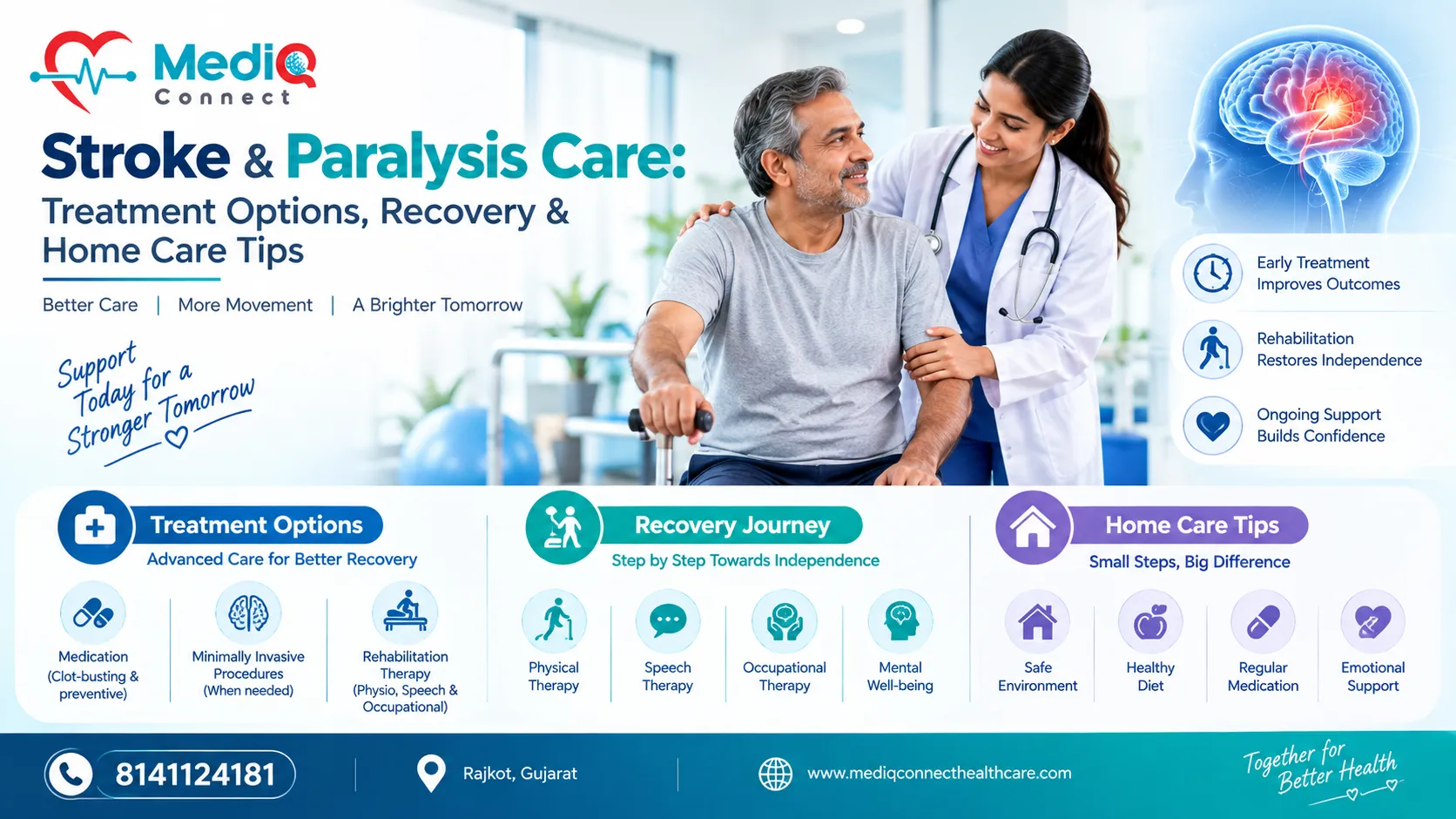



Stroke & Paralysis Care: Treatment Options, Recovery & Home Care Tips
Few medical events unfold as fast, or matter as much, minute by minute, as a stroke. Brain tissue is lost at a rate of roughly 1.9 million neurons per minute during an untreated stroke - which is exactly why recognising the signs immediately and acting without hesitation genuinely changes outcomes, sometimes dramatically, and sometimes meaning the difference between a full recovery and permanent, life-altering disability.
This guide covers everything essential about stroke & paralysis care - how to recognise a stroke instantly, what happens during emergency treatment, how paralysis recovery actually unfolds, and practical home care guidance for the weeks, months, and sometimes years that follow.
Common Myths About Stroke and Paralysis, Debunked
Myth: Strokes only happen to elderly people
While risk increases with age, strokes can and do happen to younger adults, sometimes even children, particularly with underlying conditions like clotting disorders or congenital heart defects. Age is a risk factor, not a requirement.
Myth: If symptoms go away, it's safe to skip the hospital visit
Symptoms resolving quickly can indicate a TIA (transient ischaemic attack), which is a serious warning sign of high near-term stroke risk, not a reason for relief. This still requires urgent medical evaluation.
Myth: Nothing can be done once paralysis has occurred
Rehabilitation can produce significant functional improvement even for substantial paralysis, particularly when started early and pursued consistently. The brain's capacity to adapt and rewire is genuinely remarkable, especially in the first year.
Myth: Stroke recovery is complete within a few weeks
Meaningful recovery often continues for six months to a year or longer, with the most significant gains typically in the first three months. Expecting a quick, complete recovery can lead to unnecessary discouragement.
Myth: A healthy-looking person can't be at risk of stroke
Stroke risk factors like high blood pressure and irregular heart rhythms often have no visible symptoms until a stroke actually occurs, which is why regular health check-ups matter regardless of how someone looks or feels.
Stroke Risk Factors Worth Knowing
Understanding risk factors helps with both prevention and recognising who might be at elevated risk within a family.
- High blood pressure - the single largest modifiable risk factor for stroke
- Atrial fibrillation and other irregular heart rhythms, which increase clot formation risk
- Diabetes, which affects blood vessel health throughout the body, including in the brain
- High cholesterol, contributing to the artery blockages that cause ischaemic stroke
- Smoking, which significantly damages blood vessels and increases clotting risk
- Family history of stroke, particularly at a younger age
- Obesity and sedentary lifestyle, which compound several of the above risk factors
Many of these factors are genuinely modifiable through medical management and lifestyle changes - which is exactly why regular check-ups and proactive management matter, even before any symptoms appear.
Diagnostic Tests Used in Stroke Care
A few key tests guide diagnosis and treatment decisions, and understanding what each one does helps make sense of the urgency around them.
- CT scan - typically the first imaging test, quickly distinguishing between ischaemic and haemorrhagic stroke
- MRI - provides more detailed imaging, sometimes used for further assessment once initial treatment decisions are made
- CT or MR angiography - visualises blood vessels directly, helping identify the exact location of a blockage
- Carotid ultrasound - checks for narrowing in the neck arteries that supply blood to the brain
- Echocardiogram - checks the heart for clot sources, particularly relevant for certain stroke types
These tests are typically performed in rapid succession during the emergency evaluation, since the results directly determine which time-sensitive treatments remain viable.
Recognising a Stroke - The FAST Warning Signs
The FAST acronym exists because it's fast to remember in a genuine emergency, when panic makes complex information hard to process.
- Face - ask the person to smile; watch for drooping on one side of the face
- Arms - ask them to raise both arms; watch for one arm drifting downward or an inability to raise it
- Speech - ask them to repeat a simple sentence; listen for slurred or strange speech
- Time - if you notice any of these signs, call emergency services immediately; note the time symptoms started, since this directly affects treatment options
- Additional signs can include sudden severe headache, sudden vision loss or double vision, sudden dizziness or loss of balance, and sudden confusion
Never wait to see if symptoms improve on their own, and never drive the person yourself if an ambulance is available - emergency medical teams can begin assessment and treatment before even reaching the hospital, and every single minute saved during transport genuinely matters for the final outcome.
A Realistic Recovery Scenario: Moderate Ischaemic Stroke
To make this less abstract, here's how a typical moderate stroke recovery might unfold for a patient who received prompt treatment.
- Day 1–3: Hospital stabilisation, initial assessment of deficits (right-arm weakness, mild speech difficulty)
- Day 4–10: Inpatient rehabilitation begins - daily physiotherapy and speech therapy sessions
- Week 2–6: Discharge home with continued outpatient therapy 3–4 times weekly, plus daily home exercises
- Month 2–3: Noticeable improvement in arm strength and speech clarity; therapy frequency gradually reduces
- Month 6 onward: Continued gradual improvement, transition to a home maintenance exercise programme with periodic check-ins
This is one illustrative pattern among many possible trajectories - actual timelines depend heavily on stroke severity, treatment speed, and individual factors, but it illustrates how recovery typically unfolds in stages rather than all at once.
Assistive Devices and Equipment for Paralysis Recovery
A range of equipment can support both safety and functional independence during recovery, often recommended by the occupational or physical therapy team.
- Mobility aids - canes, walkers, or wheelchairs, chosen based on the specific balance and strength deficits present
- Ankle-foot orthoses (AFOs) - braces supporting foot positioning for patients with foot drop, a common effect of certain strokes
- Adaptive utensils and dressing aids - supporting independence in daily activities despite reduced hand function
- Grab bars and shower chairs - supporting safe bathing, one of the higher-risk daily activities for fall-prone patients
- Communication aids or apps, for patients with significant speech difficulty, supporting continued interaction and expression
A rehabilitation team can assess which specific equipment genuinely fits your situation - introducing devices too early or unnecessarily can sometimes discourage independent effort, so this should be a guided decision, not a default purchase.
Nutrition Considerations During Stroke Recovery
Diet plays a meaningful role both in recovery itself and in reducing future stroke risk, making nutritional guidance a genuine part of comprehensive stroke care.
- A heart-healthy diet - lower sodium, limited saturated fat, rich in fruits and vegetables - supports both recovery and long-term risk reduction
- Texture-modified diets may be needed temporarily or long-term for patients with swallowing difficulties, guided by a speech therapist's assessment
- Adequate protein intake supports tissue repair and helps maintain muscle mass during a period of reduced activity
- Hydration matters significantly, particularly for patients who may have reduced thirst awareness following certain types of stroke
- A dietitian's involvement is often genuinely valuable for stroke patients, particularly those with swallowing difficulties or additional conditions like diabetes
Never assume a stroke survivor can safely resume a normal diet without a proper swallowing assessment first - aspiration risk is a serious, sometimes overlooked concern in early recovery.
What Happens in the Hospital - Immediate Treatment Options
Hospital treatment depends heavily on the stroke type and how quickly the patient arrives after symptoms began.
- Immediate CT or MRI imaging to determine whether the stroke is ischaemic (clot-caused) or haemorrhagic (bleeding-caused) - this distinction determines everything about treatment
- Thrombolysis (clot-busting medication) can be given for ischaemic stroke, typically within 4.5 hours of symptom onset, to dissolve the clot and restore blood flow
- Mechanical thrombectomy (physically removing the clot via catheter) may be an option for select patients up to 24 hours after onset, depending on specific imaging findings
- Haemorrhagic strokes require different management, sometimes including surgery to relieve pressure or repair the bleeding source, and thrombolysis is not used for this type
- Close monitoring in a stroke unit or ICU during the acute phase, watching for swelling, recurrent bleeding, or other early complications
This is precisely why the time noted when symptoms first appeared matters so much - it directly determines which treatments remain available, which is the core reason acting immediately, rather than waiting to see if things improve, is genuinely so critical to the eventual outcome.
Types of Stroke and How They Affect Treatment
Ischaemic Stroke
Caused by a blood clot blocking blood flow to part of the brain, accounting for the large majority of strokes. Treatable with clot-dissolving medication or mechanical clot removal within specific time windows.
Haemorrhagic Stroke
Caused by bleeding into or around the brain, often from a ruptured blood vessel. Requires different, sometimes surgical, management, and clot-busting medication is never used since it would worsen bleeding.
Transient Ischaemic Attack (TIA)
Sometimes called a "mini-stroke," symptoms resolve within minutes to hours, but a TIA is a serious warning sign of high near-term risk for a full stroke and requires the same urgent medical attention.
Because ischaemic and haemorrhagic strokes require completely different - and in some ways opposite - treatments, emergency imaging to distinguish between them is always the first essential step before any treatment decision.
The Role of Telemedicine in Stroke Follow-Up Care
Once past the acute hospital phase, telemedicine has become an increasingly valuable tool for ongoing stroke and paralysis care management, particularly for routine follow-ups.
- Video consultations allow neurologists to check on medication effectiveness and any new symptoms without requiring a full in-person visit every time
- Remote monitoring of blood pressure and other risk factors can be shared digitally with the treating physician between visits
- Tele-rehabilitation programmes, where a therapist guides exercises remotely via video, have shown promising results for patients with transportation or mobility barriers to in-person therapy
- Family members in different cities can join video consultations to stay informed and involved in care decisions
Telemedicine works best as a complement to in-person care, not a full replacement - physical assessments during hands-on therapy sessions remain essential, particularly in the earlier, more intensive recovery phases.
Coordinating Multiple Specialists in Stroke Care
Comprehensive stroke and paralysis care typically involves several specialists working together, and good coordination between them significantly affects outcomes.
- A neurologist typically leads overall medical management and monitors for recurrence risk
- A physiatrist (rehabilitation physician) often oversees the overall rehabilitation plan, coordinating between different therapy disciplines
- Physiotherapists, occupational therapists, and speech therapists each address specific functional deficits
- A cardiologist may be involved if the stroke was related to a heart condition like atrial fibrillation
- A psychologist or psychiatrist may support emotional and cognitive recovery, particularly for post-stroke depression
Having one clear point of coordination - often the neurologist or physiatrist - helps ensure these different specialists are working from the same overall picture rather than in isolation.
Understanding Paralysis After Stroke
Paralysis after stroke happens because the affected brain region controls movement on the opposite side of the body - a stroke on the brain's left side typically causes right-side weakness or paralysis, and vice versa.
- Hemiplegia - complete paralysis of one side of the body
- Hemiparesis - partial weakness on one side, less severe than full paralysis
- Facial paralysis or drooping, affecting expression and sometimes speech clarity
- Difficulty swallowing (dysphagia), which affects a significant proportion of stroke survivors and carries its own specific care needs
- Speech and language difficulties (aphasia), which can affect understanding, speaking, or both, independent of paralysis
The specific pattern and severity of paralysis depends on which brain area was affected and how much tissue was damaged before treatment began - which is, once again, directly tied to how quickly treatment started after the very first symptoms appeared.
The Golden Window - Why Early Rehabilitation Matters
Recovery potential is highest in the first 90 days after a stroke, often called the "golden period" - the brain's natural neuroplasticity (its ability to rewire and adapt) is at its peak during this window.
- Rehabilitation often begins within 24–48 hours of a stable stroke, even while still hospitalised, since early mobilisation improves outcomes
- The most significant functional gains typically occur within the first three months, though meaningful improvement can continue for a year or more
- Consistency during this window - daily, deliberate practice, not just occasional effort - meaningfully affects how much overall function is ultimately regained by the end of the recovery process
- Even after the golden period, recovery doesn't stop entirely; progress simply tends to become more gradual
This is exactly why immediate, structured stroke & paralysis care in the weeks following a stroke matters so much - delaying rehabilitation, even by a few short weeks, can mean permanently missing some of the recovery potential available during this critical, time-limited window.
A Quick Reference Checklist
Keep this condensed checklist handy, both for stroke emergencies and ongoing recovery management.
- ✔ Know the FAST signs and act immediately if any appear - never wait to see if they resolve
- ✔ Note the exact time symptoms began, since this affects treatment options
- ✔ Begin rehabilitation as early as safely possible, ideally within the golden 90-day window
- ✔ Follow the specific home exercise plan from your rehabilitation team, not generic exercises online
- ✔ Watch for and prevent common complications - pressure sores, blood clots, aspiration
- ✔ Address emotional and cognitive changes directly with the medical team, not silently
- ✔ Maintain consistent follow-up for stroke prevention - blood pressure, medication, lifestyle factors
This checklist condenses the most action-relevant points from this guide into something easy to reference during what can be an overwhelming time for families.
Final Thoughts for Families Navigating This Journey
A stroke diagnosis changes life abruptly, for both the survivor and the family supporting them through it. Understanding what genuinely effective stroke & paralysis care looks like - from the first emergency minutes through months of dedicated rehabilitation - replaces a lot of fear and uncertainty with a clear, actionable path forward.
Recovery is rarely linear, and setbacks alongside genuine progress are a normal part of the process. Most families find that leaning on the full care team - neurologists, therapists, and each other - makes an enormous difference in navigating what is genuinely one of the harder medical journeys a family can face together.
Stages of Stroke Recovery
Recovery unfolds in phases, each with different priorities and realistic expectations.
- Acute phase (days 1–7): Medical stabilisation, initial assessment of deficits, and early mobilisation as soon as safely possible
- Early rehabilitation (weeks 1–12): Intensive therapy - physical, occupational, and speech - targeting the specific deficits identified
- Ongoing rehabilitation (months 3–12): Continued therapy with a shift toward functional independence and community reintegration
- Long-term recovery (beyond 1 year): Slower, ongoing improvement is still possible, alongside adaptation and compensation strategies for any permanent deficits
Every stroke survivor's timeline looks somewhat different based on stroke severity, overall health, age, and how consistently rehabilitation is pursued day after day - these phases are a general guide meant to set realistic expectations, not a fixed schedule guaranteed for everyone.
Insurance and Financial Planning for Stroke Care
Given how significant stroke treatment and rehabilitation costs can become, understanding what's typically covered helps families plan realistically.
- Emergency hospitalisation and acute treatment are generally covered under standard health insurance policies, subject to policy limits
- Inpatient rehabilitation is often covered, though coverage for extended outpatient therapy varies considerably by policy
- Long-term home care and equipment needs may require out-of-pocket planning, since coverage for these is less consistent
- Critical illness insurance riders, if held, sometimes provide a lump-sum payment specifically for stroke diagnosis, which can help offset costs not covered by standard health insurance
Reviewing your specific policy details early in the treatment process, rather than assuming full coverage, helps avoid difficult financial surprises during an already stressful time.
Stroke Rehabilitation Therapies Explained
A comprehensive rehabilitation programme typically involves several specialists working together toward the patient's specific recovery goals.
Physiotherapy
Focuses on rebuilding strength, balance, and mobility - relearning to sit, stand, walk, and move safely, often starting with basic movements and building toward more complex ones.
Occupational Therapy
Focuses on relearning daily living activities - dressing, eating, bathing, cooking - and adapting techniques or using assistive tools where full recovery of a skill isn't possible.
Speech and Language Therapy
Addresses speech difficulties, language comprehension issues, and swallowing problems, which are common and significant after stroke, particularly when the stroke affects specific brain regions controlling these functions.
Cognitive Rehabilitation
Addresses memory, attention, and problem-solving difficulties that can follow a stroke, sometimes less visible than physical deficits but equally important for independent living.
Most stroke rehabilitation programmes combine several of these therapies simultaneously, tailored specifically to the deficits each individual patient experiences, rather than applying a single generic protocol regardless of the person's particular needs and recovery goals.
Returning to Work and Driving After Stroke
For stroke survivors of working age, returning to work and driving are significant recovery milestones that need careful, individualised assessment rather than a fixed timeline.
- A formal driving assessment is often recommended before resuming driving, particularly if there's been any visual, cognitive, or physical impairment
- Return to work may need to be phased, with reduced hours or modified duties initially, depending on the specific job demands and remaining deficits
- Cognitive changes, even subtle ones, can affect work performance in ways that aren't always obvious immediately - a neuropsychological assessment can help clarify readiness
- Occupational therapists can provide workplace-specific recommendations and, in some cases, liaise directly with employers about reasonable accommodations
Rushing back to work or driving before genuinely ready carries real safety risks, both for the survivor and others - this is an area where patience, guided by professional assessment, matters considerably.
Home Exercises for Stroke and Paralysis Recovery
Therapy doesn't stop when a formal session ends - consistent practice at home significantly affects overall recovery speed and extent.
- Range-of-motion exercises for affected limbs, done gently and regularly to prevent stiffness and maintain joint flexibility
- Weight-bearing and balance exercises, progressing gradually as strength and stability improve
- Fine motor tasks - picking up small objects, buttoning clothing - to rebuild hand function
- Speech practice exercises, if recommended by a speech therapist, done consistently between formal sessions
- Mirror therapy and other neuroplasticity-based techniques, sometimes recommended by physiotherapists for specific deficits
Always follow your specific rehabilitation team's exercise plan rather than generic exercises found online - the right exercises depend entirely on your particular deficits and current ability level, and incorrect or poorly timed exercises can occasionally do more harm than good.
Practical Home Care Tips for Stroke Survivors
Beyond formal therapy, daily home environment and routines significantly affect both safety and recovery quality.
- Modify the home for safety - grab bars, non-slip mats, clear pathways, and furniture arranged to support safe movement
- Encourage the affected side to be used as much as safely possible, rather than compensating entirely with the unaffected side, which supports neuroplasticity
- Maintain a consistent daily routine, since structure and predictability generally support recovery, especially with any cognitive changes
- Support proper nutrition and hydration, adjusting food texture if swallowing difficulties are present
- Celebrate small, incremental progress - recovery often happens in small steps that are easy to overlook day to day
Family involvement in these daily practices, guided closely by the professional rehabilitation team, genuinely amplifies the effectiveness of formal therapy sessions far beyond what the sessions alone could accomplish on their own.
Preventing Complications During Recovery
Reduced mobility after stroke increases risk for several specific complications worth actively monitoring and preventing.
- Pressure sores (bedsores) - regular repositioning and skin checks for patients with limited mobility
- Blood clots (DVT) - movement as approved, compression stockings if prescribed, and awareness of leg swelling or pain
- Aspiration pneumonia - careful attention to swallowing safety, particularly important for patients with dysphagia
- Muscle contractures - regular range-of-motion exercises to prevent joints from stiffening in a fixed position
- Falls - home safety modifications and appropriate supervision during the recovery period
Most of these complications are genuinely preventable with consistent, informed care and attentive daily monitoring - this is exactly why structured, professional guidance during recovery matters just as much as the rehabilitation exercises themselves.
Emotional and Cognitive Changes After Stroke
Stroke affects the brain directly, which means emotional and cognitive changes are common and biologically rooted, not simply a reaction to the difficult circumstances.
- Post-stroke depression affects a significant proportion of survivors and is a genuine medical condition worth treating directly, not just "understandable sadness"
- Emotional lability - sudden, sometimes disproportionate crying or laughing - can result directly from the stroke itself
- Memory and concentration difficulties are common, even without an obvious physical deficit
- Frustration and grief over lost abilities are completely normal responses worth acknowledging rather than dismissing
Mention any of these changes to the treating medical team without hesitation - many are genuinely treatable, and addressing them directly meaningfully improves both quality of life and overall rehabilitation engagement going forward.
Supporting a Family Member Through Stroke Recovery
Family involvement significantly affects stroke recovery outcomes, but it also places real demands on caregivers worth acknowledging directly.
- Learn the specific exercises and care techniques from the rehabilitation team, rather than guessing at what might help
- Encourage independence in tasks the survivor can safely do themselves, resisting the urge to do everything for them
- Watch for caregiver burnout, which is genuinely common given the intensity of stroke caregiving, especially in the early months
- Connect with stroke support groups, which can offer both practical guidance and emotional support from others in similar situations
- Celebrate progress together, however incremental, since morale genuinely affects the survivor's ongoing motivation and engagement
Caring for your own wellbeing as a caregiver isn't a distraction from supporting your family member's recovery - it's genuinely what makes sustained, high-quality support possible over the many months this entire process typically takes to unfold.
Preventing a Second Stroke
Stroke survivors face a meaningfully higher risk of a second stroke, making prevention a genuinely important part of long-term care, not just an afterthought.
- Manage blood pressure closely, since hypertension is the single largest modifiable stroke risk factor
- Take prescribed medications consistently, including blood thinners or antiplatelet medication if prescribed
- Manage diabetes and cholesterol levels, both of which independently affect stroke risk
- Quit smoking and limit alcohol, both of which significantly increase stroke risk
- Maintain regular follow-up with a neurologist or cardiologist to monitor ongoing risk factors
This preventive care isn't separate from recovery - it's an essential, ongoing part of the same overall care plan, deserving the same consistency and daily attention as the rehabilitation exercises covered earlier in this guide.
How MediQConnect Supports Stroke and Paralysis Care
Coordinating neurologists, physiotherapists, and ongoing follow-up during stroke recovery is genuinely complex. MediQConnect helps bring key pieces of this together for families managing stroke & paralysis care.
- Verified neurologists and specialists available for consultations and ongoing follow-up
- Video consultation options for quick medical guidance between in-person visits
- A directory of verified physiotherapists and rehabilitation specialists
- Transparent consultation fees, so there are no surprises when arranging ongoing care
Whether you need a neurology follow-up or want to arrange rehabilitation support, MediQConnect helps you find and book verified medical care quickly, without the added hassle of coordinating everything manually on your own.
For patients needing intensive nursing support during acute recovery, see our guide to 24×7 Nursing Care at Home: Benefits, Services & What to Expect.
For broader home-care staffing and attendant support during recovery, see our complete guide to Patient Care at Home: A Complete Guide for Families in India.
For elderly stroke survivors needing ongoing daily support, our guide to Elderly Care at Home: Benefits, Services, Costs & How to Choose covers the full range of care options.
You can also browse verified doctors near me in Rajkot across all specialities, including neurology, on MediQConnect.
Frequently Asked Questions
What are the FAST warning signs of a stroke?
Face drooping on one side, Arm weakness or drift when raised, Speech difficulty or slurring, and Time to call emergency services immediately, noting when symptoms started, since this affects treatment options.
How long does stroke recovery take?
The most significant recovery typically happens in the first three to six months, especially the first 90 days, though meaningful improvement can continue for a year or more with consistent rehabilitation.
Can paralysis after stroke be fully reversed?
It depends on stroke severity and how quickly treatment began. Many patients regain significant function through rehabilitation, though some experience permanent deficits. Early, intensive therapy meaningfully improves the odds of fuller recovery.
What is the golden period after a stroke?
Generally the first 90 days, when the brain's neuroplasticity is highest and rehabilitation tends to produce the most significant functional gains. Starting therapy as early as safely possible during this window matters considerably.
What causes paralysis on one side of the body after stroke?
Each side of the brain controls movement on the opposite side of the body, so damage to one side of the brain typically causes weakness or paralysis on the opposite side of the body.
Is depression common after a stroke?
Yes, post-stroke depression affects a significant proportion of survivors and has both biological and situational causes. It's a genuine, treatable medical condition worth discussing directly with the treating medical team.
Can a stroke happen again after recovery?
Yes, stroke survivors face meaningfully higher risk of a second stroke, which is why managing blood pressure, medication adherence, and other risk factors remains an essential, ongoing part of long-term care.
How much does stroke rehabilitation cost in India?
Costs vary widely by intensity and setting - outpatient physiotherapy sessions typically range from ₹500 to ₹1,500 per session, while comprehensive inpatient rehabilitation programmes can range from ₹1,500 to ₹5,000 per day depending on the facility and services included.
Conclusion: Every Stage of Recovery Matters
Understanding stroke & paralysis care - from recognising the earliest warning signs to sustaining rehabilitation months later - genuinely changes outcomes. The single most important message is this: never wait on stroke symptoms, and never underestimate how much consistent, early rehabilitation can achieve.
When ongoing neurology follow-up or rehabilitation coordination is part of the picture, MediQConnect makes it genuinely simple to find verified specialists throughout the entire recovery journey, from the first weeks onward.
Need to arrange follow-up care or rehabilitation support? view doctors across specialities on MediQConnect and book a consultation today.